




Colorado Safety Videos Focus on Mountain Driving
The Mountain Rules safety awareness program in Colorado offers videos to educate truck drivers on handling winter weather, runaway trucks, and navigating construction zones.

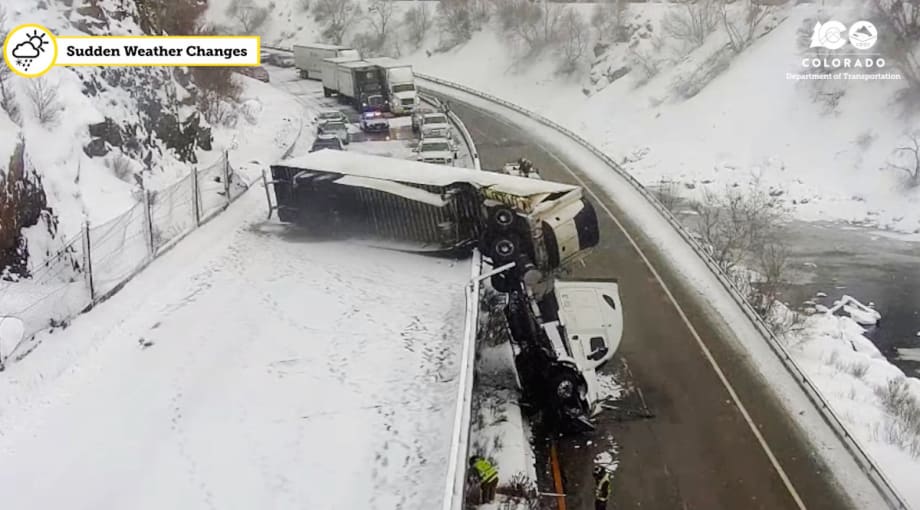
Colorado's safety and education program, The Mountain Rules, is using videos to help drivers better prepare for mountain driving, including winter weather.
Photo: CDOT screenshot
Through The Mountain Rules campaign, the Colorado Department of Transportation is trying to increase awareness of the challenges truck drivers face on the state's mountainous highways.
The safety-related videos on mountain driving in Colorado focus on topics such as:
Safe winter driving
Hot brakes, runaway truck ramps, and summer driving
Construction zone safety
The Mountain Rules awareness and safety education program, launched in 2019, is a joint effort of the Colorado DOT, the Colorado State Patrol, and the Colorado Motor Carriers Association. The short videos are narrated by Nate McCarty, a Colorado native and veteran truck driver.
There is also a video that discusses challenges specific to the state’s Interstate-70 corridor.
“We know that our state’s terrain and unpredictable weather conditions create immense challenges for semi truck drivers,” said Shoshana Lew, CDOT executive director. “We’ve created this series as a way to equip truck drivers with the necessary knowledge and awareness to safely and confidently navigate our highways, especially in the high country.”
While local truckers may be familiar with Colorado’s highways, the concern is that those from out of state often are new to winter driving conditions along steep mountain corridors, understanding chain and traction laws, managing hot brakes, and adhering to Colorado's Move Over law.
Col. Matthew Packard, chief of the Colorado State Patrol, pointed out that the I-70 corridor includes sharp curves, 7-8% grades, and congested peak travel times, accompanied by quickly changing weather conditions.
“The steep downgrades, winding roadways, and fast-changing weather conditions make for a challenging drive, for even the most experienced truck driver,” said Greg Fulton, CMCA president.
“We believe this tool and other strategies by our state and local partners will make mountainous corridors like I-70 safer and reduce delays and closures.”
Truck Safety & Winter Driving
The video related to winter driving in the Colorado mountains covers several topics, which include:
Sudden weather changes – what to be prepared for.
Winter-driving driver etiquette.
Chain law requirements, including when, how and where to use chains.
How truck drivers can best prepare for Colorado winter travel.
“Weather in Colorado can change within minutes," McCarty explains in a video.
“You can experience challenges such as avalanches, weather-related detours, blizzard conditions, rain, snow, sleet, ice, high winds, and blinding sun glare. Even traveling from one side of the Eisenhower-Johnson Tunnel to the other, a distance of less than 2 miles.”
The state patrol chief, in the winter-weather video, shares the top things state troopers see in serious injury and fatal crashes where a commercial motor vehicle operator is at fault. Those include:
Lane violations in which a truck does not maintain proper lane position or drives over the outside or interior lines.
Unsafe passing.
Distracted driving.
Speeding.
Packard also stresses the importance of obeying the Move Over Law, noting that it also requires moving over a lane when passing truckers on the side of the road, such as when trucks are pulled to the side to install chains.
Truck drivers must carry chains or alternative traction devices under the state’s "must carry" chain laws, which are active from Sept. 1 to May 31 for commercial vehicles on certain corridors.
When the requirement to use chains is activated, truckers can be alerted in a manner of ways, including CDOT notifications, signs, and notices on the CDOT website.
“Notifications will be specific by mile post and exit numbers when chains are required. If the law is active, stop at the first available chain-up station to put your chains on,” McCarty explains in the video.
Hot Brakes & Runaway Truck Ramps
The video on hot brakes and runaway truck ramps covers:
Drivers not overheating their brakes and maintaining control.
Pre-trip inspection procedures.
Brake cooling stations and their locations.
How to prevent hot brakes and using the right gear go down the mountain.
How to safely use runaway truck ramps if necessary and their locations.
The state provides an interactive map at maps.cotrip/org that shows the location of each runaway truck ramp and other useful information.
According to CDOT, the Lower Straight Creek runaway truck ramp along westbound Interstate 70 at Milepost 211.83 is the most heavily used runaway truck ramp, not only in Colorado, but also in the U.S. Also, the agency reports that major truck crashes are common on Colorado Highway 160 at the switchback curve near the Wolf Creek scenic overlook.
Common sections of highway where drivers experience hot brakes along I-70 are westbound just east of Silverthorne near exit 205 and eastbound near Georgetown at exit 228. Although the runaway truck ramps can be used whenever needed, CDOT reports they are more commonly used in the summer months.
In 2021, a truck driver was sentenced to 110 years in prison in connection to his April 2019 actions resulting in an Interstate 70 collision that killed four people. The Colorado governor later reduced the sentence to 10 years. The crash occurred on a part of the interstate where commercial vehicles are limited to 45 mph because of the steep descent. Aguilera-Mederos has said his brakes failed. There was criticism that he did not take the opportunity to use a runaway truck ramp.
Construction Zone Safety
The video covering how truck drivers should adjust to driving through construction zones includes:
How to be prepared for upcoming work zones, and travel them safely.
Speeding through construction zones is double the fine along with a ticket.
Overview of Colorado’s Move Over Law, which includes moving over for fellow truck drivers.
“There will always be construction and progress on many of Colorado's roadways. While the infrastructure improvements make for a smoother, safer ride for truck drivers, and all motorists, it's important to be aware of upcoming construction zones and make sure to travel them safely,” McCarty explains.
“If you're driving and notice an increase in orange signage on the roadway, like orange construction cones, barriers, roadwork ahead signs, and changing travel lane widths, you're approaching an active construction zone. You may also notice some speed limit reduction signs."
Note to our readers: This story was originally published in 2023 and updated in October 2025
More Safety & Compliance

FMCSA Pauses Biennial-Update Enforcement Amid Motus Transition
Carriers whose updates were due on or after June 1 have more time, while FMCSA works to stabilize its new registration system and warns of phishing sites impersonating its new carrier registration system, Motus.
Read More →
ZF Expands Commercial Vehicle Push in North America
ZF is expanding its North American commercial-vehicle presence with new transmission applications, electrification, trailer technology and autonomous-driving systems.
Read More →
Truck Drivers Need More Than Another Alert
Fleets have more visibility into truck health, safety events, and driver activity than ever. The next challenge is turning all that information into useful guidance for the person who has to decide what to do next.
Read More →
Tesla Wants a Self-Driving Semi. Are Cameras Enough?
Could Tesla’s camera-only autonomous driving technology work on an 80,000-pound Semi? In this commentary, HDT's Deborah Lockridge takes a look at Tesla, Cybercab, and how autonomous trucks see the road.
Read More →
What DOT’s Automated Vehicle Strategy Means for Trucking
The U.S. Department of Transportation issued a new automated-vehicle strategy that outlines plans for driverless-truck regulations, cross-state freight corridors, and federal safety standards.
Read More →
NYC Expands Speed, Pedestrian Safety Tech Across Fleet
New York City is expanding intelligent speed assistance and pedestrian-alert systems across its municipal fleet, moving the technologies from pilot programs into vehicle procurement and retrofit requirements.
Read More →
FMCSA Removes 110 Truck Driver Training Schools from Certified ELDT List
Federal regulators also are targeting more than 160 additional training providers and launching a nationwide audit of third-party CDL skills testers as part of a broader crackdown on trucking fraud.
Read More →
Beyond DOT Compliance: What Makes a Trucking Fleet Truly Safe?
A trucking fleet can follow every rule and still make unsafe decisions. The real test comes when safety conflicts with freight, productivity, or cost.
Read More →
Hours of Service Pilot Programs: FMCSA Readies for 2027 Rollout
Two pilot programs could eventually reshape hours-of-service rules, giving truck drivers options to pause their 14-hour clock or use longer split sleeper rest periods.
Read More →
New Guide Offers Pet Safety Tips for Truck Drivers
Hundreds of thousands of pets travel in truck cabs. A new safety guide from Volvo Trucks and the Center for Pet Safety offers practical advice for truck drivers who bring dogs and cats along for the ride.
Read More →