





Learn more: How Speed, Weight and Grades Affect Brakes
110-Year Trucker Sentence Cut to 10 by Governor
A truck driver whose 110-year sentence following a fatal mountain crash prompted a national outcry has had his sentence cut to 10 years by Colorado Gov. Jared Polis.
December 31, 2021
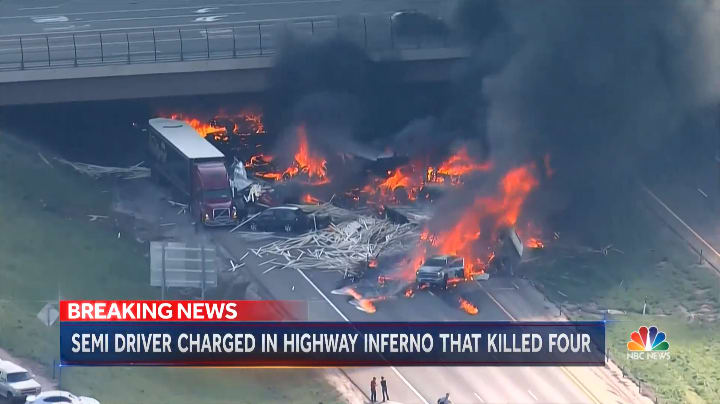
Four people were killed in 2019 when a trucker lost his brakes on a steep mountain grade.
Photo: Screen capture
2 min to read
A truck driver whose 110-year sentence following a fatal mountain crash prompted a national outcry has had his sentence cut to 10 years by Colorado Gov. Jared Polis.
Rogel Aguilera-Mederos, 26, was sentenced to 110 years in prison for his April 2019 actions resulting in a pileup on Interstate 70 that left four people dead. The crash occurred on a part of the interstate where commercial vehicles are limited to 45 mph because of the steep descent. Aguilera-Mederos has said his brakes failed.
He was convicted earlier this year on 27 charges, including four counts of vehicular homicide. Under Colorado law, prosecutors only had to prove that he acted recklessly in ignoring the 45-mph limit and blowing right by a runaway truck ramp. The judge in the case said the extreme sentence was the result of Colorado sentencing guidelines requiring sentences to be served consecutively.
The sentence quickly gained national attention, with millions signing a petition asking the governor to grant clemency and truckers threatening boycotts of the state on social media. In an unusual step, the prosecutors had petitioned the judge to reconsider and asked for a 20- to 30-year sentence.
On Dec. 30, Gov. Polis granted Aguilera-Mederos’ application for a commutation, reducing the sentence too 10 years and granting parole eligibility in five years, on Dec. 30, 2026.
“You were sentenced to 110 years in prison, effectively more than a life sentence, for a tragic but unintentional act,” Polis wrote in his clemency letter. “While you are not blameless, your sentence is disproportionate compared with many other inmates in our criminal justice system who committed intentional, premeditated, or violent crimes.”
Polis said the unusual sentence highlighted the lack of uniformity between sentences for similarly situated crimes and expressed hope that the case would spur an important conversation about sentencing laws.
“You have wondered why your life was spared when other lives were taken,” the governor wrote to Mr. Aguilera-Mederos. “You will struggle with this burden of this event for the rest of your life,” and “you will serve your just sentence.”
Polis also noted that the tragic event prompted the Colorado Department of Public Safety to launched the Mountain Rules, implementng in-cab traffic alerts via Drivewyze and PrePass that notify drivers of steep grades, locations of runaway truck ramps, and areas for brake checks and cooling.
DPS also developed and deployed new technology to measure and detect hot brakes along the I-70 corridor.
More Safety & Compliance

FMCSA Pauses Biennial-Update Enforcement Amid Motus Transition
Carriers whose updates were due on or after June 1 have more time, while FMCSA works to stabilize its new registration system and warns of phishing sites impersonating its new carrier registration system, Motus.
Read More →
ZF Expands Commercial Vehicle Push in North America
ZF is expanding its North American commercial-vehicle presence with new transmission applications, electrification, trailer technology and autonomous-driving systems.
Read More →
Truck Drivers Need More Than Another Alert
Fleets have more visibility into truck health, safety events, and driver activity than ever. The next challenge is turning all that information into useful guidance for the person who has to decide what to do next.
Read More →
Tesla Wants a Self-Driving Semi. Are Cameras Enough?
Could Tesla’s camera-only autonomous driving technology work on an 80,000-pound Semi? In this commentary, HDT's Deborah Lockridge takes a look at Tesla, Cybercab, and how autonomous trucks see the road.
Read More →
What DOT’s Automated Vehicle Strategy Means for Trucking
The U.S. Department of Transportation issued a new automated-vehicle strategy that outlines plans for driverless-truck regulations, cross-state freight corridors, and federal safety standards.
Read More →
NYC Expands Speed, Pedestrian Safety Tech Across Fleet
New York City is expanding intelligent speed assistance and pedestrian-alert systems across its municipal fleet, moving the technologies from pilot programs into vehicle procurement and retrofit requirements.
Read More →
FMCSA Removes 110 Truck Driver Training Schools from Certified ELDT List
Federal regulators also are targeting more than 160 additional training providers and launching a nationwide audit of third-party CDL skills testers as part of a broader crackdown on trucking fraud.
Read More →
Beyond DOT Compliance: What Makes a Trucking Fleet Truly Safe?
A trucking fleet can follow every rule and still make unsafe decisions. The real test comes when safety conflicts with freight, productivity, or cost.
Read More →
Hours of Service Pilot Programs: FMCSA Readies for 2027 Rollout
Two pilot programs could eventually reshape hours-of-service rules, giving truck drivers options to pause their 14-hour clock or use longer split sleeper rest periods.
Read More →
New Guide Offers Pet Safety Tips for Truck Drivers
Hundreds of thousands of pets travel in truck cabs. A new safety guide from Volvo Trucks and the Center for Pet Safety offers practical advice for truck drivers who bring dogs and cats along for the ride.
Read More →