




Colorado Reminds Commercial Vehicle Drivers of 'Must-Carry' Snow Chain Law
The Colorado Department of Transportation is reminding commercial motor vehicle drivers that the winter chain season is officially underway, and it’s the second year that Colorado’s updated "must-carry" chain law is in effect.

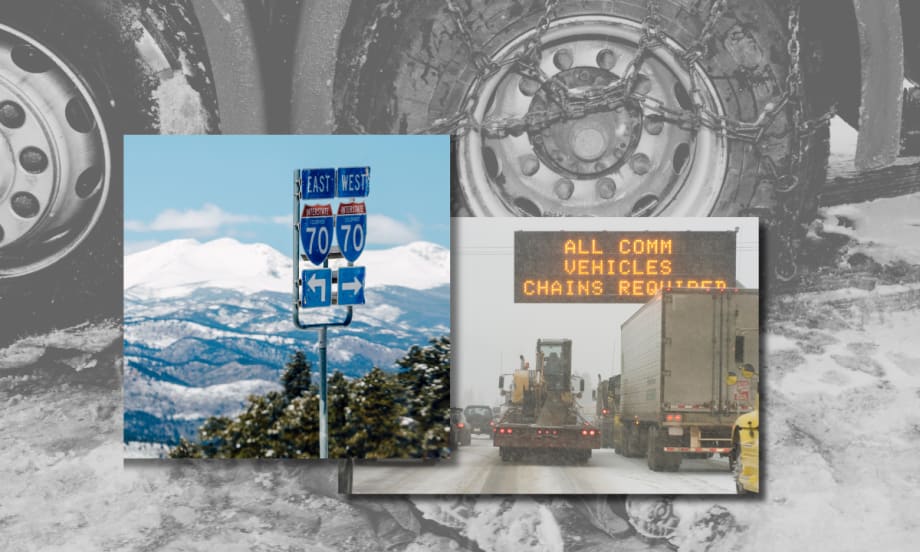
Over 1,400 centerline miles of highway are subject to Colorado’s Must Carry Chain Law.
HDT Graphic
The Colorado Department of Transportation is reminding commercial motor vehicle drivers that the winter chain season is officially underway, and it’sthe second year that Colorado’s updated "must-carry" chain law is in effect.
The “Must Carry Law,” signed into law in 2024, requires all CMV drivers to carry chains from September 1 to May 31.
This applies to vehicles with a combined weight of more than 16,000 pounds used in commerce or as transport for at least 16 passengers (including the driver) on public highways.
Failure to comply can result in fines of $500 for not carrying chains and up to $1,000 plus surcharge for blocking the roadway.
Chains are not required for trailers. Chains can be removed once the Colorado DOT communicates by digital overhead sign, static sign or other notification, or when centerline or lanes are visible on a descending grade.
The law affects the following corridors:
Interstate highway 70 (I-70) west of milepost 259 (Morrison);
Colorado state highway 9 from milepost 63 to milepost 97 (Frisco to Fairplay);
U.S. Route 40 west of milepost 256 (Empire);
U.S. Route 50 west of milepost 225 (Salida);
U.S. Route 160 west of milepost 304 (Walsenburg);
U.S. Route 285 west of milepost 250 (Morrison); and
U.S. Route 550 from milepost 0 to 130.
For more information on the details of the law and chain-up stations across the state, CDOT has compiled an in-depth fact sheet.
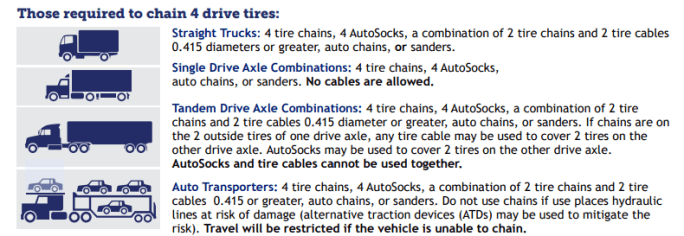
Colorado's chain law applies to vehicles with a combined weight of more than 16,000 pounds used in commerce.
Source: Colorado DOT
What Traction Devices Will Meet the Chain Laws in Colorado?
Tire chains: Include but are not limited to metal chains which consist of two circular hoops, one on each side of the tire, connected by not less than nine evenly spaced chains across the tire tread.
Tire cables: Traction devices made of steel cable as opposed to steel chain link, which has high strength steel cross member rollers 0.415" or greater in diameter. If chains are on the 2 outside tires of one drive axle, any tire cable may be used to cover 2 tires on the other drive axle. AutoSocks and tire cables cannot be used together.
Alternative Traction Devices (ATD): Must be listed on the state’s approved devices list. Drive wheel sanders and pneumatically driven chains are also allowed.
Colorado's Must Carry Chain Law in Action
More than 1,300 Must Carry Chain Law citations were issued by law enforcement during the 2024-2025 chain season.
CMV traffic accounts for roughly 10% of vehicles on I-70, with chains helping to reduce roadway closures and delays.
Over 1,400 centerline miles of highway are subject to Colorado’s Must Carry Chain Law.
There are 130 designated chain stations along Colorado’s roadway network. Twenty-two are situated on I-70’s mountain corridor.
Colorado’s mountain highways are uniquely challenging with steep grades, unpredictable weather and heavy snow, and commercial vehicles and buses have a larger footprint on roadways where chains are required, explained a DOT news release.
Winter Driver Preparedness
Before starting their routes, CMV drivers should check forecasts to adjust schedules around storm systems and ensure that their chains are on board and ready for use.
When storms hit, drivers are often required to pull into chain-up stations, many times after dark and in below freezing temperatures.
“For commercial drivers, winter in Colorado requires extra preparation and resilience,” said CDOT’s Freight Mobility and Safety Branch Manager Craig Hurst.
For more information about Colorado’s Must Carry Law, including videos and tutorials, visit freight.colorado.gov/mountain-rules/chain-up-tips. For real-time road conditions and chain law alerts, visit COTrip.org.
More Safety & Compliance

FMCSA Pauses Biennial-Update Enforcement Amid Motus Transition
Carriers whose updates were due on or after June 1 have more time, while FMCSA works to stabilize its new registration system and warns of phishing sites impersonating its new carrier registration system, Motus.
Read More →
ZF Expands Commercial Vehicle Push in North America
ZF is expanding its North American commercial-vehicle presence with new transmission applications, electrification, trailer technology and autonomous-driving systems.
Read More →
Truck Drivers Need More Than Another Alert
Fleets have more visibility into truck health, safety events, and driver activity than ever. The next challenge is turning all that information into useful guidance for the person who has to decide what to do next.
Read More →
Tesla Wants a Self-Driving Semi. Are Cameras Enough?
Could Tesla’s camera-only autonomous driving technology work on an 80,000-pound Semi? In this commentary, HDT's Deborah Lockridge takes a look at Tesla, Cybercab, and how autonomous trucks see the road.
Read More →
What DOT’s Automated Vehicle Strategy Means for Trucking
The U.S. Department of Transportation issued a new automated-vehicle strategy that outlines plans for driverless-truck regulations, cross-state freight corridors, and federal safety standards.
Read More →
NYC Expands Speed, Pedestrian Safety Tech Across Fleet
New York City is expanding intelligent speed assistance and pedestrian-alert systems across its municipal fleet, moving the technologies from pilot programs into vehicle procurement and retrofit requirements.
Read More →
FMCSA Removes 110 Truck Driver Training Schools from Certified ELDT List
Federal regulators also are targeting more than 160 additional training providers and launching a nationwide audit of third-party CDL skills testers as part of a broader crackdown on trucking fraud.
Read More →
Beyond DOT Compliance: What Makes a Trucking Fleet Truly Safe?
A trucking fleet can follow every rule and still make unsafe decisions. The real test comes when safety conflicts with freight, productivity, or cost.
Read More →
Hours of Service Pilot Programs: FMCSA Readies for 2027 Rollout
Two pilot programs could eventually reshape hours-of-service rules, giving truck drivers options to pause their 14-hour clock or use longer split sleeper rest periods.
Read More →
New Guide Offers Pet Safety Tips for Truck Drivers
Hundreds of thousands of pets travel in truck cabs. A new safety guide from Volvo Trucks and the Center for Pet Safety offers practical advice for truck drivers who bring dogs and cats along for the ride.
Read More →