




ATA Economist Predicts Supply Crunch Like Industry's Never Seen
Even though he doesn't expect the economy to grow very quickly, the American Trucking Associations' chief economist says we're heading into "a supply side story the likes of which we have probably never seen in our industry." The result will be higher rates, and the best drivers in demand like they've never been before
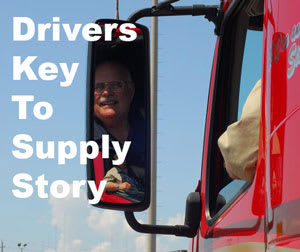
The cream of the crop drivers will be in high demand as increased demand and new regulations collide. (Photo by Jim Park)
Even though he doesn't expect the economy to grow very quickly, the American Trucking Associations' chief economist says we're heading into "a supply side story the likes of which we have probably never seen in our industry." The result will be higher rates, and the best drivers in demand like they've never been before.
In a webinar for members of the National Industrial Transportation League Monday, ATA's Bob Costello said he does not believe we are in for a double-dip recession. Corporations are sitting on a "mountainload" of cash, he points out, and there is still about $150 billion of fiscal stimulus in the pipeline.
"I do think we're in for some subpar growth," he said, predicting the economy will not hit 3 percent growth in gross domestic product (the level considered "normal" by most economists) in any quarter until the end of next year.
Even though the number of truckload loads (not tonnage) fell 24 percent from peak to trough, "we are well on our way up," Costello said. "Things are well off the bottom."
Costello showed a graph illustrating how different types of freight have improved in the first seven months of this year compared to the same period of 2009. Dry van, the largest part of the market, is up 5.4 percent, flatbed freight 6.8 percent, temperature-controlled freight 7.1 percent, and tank freight up 9.3 percent.
Even better, he said, is the average truckload revenue per mile, up 4.2 percent in July compared to a year ago -- the largest gain we've seen in the modern era coming out of a recession, Costello said.
The supply side of the supply/demand equation "is very different than anything we've seen in the past," Costello said. "And I think at the end of the day it means truck volumes don't have to grow that much for this industry to do well."
"In general, we all saw the historic drop in demand while it was happening. What we didn't see was an even more historic drop in demand. I don't think it's going to take much of an increase in demand for us to get tightness out there, particularly on the truckload side."
Trends for tightening
Costello identified a number of reasons for this tightening in supply, or capacity:
* Fleet size. Fleets today are 14 percent smaller on average than they were at the height three years ago.
* Trucking company failures. While not as high as we would have thought, thanks to low used truck values keeping finance companies from foreclosing, Costello said there are still many fleets that have gone out of business. Now that used truck values are improving, he said, "I don't think failures are going to skyrocket, but I wouldn't expect them to plummet to very low levels, either."
* Class 8 truck sales are "well below any reasonable replacement rate," he said. "We continue to dispose of more trucks than we are bringing online."
* We have exported a significant number of used Class 8 tractors over the past few years, to countries such as Russia and Nigeria.
* Truck utilization has improved. "We've been able to absorb the additional demand with the existing fleet, but that's not going to go on forever."
* The driver shortage is returning already.
* "We cannot underestimate the impact of government regulations, not only on supply, but on the addition of supply in this industry," Costello said.
The federal government's new CSA 2010 enforcement regime, he said, is going to result in "the free agency of trucking. The cream of the crop drivers are going to know who they are. They're going to walk into management's office and say, 'I wnat to be paid more or I'm going to go somewhere else.'" New hours of service regulations and a broader mandate for electronic logs will likely cut productivity, he said.
"All of these things not only increase costs, but they limit industry supply and increase the barriers to entry. All of these things in the near and the long term mean it's going to be harder to add to industry capacity."
Driver turnover has already started to increase, he noted. After peaking at 136 percent in late 2005, the turnover rates for large truckload fleets fell to 39 percent in the first quarter of the year. But in the second quarter, the turnover rate for these carriers rose to 49 percent.
All this will mean higher rates for carriers.
The Owner-Operator and Small Fleet
One of the questions that came up during the webinar was the fate of the owner-operator and small fleet. Costello admitted that the cost pressures do tend to hit smaller fleets harder, and of course the smallest fleet out there is the owner-operator.
"That said, I don't see owner-operators going away," he said. "I know a lot of fleets like owner-operators. It's a great way for them to add capacity without making those truck purchases. They're going to have to pay them more, but I don't think the owner-operator is going to go away."
Costello pointed out that there are tens of thousands of fleets out there. "It's going to be a challenge for them, they've got to get better at what they're doing, but I don't see owner-operators and small fleets going away."
More Fleet Management

How Telematics Improves Visibility, Control, and Performance in Refrigerated Fleets
Explore how telematics help refrigerated fleets improve visibility, uptime, efficiency, compliance, and cargo protection across connected cold chain operations.
Read More →
What the U.S.-Canada Trade War Means for Trucking
Escalating U.S.-Canada tariffs could disrupt cross-border freight, reduce truck volumes, raise costs, and create new uncertainty for carriers on both sides of the border.
Read More →
What Are Trucking’s Top Concerns for 2026?
The American Transportation Research Institute wants to know what's worrying trucking fleet managers, drivers, and other stakeholders in its annual Industry Issues survey.
Read More →

American Trucking Associations Looks for a New Leader
ATA President and CEO Chris Spear abruptly left his job at the association on August 21, at a pivotal time for the trucking industry.
Read More →
Public Wi-Fi Cybersecurity Risks: How Truck Drivers and Fleets Can Protect Their Data
Public Wi-Fi can expose truck drivers and fleets to credential theft, malware, and other cyber threats. Here’s how to reduce the risk on the road.
Read More →
For Nicky Cupp, Fleet Innovation Starts With Frustration
HDT Truck Fleet Innovator Nicky Cupp turns everyday pain points at Fraley & Schilling into opportunities for better technology and smarter processes.
Read More →
Adam Buttgenbach’s Approach to Electric Trucks: Start With Where They Fit
HDT Truck Fleet Innovator Adam Buttgenbach helped PepsiCo build one of North America’s largest EV fleets by focusing on where electric trucks make operational sense.
Read More →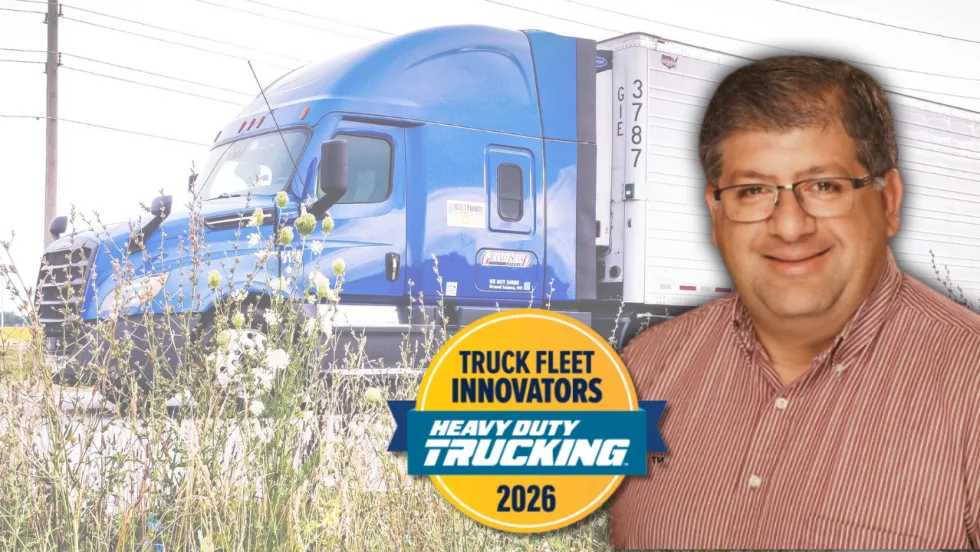
Deen Albert: Let Automation Do the Math, People Make the Decisions
HDT Truck Fleet Innovator Deen Albert makes sure people are still at the heart of operations at Grand Island Express, even while adopting artificial intelligence tools. AI-assisted dispatch helped boost revenue 25% with the same number of trucks.
Read More →
Trimble’s New AI Agent Takes Aim at Fleet Back-Office Busywork
Arc Agent works across Trimble TMS products to automate repetitive tasks such as freight orders, maintenance, invoices, fuel costs and more.
Read More →
How HDT’s 2026 Truck Fleet Innovators Are Rethinking Fleet Operations
Meet five trucking leaders who are challenging assumptions, solving operational problems, and putting innovative ideas to work.
Read More →