





Dig Deeper: Can Strong Job Growth in Trucking Continue?
AB5 Protests Hit Port of Oakland
Close to 1,000 protesters slowed the operations at the Port of Oakland to a crawl on July 19 as they tried to draw attention to how the controversial AB5 law will affect truck owner-operators in the state.
July 19, 2022
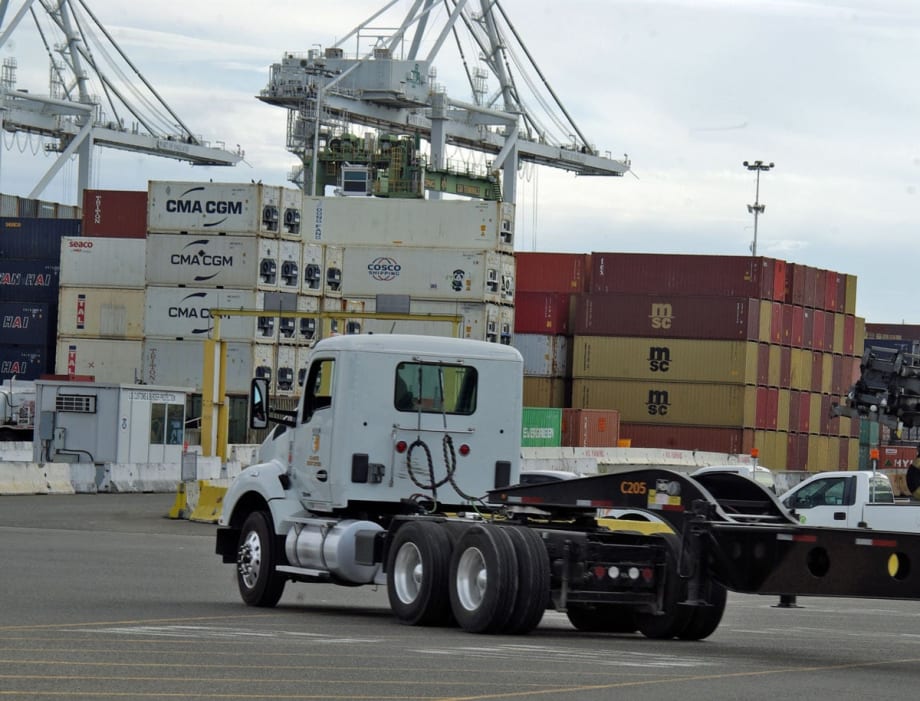
Three container terminals serve the Oakland waterfront at the port.
Photo: Port of Oakland file/press photo
4 min to read
Independent truck drivers are protesting California’s restrictive AB5 labor law at the Port of Oakland this week in a three-day action that started Monday.
Owner-operator truck drivers, who make up 90% of the Bay Area port's operation, are protesting Assembly Bill 5, known as AB5, which is expected to virtually eliminate the use of owner-operators in trucking in the state. The protests follow actions last week at the ports of Los Angeles and Long Beach.
AB5 was passed and signed into law in 2019. Provisions in the bill will prevent independent owner-operator truck drivers from contracting with other trucking companies for services, essentially leaving trucking companies no choice but to use only employee drivers. An injunction in place since 2020 has prevented the law from being enforced while a lawsuit on the bill made its way through the judicial system. On June 30, however, the U.S. Supreme Court denied a petition from the California Trucking Association to hear the case, paving the way for full enforcement of the law.
Truckers blocked most operations at the Port of Oakland and container ships couldn’t be loaded or unloaded because ILWU dockworkers refused to cross the picket line. https://t.co/RUqO8ivnOH via @WSJ
— WSJ Logistics Report (@WSJLogistics) July 19, 2022
Trucker Protest Swells
On Monday, July 18, protesters started blocking other trucks from entering the Port of Oakland, as a way to get the attention of government officials. According to CBS News, trucks lined the street Monday as protesters made a deal with police to allow 10 trucks in every 30 minutes.
The number of protesters depends on who you ask.
Port officials disputed estimates by those on the front lines Monday that the number of protesters was between 300 and 400 owner-operators, saying it was around 100 to 130 truckers. Reuters reported more than 100 drivers and small trucking company operators opposed to the law slowed truck entry to a trickle at two terminal gates.
Multiple published reported indicated that the number grew significantly on Tuesday, with reports of nearly 1,000 owner-operators on Tuesday blocking access to the SSA, TraPac and Everport terminals.
A spokesperson for TraPac told the Wall Street Journal that protesters on Tuesday barred short-haul truckers from entering the facility and only allowed long-haul drivers in at a rate of three trucks per half-hour, reducing TraPac’s operations by 95%.
In addition, members of the International Union of Longshoremen and Warehouse Workers refused to cross an AB5 protest picket line blocking the gates of the SSA terminal.
Ed DeNike, president of SSA Containers, told the Wall Street Journal that the protests blocked truck gates into and out of the company’s container terminal. Container ships couldn’t be loaded or unloaded because dockworkers with the International Longshore and Warehouse Union refused to cross the picket line.
Some terminals closed early Tuesday because of the congestion from the protests.
The protest, scheduled for three days, could go longer, according to Bill Aboudi, president of Oakland Port Services Corp., who told the Wall Street Journal that protesters are “digging in for a whole week,” with some setting up tents, deep-frying food and feeding people on the picket line.
Independent truckers strike at Port of Oakland over worries about AB5https://t.co/beqElRCrBX
— wake1up (@n2oneness) July 19, 2022
The Teamsters Union has pushed “worker misclassification” efforts such as AB5. Jason Rabinowitz, president of the Teamsters' Joint Council 7, told CBS AB5 is about unionizing truckers. “Every worker, every driver deserves the right to have a union and all the benefits that come with that,” he said.
But the protesting truckers don’t want to be employees.
'Employee Misclassification' on the Agenda for NLRB-FTC
Meanwhile, on the federal level, the National Labor Relations Board and the Federal Trade Commission are teaming up to “promote fair competition and advance workers’ rights.”
Among the areas of interest are labor market developments relating to the “gig economy” such as misclassification of workers and algorithmic decision-making; the imposition of one-sided and restrictive contract provisions, such as noncompete and nondisclosure provisions; the extent and impact of labor market concentration; and the ability of workers to act collectively.
“Workers in this country have the right under federal law to act collectively to improve their working conditions. When businesses interfere with those rights, either through unfair labor practices, or anti-competitive conduct, it hurts our entire nation,” said NLRB General Counsel Jennifer A. Abruzzo.
More Drivers

Why Hiring Truck Drivers Is Getting Harder
Higher recruiting costs, a shrinking driver pool, and renewed pay competition are raising the stakes for fleets heading into 2027.
Read More →
Roehl Offers Truck Drivers $10,000 Retention Incentive
Payments begin after the first load and continue in mileage-based installments for eligible experienced drivers joining the fleet.
Read More →
Platform Science Adds Dispatch and Safety Tools
Four additions to PS Fleet help fleets monitor loads, manage driver coaching, share truck locations and adjust video system settings.
Read More →
When Language Stops the Truck: The Return of ELP Out-of-Service Orders
English language proficiency rules for commercial drivers aren’t new, but renewed out-of-service enforcement has raised the stakes. Here’s what carriers need to know before a driver reaches a roadside inspection.
Read More →
Samsara Launches Custom AI Agent Builder
Agent Studio lets fleets create AI tools for hours-of-service monitoring, reporting and driver support, including agents that communicate by phone.
Read More →
Trucker Path Expands Reserved Parking Network
Trucker Path has added close to 6,000 more truck parking spaces to its Trucker Path Reserved Parking Network with the addition of Safe Truck Parking.
Read More →
EEOC Sues Texas Trucking Company Over Driver Age Limits
The agency says Trancasa USA rejected applicants over 65 and applied tougher driving-record standards to those over 60.
Read More →
Nussbaum, Roehl Announce Second Driver Pay Increase This Year
This year has seen a swath of major truck driver pay increases as freight capacity has tightened.
Read More →
From One Generation to the Next: How Mentorship Builds Safer Truck Drivers
After three decades in trucking, Harold Perry shares what he's learned about driver safety, mentorship, and helping the next generation build confidence behind the wheel.
Read More →
Truck Drivers Need More Than Another Alert
Fleets have more visibility into truck health, safety events, and driver activity than ever. The next challenge is turning all that information into useful guidance for the person who has to decide what to do next.
Read More →