




From the HDT archives (2019): Trucking Looks for Solutions to California's Stringent New Independent Contractor Law
Can Strong Job Growth in Trucking Continue?
FTR's Avery Vise explores how trucking employment, truck order backlogs, fuel prices, motor carrier failures, and the attack on the independent contractor model all tie together.
by Avery Vise, FTR
June 15, 2022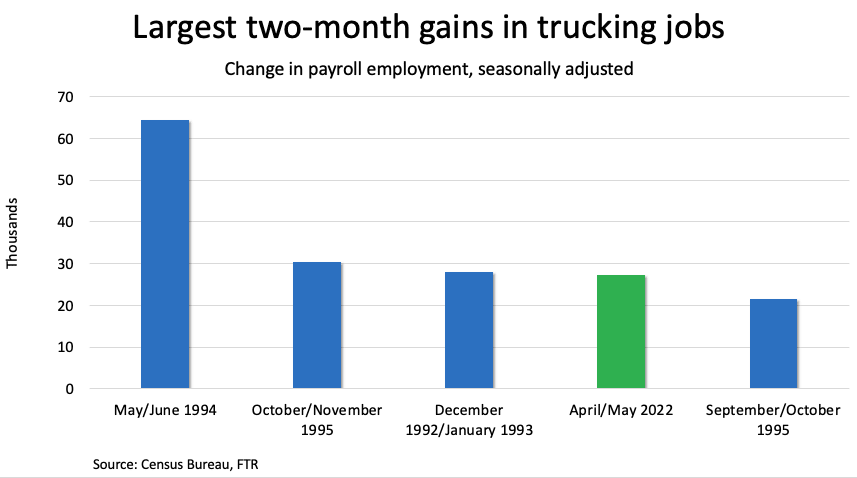
Only three times in the 32-plus years of available data has trucking seen a larger two-month surge in trucking employment. And at least one of those (May to June 1994) resulted from the resolution of a huge Teamsters strike.
Source: FTR
4 min to read
In April and May combined, the for-hire trucking industry added 27,300 payroll jobs (seasonally adjusted), according to the latest Bureau of Labor Statistics data. That puts trucking employment at the highest on record and 65,900 payroll jobs, or 4.3%, ahead of the pre-pandemic month of February 2020.
Only three times in the 32-plus years of available data has trucking seen a larger two-month surge in trucking employment. And at least one of those (May to June 1994) resulted from the resolution of a huge Teamsters strike.
As we reported recently, the number of trucking companies leaving the market has begun to rise, most of those single-truck carriers. But the data on DOT authority revocations clearly lags the reality of the marketplace. Given an unprecedented surge in diesel prices and, until recently at least, steadily weakening dry van and refrigerated spot rates, we presume that we have already seen a sharp increase in the number of those owner-operator drivers looking for a more stable environment in which they are less exposed — or perhaps not exposed at all — to higher fuel costs and rate volatility. That growing pool of willing recruits probably was a significant contributor to the extraordinary job growth in the past two months.
With diesel prices showing no signs of collapsing, the ground for recruiting should remain fertile as long as freight demand is solid. The relatively tamer volumes and rates in dry van and refrigerated appear to reflect primarily a shift of activity to the contract arena rather than a drop in overall demand. Given the unprecedented shift of capacity and volume into the spot market over the past two years, this trend could continue, assuming no limitations other than driver availability.
Truck Supply + Fuel Costs = A New Driver Model?
A ready supply of drivers is not the only issue, however. Add to the list of unprecedented situations the constraints on truck production due to the semiconductor shortage and other supply-chain problems. “Official” lead times for obtaining new trucks have come down from levels seen in 2021, although they are still nearly as high as the pre-pandemic peak in December 2018. However, the formal backlog-to-build metric is misleading. Truck manufacturers are unable to slot tens of thousands of would-be truck orders because they simply do not know when they can build them. So the true lead time for trucks clearly is higher than the more than 10 months FTR reports.
Constraints on new truck availability raise some interesting challenges for fleets. Carriers could snap up used trucks, which presumably should become increasingly available as these single-truck operations fail in greater numbers. However, many carriers will avoid doing that unless absolutely necessary, because operating used trucks — especially older ones — complicates maintenance practices and increases maintenance costs.
The more attractive approach for most carriers probably is to take on former independent carriers as leased owner-operators. Indeed, most of those small carriers probably had been leased owner-operators before the pandemic. However, today’s landscape is different. For starters, the leased owner-operator model is under attack. Indeed, it is even possible that by July they will be illegal altogether in California, depending on what the U.S. Supreme Court decides.
Fuel costs arguably are another hurdle to converting failing independent carriers into leased owner-operators. Even though the leased operator might get pass-through fuel surcharges, the time lag between payment and reimbursement is potentially a big pill to swallow. Many operators who have struggled due to surging diesel prices likely want out of the fuel-buying process altogether, preferring instead company driver jobs that give them company-paid fuel cards.
As aversion to fuel purchasing meets constraints on new trucks, FTR believes we could see growing interest in a new model where the larger carrier agrees to buy the single-truck carrier’s truck and to hire the driver to operate it. Think of it almost as the reverse of a typical lease-purchase agreement. We do not expect such an approach to become common, but it could be one way some carriers can deal with the current environment.
Avery Vise is FTR’s vice president of transportation.
Subscribe to Our Newsletter
More Fleet Management

Sponsored•September 16, 2026
Color Match Smarter: Tools That Restore & Perform
For fleet managers and collision repair professionals keeping heavy-duty trucks on the road, getting the color right the first time isn't just about appearance — it's about efficiency, turnaround time, and bottom-line results. Discover how today's digital color tools are transforming the repair process from guesswork to precision.
Read More →
FMCSA Pauses Biennial-Update Enforcement Amid Motus Transition
Carriers whose updates were due on or after June 1 have more time, while FMCSA works to stabilize its new registration system and warns of phishing sites impersonating its new carrier registration system, Motus.
Read More →
Sponsored•September 14, 2026
2026 Blueprint for Countering Smarter Supply Chain Theft
Cargo theft is no longer just the cost of doing business. It's a multi-billion-dollar criminal enterprise exploiting vulnerabilities across your fleet, drivers, and supply chain.
Read More →


Sponsored•September 1, 2026
How Telematics Improves Visibility, Control, and Performance in Refrigerated Fleets
Explore how telematics help refrigerated fleets improve visibility, uptime, efficiency, compliance, and cargo protection across connected cold chain operations.
Read More →
What the U.S.-Canada Trade War Means for Trucking
Escalating U.S.-Canada tariffs could disrupt cross-border freight, reduce truck volumes, raise costs, and create new uncertainty for carriers on both sides of the border.
Read More →
What Are Trucking’s Top Concerns for 2026?
The American Transportation Research Institute wants to know what's worrying trucking fleet managers, drivers, and other stakeholders in its annual Industry Issues survey.
Read More →
American Trucking Associations Looks for a New Leader
ATA President and CEO Chris Spear abruptly left his job at the association on August 21, at a pivotal time for the trucking industry.
Read More →
Public Wi-Fi Cybersecurity Risks: How Truck Drivers and Fleets Can Protect Their Data
Public Wi-Fi can expose truck drivers and fleets to credential theft, malware, and other cyber threats. Here’s how to reduce the risk on the road.
Read More →
For Nicky Cupp, Fleet Innovation Starts With Frustration
HDT Truck Fleet Innovator Nicky Cupp turns everyday pain points at Fraley & Schilling into opportunities for better technology and smarter processes.
Read More →
Adam Buttgenbach’s Approach to Electric Trucks: Start With Where They Fit
HDT Truck Fleet Innovator Adam Buttgenbach helped PepsiCo build one of North America’s largest EV fleets by focusing on where electric trucks make operational sense.
Read More →