




Volvo Offers Sneak-Peek of All-New Class 8 Electric Tractor
At its Technology Summit, Volvo Trucks North America highlighted a number of new products and upgrades, including a glimpse of an all-electric Class 8 VNR slated for production next year.

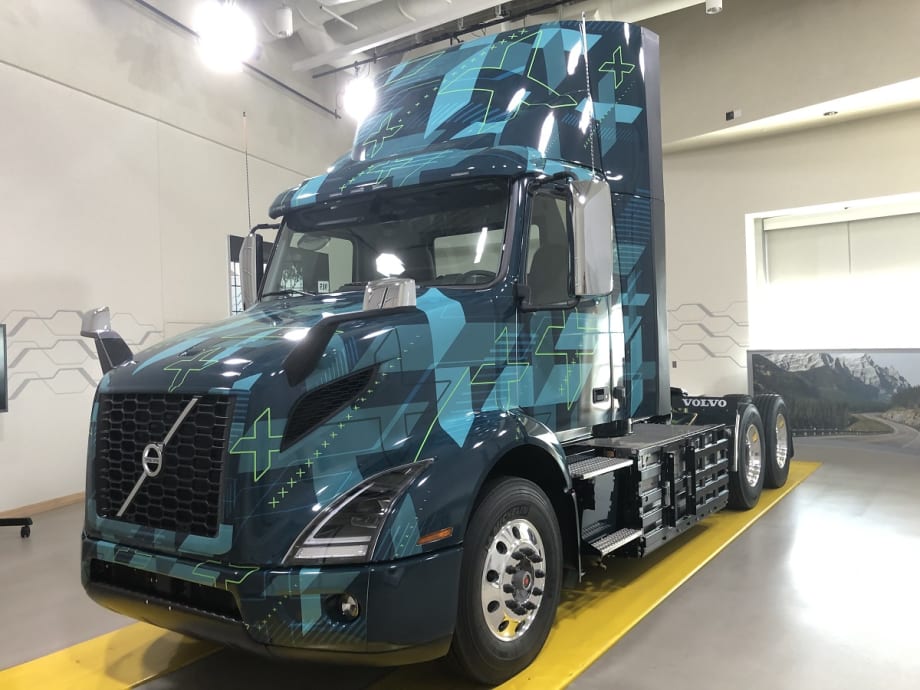
The new Volvo electric VNR on display at the company’s Customer Center in Dublin, Virginia, is slated to begin serial production next year.
Photo: Jack Roberts
Volvo is a company committed to safety, efficiency, and the environment, according to Magnus Koeck, vice president, brand marketing for Volvo Trucks North America, speaking to a gathering of trucking media at the company's Technology Summit in Dublin, Viriginia. He followed up his claim by highlighting a host of new technologies, products, and upgrades to existing vehicle systems that will begin appearing on Volvo Class 8 trucks beginning next year, including a more fuel-efficient engine, improved active safety system, and that it's bringing its Dynamic Steering to the U.S. (See separate story)
But the surprise of the day was the unveiling of a brand-new electric truck. This was not the medium-duty FE Electric model Volvo showcased last year (and which is now undergoing evaluations on the West Coast). No, the company unveiled a new, Class 8 electric version of its VNR regional haul tractor that Koeck said will go into production some time in 2020.
Details on the truck were sparse. We did learn that the truck has a conventional Volvo I-Shift automated transmission optimized for electric powertrains, with large battery packs mounted on the frame rail ahead of the drive tires.
“The Volvo VNR is ideal for applications like heavy urban distribution, drayage, and other regional applications where electric trucks will first have the greatest impact,” said Johan Agebrand, director of product marketing, Volvo Trucks North America. “The VNR series has received tremendous industry acceptance since its April 2017 introduction, and the addition of an all-electric powertrain provides even greater opportunities to expand its footprint in the regional-haul market.”
Introduction of the Volvo VNR Electric models is part of another Volvo partnership known as Lights, or Low Impact Green Heavy Transport Solutions. This partnership between the Volvo Group, California’s South Coast Air Quality Management District, and industry leaders in transportation and electrical charging infrastructure will begin next February.
“The Lights project is a truly unique opportunity to showcase a holistic approach to electrification of the freight transport industry as we handle ongoing challenges including electricity generation and battery optimization,” said Peter Voorhoeve, president, Volvo Trucks North America.
Volvo Doubles Down on Turbo-Compounding
Volvo led off its list of new Class 8 technologies and products with the second generation of its turbo compound diesel engine system, which Koeck said provides up to an additional 3% improvement in fuel efficiency over the current 13L turbo compound engine, the D13TC.
The new engine delivers up to 11% fuel savings overall compared to model-year 2015 trucks. Other improvements include enhanced efficiency over a wider range of applications, more engine ratings, and a new EE Extra Efficiency drive mode. The new D13TC will be available for order in the fourth quarter of 2019 and go into production at the end of the first quarter of 2020.
“We developed our first generation of the Turbo Compound engine in 2017, and since then almost 300 million miles have been logged, validating the up to 8% fuel-savings benefits,” said John Moore, product marketing manager at Volvo Trucks North America. “This new D13TC builds upon this game-changing engine technology, further increasing fuel efficiency by up to 3% over the current D13TC engine, saving approximately $1,200 per year per truck, based on the average fuel price and 125,000 miles per year.”
The new D13TC offers three individual drive modes, Dynamic Torque, an additional 405-hp rating, and the next evolution of Volvo Trucks’ patented wave piston design. These updates enable further increased fuel efficiency over a wider range of loads, vehicle speeds and engine rpm. Volvo said this offers broader applications for the engine compared to the first generation D13TC, which was designed specifically for over-the-road, long-haul applications for trucks loaded at 80,000 pounds.
The three individual drive modes available with the new D13TC engine are Extra Efficiency, Economy, and Performance. These modes will allow the driver to better optimize fuel efficiency for the vehicle with desired performance, depending on application, topography and driving conditions, Volvo engineers said. This new engine also features a wider rpm efficiency band, which enables top fuel efficiency for longer periods of time.
Dynamic Torque is an incremental torque system designed to provide the right torque at the right time. Rather than operating in silos of high-torque and low-torque modes, Dynamic Torque automatically sets a torque level dependent upon the weight of the truck, the grade and the road conditions at any given time. Dynamic Torque also features an automatic 12th gear lockout on heavy loads with Adaptive Gearing engine ratings. A kick-down switch along with performance drive mode allows access to full torque for customers requiring it on demand. This simpler, more effective system on the new D13TC engine will provide an even more consistent improvement in fuel efficiency across different applications.
The new engine also features a revised wave piston, designed and patented by Volvo Trucks. The improved design optimizes wave technology to evenly distribute the air/fuel mixture in the cylinder, burning the fuel more consistently than a traditional piston. Volvo’s design increases the compression ratio from 17:1 to 18:1 while maintaining up to a 90% reduction of soot in the cylinder, further improving fuel efficiency in the engine.
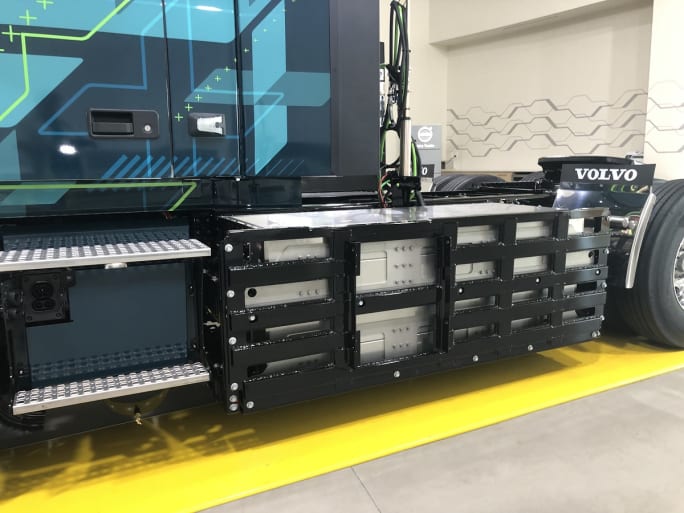
The most notable difference on the all-electric Volvo VNR are the massive battery packs on the frame rails ahead of the drive tires.
Volvo Upgrades Advanced Driver Assist Safety System
Volvo also announced that its Volvo Active Driver Assist (VADA) 2.0 comprehensive collision mitigation system will be made standard on new Volvo VNR and VNL models, and available on VNX models, beginning later this year.
The system enhances the original VADA platform by integrating radar and camera capabilities to help drivers maintain a safe following distance through alerts and improved traffic awareness, as well as emergency braking to reduce the risk of collisions.
Volvo Active Driver Assist technology was first introduced with Bendix Wingman Fusion in 2017. This comprehensive collision mitigation system uses camera and radar sensors to detect motorized vehicles in the vehicle’s proximity. The technology enables a series of features to activate driver alerts and foundation braking according to information detected by these advanced sensors.
Available in in the third quarter of 2019, with improvements scheduled to roll out through late 2020, VADA 2.0 offers enhancements to features including:
Automatic Emergency Braking (AEB) uses camera and radar sensors to determine how traffic is behaving around the truck. When a vehicle is detected, audible and visual warnings alert the driver to take action. If the driver does not respond, AEB engages to mitigate potential collisions. VADA 2.0 expands the capability of AEB beyond the current VADA, allowing it to operate across multiple lanes of traffic.
Lane Departure Warning alerts the driver when an unintentional lane departure occurs. VADA 2.0 allows for adjustable volume and audio mute override options and enables drivers to turn off the system momentarily (10 minutes) for select functions.
Highway Departure Warning and Braking automatically activates if the driver does not take corrective action after a Lane Departure Warning and the system detects that the vehicle may leave the drivable roadway, slowing the vehicle by a pre-defined speed.
Adaptive Cruise Control with Cruise Auto Resume enables the truck to revert back to cruising speed with Cruise Auto Resume (also known as “Slow & Go”) at speeds above 10 mph, an improved feature in VADA 2.0.
Driver Awareness Support offers an in-cab windshield-mounted camera with data capture support to enhance driver coaching and data availability
Future updates to VADA 2.0 will include Adaptive Cruise Control with Traffic Stop & Driver Go, Lane Change Support with audible alert adjustment, and stand-alone data capture options without the need for Lane Departure Warning.
More Equipment

Electric Yard Tractors Move Beyond Pilots
Operating-cost savings have overtaken sustainability goals as the leading reason surveyed fleets are adopting battery-electric terminal tractors, according to new NACFE research.
Read More →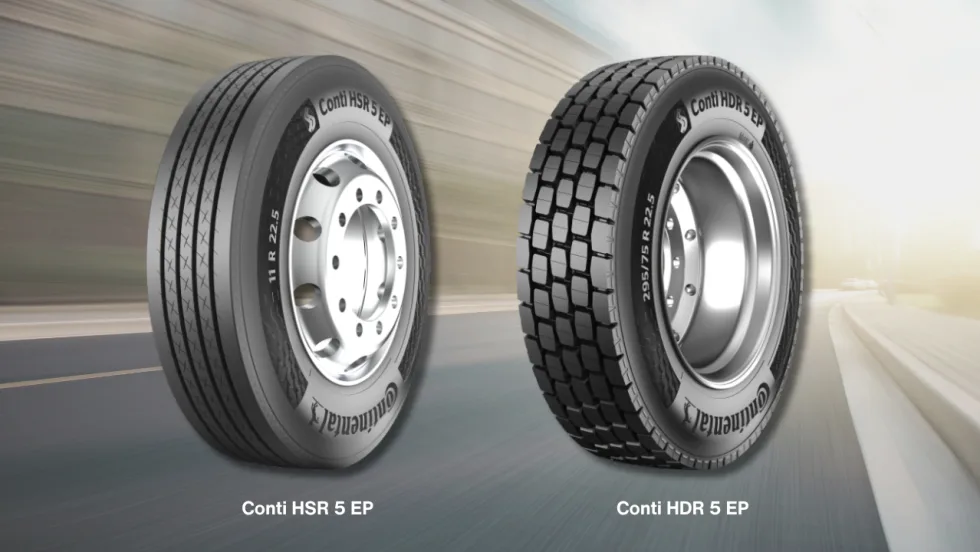
Continental Introduces New Regional Truck Tires
Continental says its new Generation 5 steer and drive tires for regional operations offer longer tread life, with estimated mileage gains of 22% and 19%, respectively.
Read More →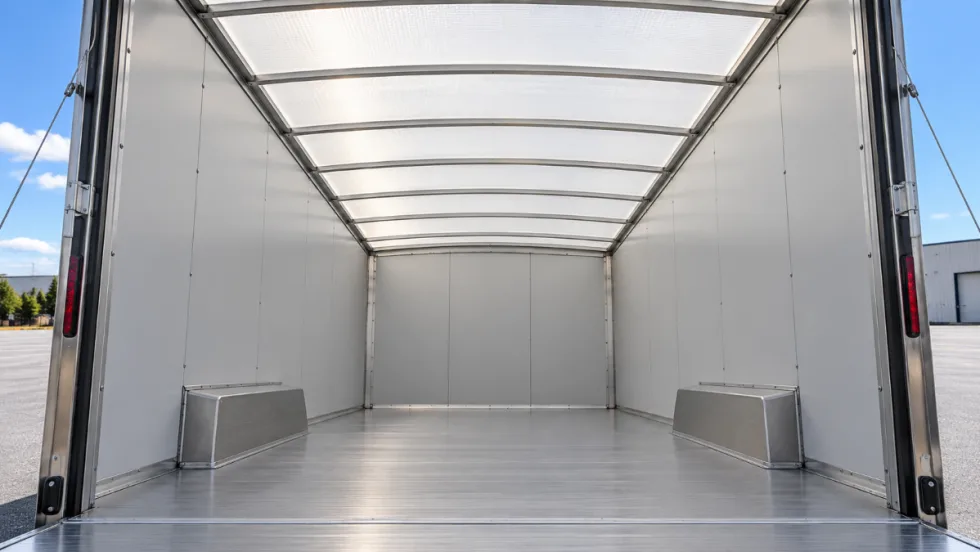
Tekmodo Introduces CargoBright Brand for Translucent Trailer Roofs
CargoBright is designed to diffuse daylight across the cargo area while performing as a working vehicle roof.
Read More →
Fleet Economics Shape Electric Truck Outlook
ACT Research expects costs, charging infrastructure, and technology improvements to drive zero-emission commercial vehicle adoption as federal regulations and incentives retreat.
Read More →
Kodiak Targets Dallas–Houston for Driverless Trucks
The company says its autonomous trucks are completing the I-45 run without a safety observer taking control. It plans to remove the observer by the end of 2026.
Read More →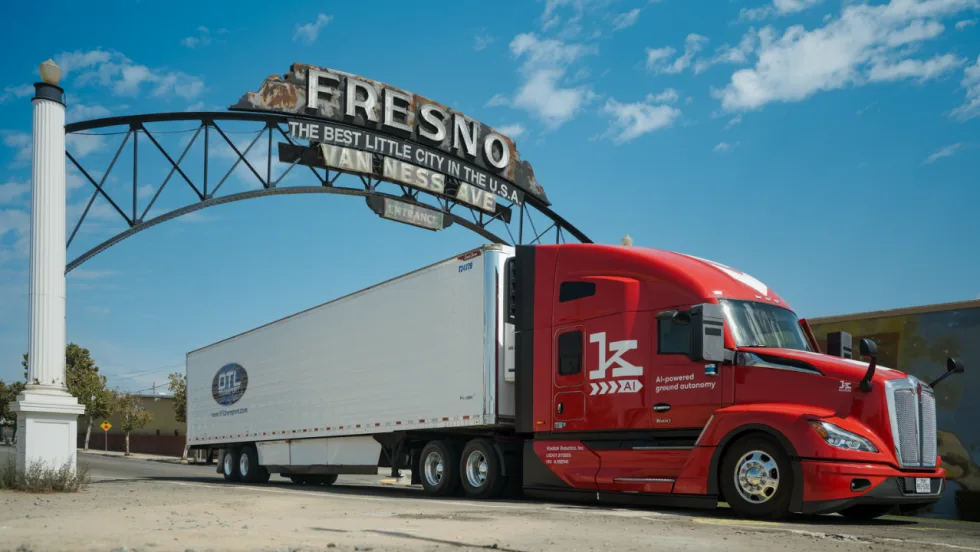
Kodiak Hauls Produce in California Autonomous Truck Pilot
Kodiak AI and DTL Transport have begun hauling produce between Fresno and Los Angeles under California’s new rules for testing heavy-duty autonomous trucks. A safety driver remains behind the wheel.
Read More →
Used-Truck Remarketing Math Is Changing
Used-truck value is no longer just a concern at trade-in. Decisions made throughout a truck’s first life can influence what it’s worth years later.
Read More →
How Volvo Updated Its D13 for EPA 2027 [Watch]
Volvo’s updated D13 promises lower emissions without sacrificing performance or fuel economy. Take a closer look at what changed inside the engine in this HDT Spotlight video.
Read More →
Michelin Tire Improves Efficiency and Durability for Regional Fleets
The Michelin X Multi Energy D2 is a regional haul drive tire engineered to help fleets improve fuel efficiency, durability and traction in demanding stop-and-go operations.
Read More →
ZF Expands Commercial Vehicle Push in North America
ZF is expanding its North American commercial-vehicle presence with new transmission applications, electrification, trailer technology and autonomous-driving systems.
Read More →