





Related: Volvo Reveals Electric VNR Model to Go On Sale in 2020
Volvo Looks to Future with New Electric Truck, Plant Improvements
At the Technology Summit at the Volvo Customer Center in Dublin, Virginia, Volvo Trucks not only highlighted its latest technology; it also gave reporters a report on the state of the North American truck-building industry and the company's position within it.
September 12, 2019
At the Volvo Customer Center in Dublin, Virginia, Volvo Trucks unveiled a host of new and upgraded safety systems as well as a brand-new Class 8 electric VNR tractor.
Photo: Jack Roberts
3 min to read
At the Technology Summit at the Volvo Customer Center in Dublin, Virginia, Volvo Trucks North America not only highlighted its latest technology; it also gave reporters a report on the state of the North American truck-building industry and the company's position within it.
In his opening remarks to journalists at the summit, Roger Alm, president of Volvo Trucks, said, “Other truck companies change with the times. Volvo is committed to changing the times.”
Looking at the wide array of diverse new products, systems, technologies and upgrades the Swedish truck OEM highlighted during the course of the day it would be hard to argue with him. The latest Volvo product offerings detailed included a second-generation turbo-compound diesel engine, a new steering assistance system, and upgrades to Volvo’s advanced active safety systems – as well as a first look at the new Class 8 VNR battery-electric tractor.
The day began, however, with business news and the announcement of a major investment in Volvo’s North American manufacturing facilities and processes.
“We are moving into new technology today. We will start serial production of electric trucks next year,” Alm said. “But the internal combustion engine will be the dominant power source in trucking for many years to come. But we are investing in our product portfolio and bringing new technology to market all the time.”
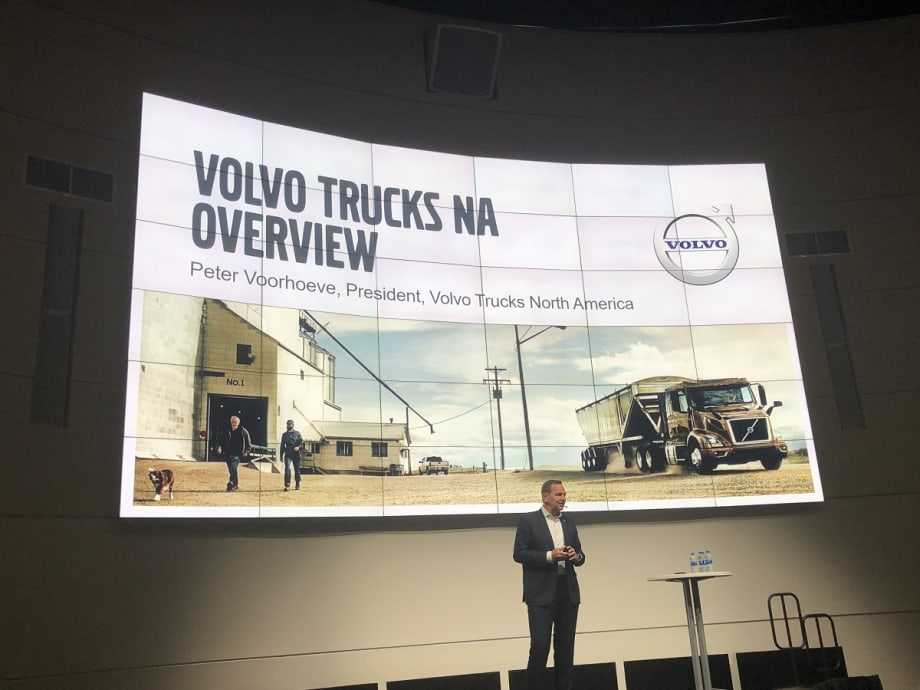
Alm and Peter Voorhoeve, president of Volvo Trucks North America, briefed reporters on the state of the North American truck market as seen by Volvo analysts, as well as significant investments in both dealerships and manufacturing facilities.
Alm said that if current build rates hold up, he expects to see a total of 311,000 new Class 8 trucks roll onto North American highways this year. That number is a bit lower than the company’s initial estimate of 325,000 units, which Alm said was a natural consequence of the economy slowing down somewhat.
Still, Voorhoeve noted that 2019 was shaping up to be a “very good year,” and added that while the economy and the trucking industry did indeed seem to be cooling off somewhat, this was to be expected given the red-hot production numbers the industry has seen over the past couple of years.
Volvo currently has North American market share of 9.6% — a figure lower than the 10% market share the company posted in 2018. Voorhoeve said this was due to delivery issues that hobbled the company in early 2019, but that he expected to make up lost ground and finish the year at 10% once again.
“In some ways, Volvo is still a new brand in North America,” Voorheve noted. “We’ve been here since 1982.” The success of any truck brand in North America — which remains Volvo’s largest market globally – depends on having a solid dealer network, which Voorheve said Volvo has made a priority from its earliest days in the United States and Canada. To date, he noted, Volvo has invested $619 million in its dealership network, which has grown to 435 locations since 2010, along with a whopping 296% increase in Volvo Master Technicians and a 64% increase in service bays.
Building on those successes, Voorhoeve announced that Volvo will invest another $400 million in its New River Valley truck plant in Dublin, where all Volvo trucks sold in North America are built.
Major components of the investment include a new 350,000-square-foot building that will ultimately house truck cab welding operations; an expansion of the existing plant to allow for further improvements to the facility’s paint operations and overall material/production flow; and a variety of equipment upgrades, including installation of several state-of-the-art dynamometers for vehicle testing.
“The outstanding product line currently produced at NRV has strongly positioned Volvo Trucks for the future,” Voorhoeve said. “This investment is another sign of our confidence in that future, and will help us prepare for even more exciting products – powered by both diesel and electric drivetrains – in the coming years.”
More Fuel Smarts

How Volvo Updated Its D13 for EPA 2027 [Watch]
Volvo’s updated D13 promises lower emissions without sacrificing performance or fuel economy. Take a closer look at what changed inside the engine in this HDT Spotlight video.
Read More →
Diesel Price Spike Shortens Payback for Natural Gas Trucks, Report Says
Energy Vision estimates fleets could recover the higher purchase price of an RNG-fueled Class 8 tractor in 1.3 to 2.8 years under current fuel-price scenarios.
Read More →
Calstart Becomes Catalyst Mobility, Reflecting Broader Focus
Calstart is now Catalyst Mobility, reflecting the nonprofit’s growing national role in clean transportation, including zero-emission trucks, infrastructure and incentive programs.
Read More →

Record Diesel Prices Squeeze Trucking Fleets
Average U.S. diesel prices have climbed to nearly $6 a gallon, surpassing the 2022 record as tight refinery capacity and Middle East disruptions keep fuel costs elevated.
Read More →
Sponsored•September 9, 2026
How Fuel Delivery Shapes Engine Performance
Fuel delivery depends on more than what happens at the injector. For fleet, maintenance and technical professionals, looking at the full path from pump to injector can provide useful context for understanding engine performance.
Read More →
East Coast Port Launches $45M Electric Truck Push
The Port Authority of New York and New Jersey announced millions in incentives for zero-emission drayage trucks, yard tractors, and new charging hubs near the port.
Read More →
California Bill Could Shed Light on Electric Truck Prices
Why do battery-electric Class 8 trucks remain so expensive? A California bill headed to Gov. Gavin Newsom would give fleets and state agencies more visibility into what manufacturers charge.
Read More →
Detroit Opens Orders for EPA 2027 Engines
Detroit isn’t starting from scratch to meet EPA 2027 diesel emissions standards. Its Gen 6 DD13 and DD15 engines keep much of today’s platform while updating the fuel and aftertreatment systems.
Read More →
Zero-Emission Truck Corridor Planned for West Coast
California, Oregon, Washington, British Columbia and Baja California are coordinating plans for truck charging and hydrogen fueling from Canada to Mexico.
Read More →
A Closer Look at Kenworth’s Electric T880E Vocational Truck [Video]
Learn more about Kenworth's T880E battery-electric vocational truck at the Paccar Technical Center, including its range, applications, upfitting considerations, and PTO options, in this HDT Spotlight video.
Read More →