





The Quest for Greener Truck Tires Part 2: Will Future Truck Tires Be Made From Dandelions and Rice Husk Ash?
The Quest for Greener Truck Tires
Environmentally friendly heavy-duty truck tires are a tough proposition, both from a manufacturing and usage standpoint. Here's how two global tire companies are working to make tires cleaner and greener.
May 17, 2024
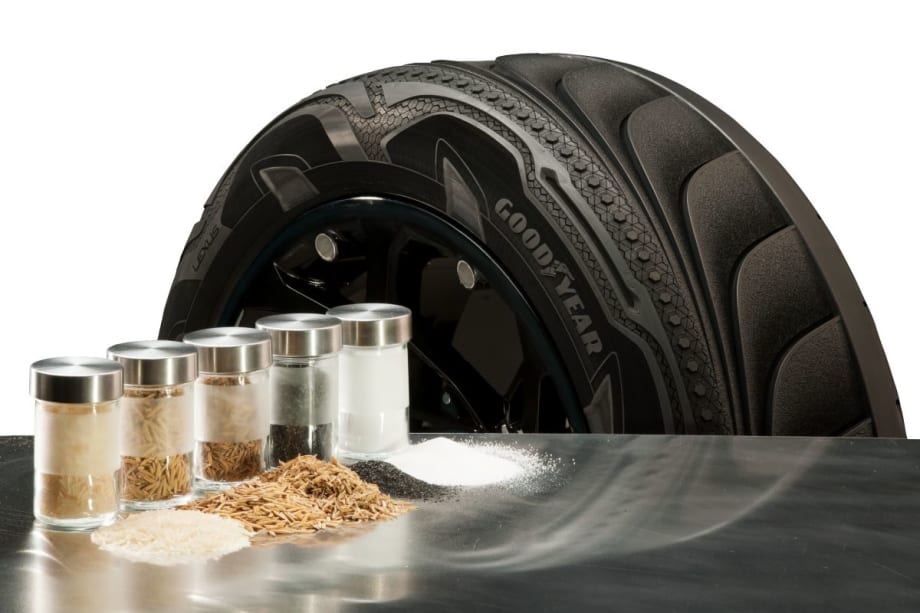
Tire OEs like Goodyear are working hard to develop new, environmentally friendly materials and manufacturing methods for truck tires.
Photo: Goodyear
6 min to read
Decarbonization of the trucking industry will require a lot more than switching over to zero-emission vehicles. In order to create a net-zero trucking industry by 2050, every aspect of the transportation sector will have to be examined and reworked to effectively reduce greenhouse gas emissions and combat climate change. Even heavy-duty truck tires.
Much of the focus today is on the downstream players in the trucking industry — vehicle operators. But upstream players have a role to play, as well.
Volvo, for example, is investing in carbon-free steel production to use in future trucks. The Swedish OEM is also looking into using recycled and environmentally friendly materials in as many different cab and powertrain components as possible.
Tire manufacturing has historically been a carbon-intensive process. But cutting-edge tire makers are looking hard at the materials and processes they use to build tires for cleaner and greener options.
However, this is no easy task. Tires aren't just "round and black." They're really modern-day technological wonders. Despite their relatively simple designs, tires use exotic materials that are not easily duplicated. They require large amounts of oil to produce in a process that emits large amounts of emissions into the atmosphere.
Nonetheless, both Goodyear and Continental have taken leadership positions in seeking out new, environmentally friendly materials to use in tire designs, as well as cleaner ways to manufacture them.
Sustainability is a Strategic Vision and Mission for These Tire Companies
Shaun Uys, head of U.S. market truck tire replacement for Continental, says the company is committed to producing tires in an environmentally friendly way. In order to accomplish this goal, Continental is investing in processes that are not only energy- and resource-efficient but also low-emission.
“By 2040, we will ensure that our operations are completely carbon neutral,” Uys says.
“Sustainability is an integral part of Continental Tires' Vision 2030 strategic program and is embedded in the foundation of our values. As a result, sustainability is already an important factor for our tires.
"We proactively strive to minimize all environmental, human rights and social risks we identify along our global tire supply chain. Our goal is to have all our tires made from 100 percent sustainable materials by 2050.”
From a tire production standpoint, in 2021, Goodyear announced its goal to move its manufacturing operations and processes to all renewable energy by 2040, says Chris Queen, regional tech director, commercial, Goodyear North America. This plan includes a mid-term goal of 100% renewable electricity in manufacturing operations by 2030.
Queen says Goodyear’s energy optimization program is now focused on five key areas. These include:
Energy efficiency
Renewable energy
Technology development
Sustainable material options
High product performance
“Each of these areas has strategic action items associated with them to reduce emissions, improve energy efficiency and increase the use of renewable energy,” Queen says.
“By the end of 2022, we were using 34% renewable electricity through procurement and on-site generation. That was up from 3% from 2019.”
Global Partnerships a Must for Developing More Sustainable Tires
It's a complicated situation, Uys admits.
“We need high-performance materials for our tires, because tires are absolutely safety-relevant,” he says. “At the same time, we aim to increase the share of sustainable materials in our products. We need them at the right time in the right quantity in the right place.”
To do this, Uys says Continental works closely with its internal suppliers worldwide.
“We have innovative ways when it comes to the materials we use, and we also want to source them responsibly,” he notes. “This is quite a complex task to solve, as no part of the tire value chain can be looked at independently from the other.”
For example, Uys says, new, recycled, or renewable materials all have an individual influence on safety and performance-relevant criteria in the use phase of a tire. So, Continental invests a lot of effort in research and development and in testing new materials. The goal is to be sure these materials can be used in mass production.
“We have very ambitious sustainability targets and are making very good progress, but we will never compromise on safety in our products,” he says.
Goodyear also continually works to seek out sustainable material options that deliver product performance while meeting its high standards of quality and safety, Queen says.
“As we enter this new era of more efficient low-rolling-resistance tires, we are looking to maintain and, in most cases, improve treadwear and traction,” he says.
“We also work to develop products that look to reduce greenhouse gas emissions across the product lifecycle. This work requires close collaboration with our customers, suppliers and even our industry partners.”
Rolling Resistance and Retreads
According to Queen, Goodyear’s tire life cycle assessment study results point to the product-use phase as the greatest opportunity to reduce greenhouse gas (GHG) emissions. So, obviously, Goodyear makes a concerted effort to more efficient tires from an overall energy-use standpoint.
"Energy use is affected by design factors such as tire rolling resistance, tire weight and aerodynamics,” he explains. “A tire with low rolling resistance and a vehicle with less weight consume less energy and emit fewer GHG emissions.”
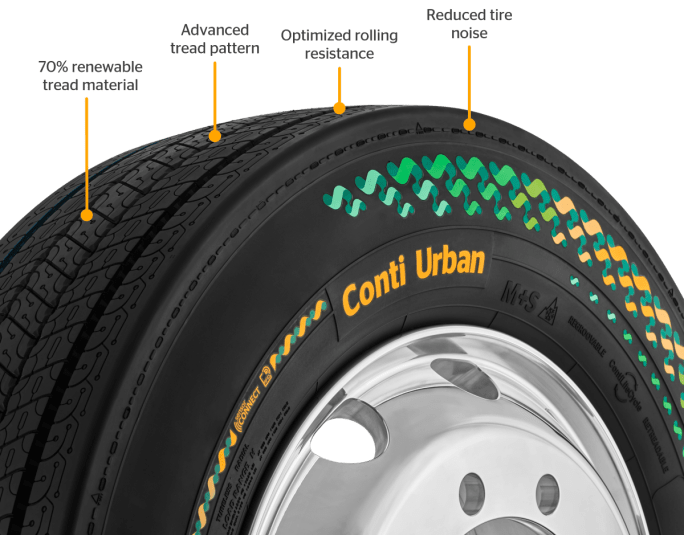
Green truck tires must be developed without compromising a number of crtical performance factors fleets rely on.
Photo: Continental Tire
To help reduce rolling resistance, Queen says, tire construction must reduce unnecessary weight and minimize the energy losses in the tire while helping provide safe performance.
"We test our rolling resistance and weight reduction advancements in tandem with a multitude of other parameters, including wet, dry and winter traction, durability and treadwear, to ensure optimized performance across all categories.”
Uys notes that most of Continental’s truck tires are built on durable casings that are designed to be retreaded multiple times to significantly lower the total cost of ownership and protect the environment.
“Reusing the casing saves energy and raw materials,” he says. “It also reduces the number of old tires in circulation, thereby reducing the burden on the environment.”
To reduce our environmental footprint, Uys says it is important for Continental to make tires more sustainable in both design and production.
“As a result, at Continental, we develop sustainable solutions along the entire value chain of a tire,” he says. “No part can be looked at independently.
"We take a holistic approach to make the material sourcing, production, and use of our tires, as well as the retreading and recycling of end-of-life tires, as environmentally friendly, energy efficient and carbon neutral as possible.
"We also utilize digital tire monitoring in our truck tires so fleets can monitor the health of their tires.”
As hard as all that sounds, it’s actually the easy part, compared to finding new materials to build tires from and new ways to manufacture them.
In Part 2 of this series, Continental and Goodyear explain how they’re looking for green innovations in every aspect of the design and manufacturing process, while still delivering safe, reliable and economical tires for fleets.
Subscribe to Our Newsletter
More Equipment

How Volvo Updated Its D13 for EPA 2027 [Watch]
Volvo’s updated D13 promises lower emissions without sacrificing performance or fuel economy. Take a closer look at what changed inside the engine in this HDT Spotlight video.
Read More →
Michelin Tire Improves Efficiency and Durability for Regional Fleets
The Michelin X Multi Energy D2 is a regional haul drive tire engineered to help fleets improve fuel efficiency, durability and traction in demanding stop-and-go operations.
Read More →
ZF Expands Commercial Vehicle Push in North America
ZF is expanding its North American commercial-vehicle presence with new transmission applications, electrification, trailer technology and autonomous-driving systems.
Read More →
Tesla Wants a Self-Driving Semi. Are Cameras Enough?
Could Tesla’s camera-only autonomous driving technology work on an 80,000-pound Semi? In this commentary, HDT's Deborah Lockridge takes a look at Tesla, Cybercab, and how autonomous trucks see the road.
Read More →
Kodiak: Driverless Long-Haul Truck Launch on Track for 2026
Kodiak AI says its driverless long-haul safety case is 93% complete and it remains on track to begin commercial operations by year-end 2026.
Read More →
What DOT’s Automated Vehicle Strategy Means for Trucking
The U.S. Department of Transportation issued a new automated-vehicle strategy that outlines plans for driverless-truck regulations, cross-state freight corridors, and federal safety standards.
Read More →
East Coast Port Launches $45M Electric Truck Push
The Port Authority of New York and New Jersey announced millions in incentives for zero-emission drayage trucks, yard tractors, and new charging hubs near the port.
Read More →
PlusAI Going Public to Fund Autonomous Truck Launch
A SPAC deal could provide PlusAI with up to $300 million as it works toward a 2027 commercial launch of factory-built autonomous trucks.
Read More →
NHTSA Moves to Rewrite Truck Fuel-Economy Rules
The National Highway Traffic Safety Administration says it lacks authority to regulate medium- and heavy-duty truck engines separately from complete vehicles, but the existing standards have not yet been eliminated.
Read More →
Detroit Opens Orders for EPA 2027 Engines
Detroit isn’t starting from scratch to meet EPA 2027 diesel emissions standards. Its Gen 6 DD13 and DD15 engines keep much of today’s platform while updating the fuel and aftertreatment systems.
Read More →