




Everything at the end of an axle has an impact on fuel economy. Tread patterns, tread compounding and depth, tire sidewall construction, wheel bearing tightness, mechanical deficiencies such as dragging brakes, and of course tire inflation pressure, each adds its own bit of resistance to the truck’s forward motion. The question is, can you do anything about it, or will you just drive yourself crazy chasing all those little demons?
How Tires and Wheels Can Help Save Fuel
From the axle spindle to the tread rubber, the rotating mass at the end of your axles have an impact on fuel economy.

Tires keep you rolling, but they do not have to consume more than their fair share of fuel. The right tire choice and diligent maintenance will help keep the fuel bills down.
Photos: Jim Park
Starting with the obvious: Are low-rolling-resistance tires a good investment? Fleets considering low-rolling-resistance tires often express concern that they give up more in tread life than they gain back in fuel savings. Is there still a case to be made for LRR tires at today’s modest fuel prices?
“There is less of a trade-off today in miles per 32nd of wear between low-rolling-resistance-tires and standard tires, due to improvements in tread compounding, tread designs, and tire construction,” says Peggy Fisher, president of TireStamp, and TMC tire guru. “However, since low-rolling-resistance tires usually have less tread depth than standard tires, they will still run fewer miles till wear-out.”
The big question is, will the fuel savings offset the loss in tread wear?
The answer, Fisher says, is maybe.
“When fuel is relatively inexpensive, like around $2-$3 a gallon, the savings in fuel may not balance out the loss in tire cost/mile. However, when fuel runs closer to $4.00 per gallon, it most likely does,” she says.
She says fleets need to run tire and fuel tests in combination on five to 10 vehicles for at least six months to determine what the loss in tread wear is and what the gain in fuel economy is.
This should be a comparison of a group of trucks with low-rolling-resistance tires versus a control group of trucks with standard tires. Fuel and tread wear records should be kept diligently during the test period. Keep in mind that fuel economy improves as tires wear, so the longer the test period, the better.
“Once the results are in, it is not hard to compute at what point the cost of fuel begins to outweigh the loss in tread wear,” she points out. “TMC’s RP208, Tire Cost Determination, shows fleets how they can determine their total tire cost, including factoring in the fuel savings from using low-rolling-resistance tires.”
In the meantime, tire manufacturers are always upping their game with new compounds and new tread and casing designs, all aimed at providing both performance and fuel savings.
“Michelin tire designers use a host of technology bricks to improve rolling resistance, such as FuelSaver rubber compounds or Dual Energy tread layers that maximize fuel efficiency of tires,” says Sharon Cowart, Michelin’s B2B product marketing director. “Through tire design, it is possible to utilize technologically advanced compounds and tire-construction techniques to minimize a tire’s rolling resistance. These tires have fuel-efficient compounds in the sidewall and bead area as well.”
Michelin recently announced it would offer the new Michelin X Line Energy D+ dual-drive tire to the replacement market. Three years in development, for the past year it has been installed exclusively on next-generation Freightliner Cascadias.
“The project yielded a product with the lowest rolling resistance ever offered by Michelin in a dual-fitment drive tire,” Cowart says.

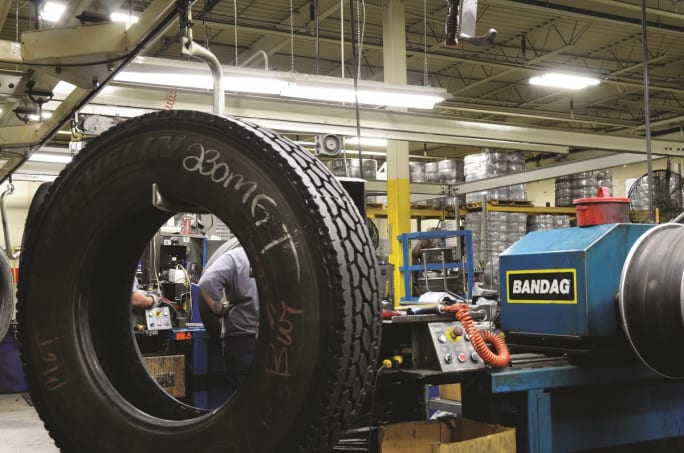
SmartWay retreads offer improved fuel efficiency through a tire’s entire lifecycle.
Turn up the pressure
Maintaining proper tire air pressure is probably the single most important maintenance activity that a fleet can do to maximize its tire investment. Under-inflation is the biggest issue in the industry. It is the number one cause of premature tire removal. Underinflated tires build up excessive heat that can result in tire destruction and/or improper vehicle handling. In addition, it can result in irregular wear and poor fuel economy.
On the other hand, over-inflated tires increase the likelihood of crown cuts, impact breaks, punctures, and shock damage resulting from the decrease of sidewall flexing and an increase in firmness of the tread surface.
So, what’s the ideal pressure?
The tire people never commit to a number, because recommended pressures per given load can change with the tire size, load rating and design. Larger tires, such as an 11R24.5, require less pressure per given load than an 11R22.5 because of the greater volume of air in the tire, and it’s the air that supports the load, not the tire.
Still, the best you can usually get from the tire folks, at least for publication, is something like, “It is key for fleets to maintain proper air pressure for their loads to take advantage of the optimized footprint for fuel economy, traction and tread life. Both under and over inflation can affect the footprint shape, causing irregular wear and premature removal. Maintain all tires at the fleet target inflation pressure based on the manufacturers’ application data book for the particular axle load.”

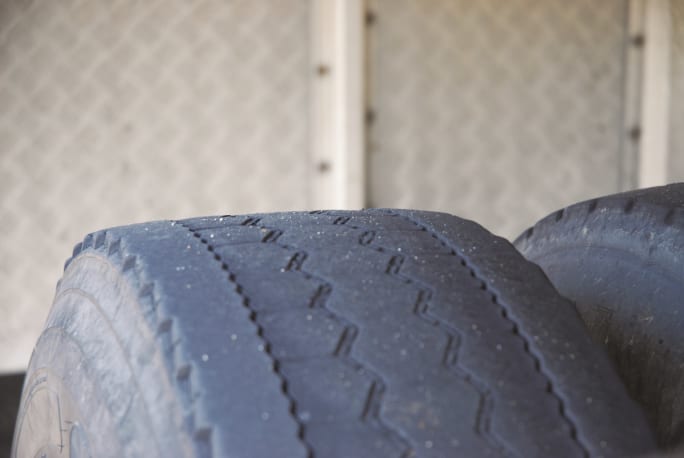
Tires are at their most efficient when the tread is shallowest – but push this too far and you risk punctures and casing damage.
When you look up the tables, however, recommended pressure can vary from a minimum of 80-85 psi up to 110 for maximum legal axle loads in drive and trailer tires. The message is really about consistency and attention. Keep a close eye on all the fleet’s chosen tire pressures and don’t be lax about it.
And of course, as you run your tires out, retreaders offer SmartWay retreads to help fleets maintain consistently good fuel efficiency through several lifecycles.
“The SmartWay program has resulted in most retread manufacturers coming up with new solutions, developing new products to meet the new standards, particularly for fleets operating in or doing business in California,” Cowart says. “Those fleets that travel into California are now required to run retreads that are SmartWay compliant, so some of this specific business has shifted to SmartWay-approved products.”
SmartWay publishes a list of new tires and retreads that are considered “verified” technology that improves vehicle fuel economy and reduces greenhouse gas emissions. To make this verified list, a tire must meet minimum rolling-resistance criteria when run on a laboratory dynamometer.
More Equipment

Is the All-New VNR Volvo's Safest Truck Ever?
The all-new Volvo VNR is jam-packed with advanced safety features. Join HDT for a first-hand look at how Volvo is keeping drivers safer and productive on the road.
Read More →
Volvo Redesigns the VNR With Drivers and Tight Turns in Mind
At Volvo’s New River Valley customer center, the all-new VNR proves that maneuverability, safety, and driver confidence can coexist in a regional-haul workhorse.
Read More →
FTR: Trailer Orders Jump in March, but Demand Still Lags
March trailer orders posted an unexpected monthly jump, but demand still trails historical norms as fleets prioritize power units over trailing equipment.
Read More →
Autonomous Start-Up Humble Announces Cabless Autonomous Electric Hauler
A new autonomous truck startup company is targeting yard, port, and short-haul freight with a lighter, fully autonomous platform designed for dock-to-dock moves.
Read More →
Top Green Fleets of 2026: Nomination Deadline Extended
Is your company a leader in sustainability efforts among trucking fleets? If so, Heavy Duty Trucking's editors want to hear from you.
Read More →
Kenworth Announces Reinforced Front Frame Option for T880 and T880S Models
Kenworth has released a factory-installed reinforced front frame option for T880 models, designed to simplify upfits, cut costs, and speed time to service.
Read More →
Stoughton Rolls Out PureBlue Reefer Trailer, Raises Safety Bar With 40-mph Rear Impact Guard
Stoughton’s new refrigerated trailer platform delivers double-digit efficiency gains while a next-generation rear impact guard exceeds current crash standards.
Read More →New Lightweight Wheel Cover Targets Simpler Aero Gains [Watch]
Watch to learn how Deflecktor's new wheel cover design is taking a simpler approach to aerodynamics, with an eye toward making it more practical for both trucks and trailers.
Read More →
How Maxiloda’s Glide System Unlocks Hidden Trailer Capacity
By turning unused vertical space into usable capacity, Maxiloda’s Glide system helps fleets move more freight per trip while reducing loading risks and equipment damage.
Read More →
Deflecktor: Hubbub Aerodynamic Wheel Cover Cost-Effective Even for Trailers
Aerodynamic wheel covers can deliver small but meaningful fuel-economy gains for fleets, and Deflecktor says its latest design aims to make the technology easier and more affordable to deploy.
Read More →









