




The Hidden Problem Behind FMCSA's ELD Revocations
NMFTA researchers say dozens of registered ELDs may be built on the same software platforms, allowing compliance and security concerns to persist even after individual devices are removed from the market.

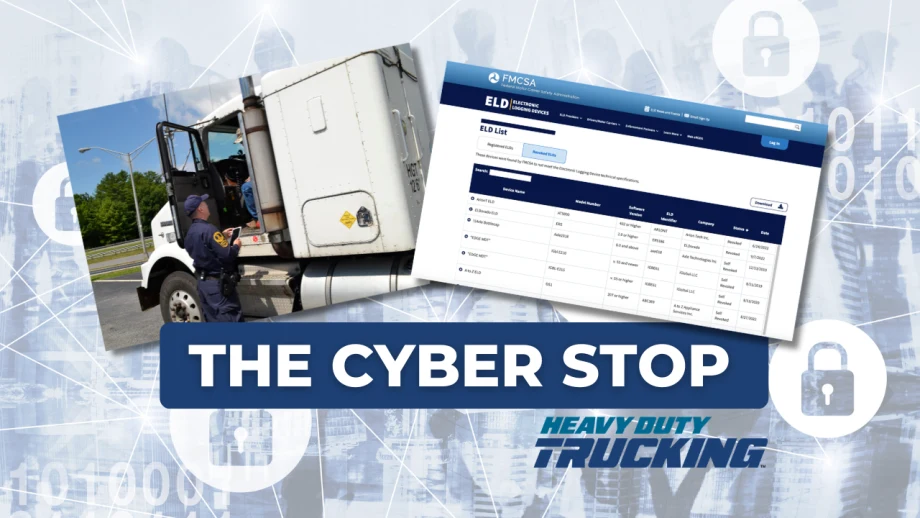
FMCSA may be pulling devices from the list, but if the underlying software lives on in dozens of related products that remain registered, the compliance and safety problem is not being solved.
HDT Graphic
- NMFTA researchers highlight that multiple registered ELDs may rely on identical software platforms.
- This shared platform usage raises ongoing compliance and security risks within the ELD ecosystem.
- Issues may persist despite individual ELD devices being removed from the market by FMCSA.
*Summarized by AI
Not all electronic logging devices are created equal. The Federal Motor Carrier Safety Administration has revoked at least 79 devices since January 2025 for failure to meet minimum federal standards.
"Safety is not optional, and neither is compliance," said FMCSA Administrator Derek Barrs.
"FMCSA is serious about removing unsafe and unreliable electronic logging devices from the market and holding manufacturers accountable to federal safety standards."
While this is a sign of a concerted effort to remove non-compliant devices from the registered list and get them out of trucks, there is an even more significant issue, according to the National Motor Freight Traffic Association: Many ELDs marketed under different brand names share the same underlying software.
FMCSA may be pulling devices from the list, but if the underlying software lives on in dozens of related products that remain registered, the compliance and safety problem is not being solved.
How Do ELDs Get on the FMCSA’s Registered List?
It helps to understand how electronic logging devices are added to the registered list in the first place.
Unlike many other safety-critical systems, ELD manufacturers are not required to submit their devices for independent third-party security testing before placing them on the market. They simply self-certify compliance with federal technical standards and register the device.
The registered list has never been a security certification.
That structural gap is precisely how non-compliant devices reached fleets at scale,
NMFTA’s Research into ELDs
The National Motor Freight Traffic Association has been conducting deep-dive research into the hardware, firmware, and software that make up many of the ELDs on the market. This research involves both reverse engineering and Open Source Intelligence (OSINT) analysis of these devices and their components.
Researchers are also examining where ELDs are manufactured and supported, as those factors may have cybersecurity implications that extend beyond basic compliance.
'Chameleon ELDs'?
ELDs run on software applications, and those applications can be identified and compared across devices.
Many of the software packages users rely on to operate these devices are shared across entire product families. Some of these device families contain more than 100 separate devices, marketed by different companies under different names, but directly sharing parts of their underlying software.
Why does that matter?
In the carrier compliance world, a “chameleon carrier” is an operation that closes up shop and re-registers under a new MC number the moment it accumulates too many safety violations or is caught engaging in fraud.
These families of ELDs operate on the same principle and can fairly be called chameleon ELDs.
If one device in the family is revoked, others can simply take its place. The single device revocation only addresses a small percentage of the ELDs that have the same safety or compliance issue.
How Bad is the ELD Software Problem?
NMFTA has shared these findings with the FMCSA and is optimistic that the situation will be taken seriously.
While it is impossible to know at this point how many devices may be impacted, there is reason to believe that chameleon ELDs will make up a notable percentage of the devices currently on the registered list.
This issue is important enough to warrant continued research and coordinated action between FMCSA, NMFTA, and other industry stakeholders.
The scale of the compliance problem these devices represent became visible in real time during the Commercial Vehicle Safety Alliance’s 2026 International Roadcheck, which ran May 12-14 with a focused emphasis on ELD tampering, falsification, and manipulation.
Final results from CVSA are still being compiled, but early enforcement data points to out-of-service rates running well above the 18.1% vehicle OOS rate recorded during the 2025 Roadcheck.
Unsafe and non-compliant ELD devices are in trucks across the industry. Devices that permit unauthorized log editing or enable drivers to exceed hours-of-service limits could create significant safety risks.
And they potentially introduce cybersecurity vulnerabilities to every fleet that deploys them.
What Should Fleets Do About This Risk?
Trucking fleets shouldn’t wait for FMCSA or CVSA to flag these issues during a roadside inspection.
Cross-reference your current ELD against the FMCSA revoked devices list regularly. If your device gets revoked, you will have limited time to source and deploy an alternative.
Verify with your provider that your device is not part of a broader product family with shared software components currently under review. If they can’t answer those questions, that should raise a caution flag.
Scrutinizing ELD Cybersecurity
NMFTA is also digging into the country of origin of these devices, including where their support is located. This can cause very real security risks when devices are manufactured or supported in countries with less strict security standards, or those with adversarial relationships with the United States.
We have seen many network devices, camera systems, drones, and other electronic devices manufactured in China placed on the Federal Communications Commission’s covered entity list due to national security concerns.
Devices deployed in the trucks making up the backbone of our nation’s supply chain deserve the same scrutiny.
More Safety & Compliance

From One Generation to the Next: How Mentorship Builds Safer Truck Drivers
After three decades in trucking, Harold Perry shares what he's learned about driver safety, mentorship, and helping the next generation build confidence behind the wheel.
Read More →
FMCSA Pauses Biennial-Update Enforcement Amid Motus Transition
Carriers whose updates were due on or after June 1 have more time, while FMCSA works to stabilize its new registration system and warns of phishing sites impersonating its new carrier registration system, Motus.
Read More →
ZF Expands Commercial Vehicle Push in North America
ZF is expanding its North American commercial-vehicle presence with new transmission applications, electrification, trailer technology and autonomous-driving systems.
Read More →
Truck Drivers Need More Than Another Alert
Fleets have more visibility into truck health, safety events, and driver activity than ever. The next challenge is turning all that information into useful guidance for the person who has to decide what to do next.
Read More →
Tesla Wants a Self-Driving Semi. Are Cameras Enough?
Could Tesla’s camera-only autonomous driving technology work on an 80,000-pound Semi? In this commentary, HDT's Deborah Lockridge takes a look at Tesla, Cybercab, and how autonomous trucks see the road.
Read More →
What DOT’s Automated Vehicle Strategy Means for Trucking
The U.S. Department of Transportation issued a new automated-vehicle strategy that outlines plans for driverless-truck regulations, cross-state freight corridors, and federal safety standards.
Read More →
NYC Expands Speed, Pedestrian Safety Tech Across Fleet
New York City is expanding intelligent speed assistance and pedestrian-alert systems across its municipal fleet, moving the technologies from pilot programs into vehicle procurement and retrofit requirements.
Read More →
FMCSA Removes 110 Truck Driver Training Schools from Certified ELDT List
Federal regulators also are targeting more than 160 additional training providers and launching a nationwide audit of third-party CDL skills testers as part of a broader crackdown on trucking fraud.
Read More →
Beyond DOT Compliance: What Makes a Trucking Fleet Truly Safe?
A trucking fleet can follow every rule and still make unsafe decisions. The real test comes when safety conflicts with freight, productivity, or cost.
Read More →
Hours of Service Pilot Programs: FMCSA Readies for 2027 Rollout
Two pilot programs could eventually reshape hours-of-service rules, giving truck drivers options to pause their 14-hour clock or use longer split sleeper rest periods.
Read More →