




Study: Cutting Methane Crucial to Future of Natural Gas Vehicles
Commercial fleets that converted from diesel to natural gas power could potentially accelerate the rate of climate change, finds one report. What is the industry doing to address the issue?
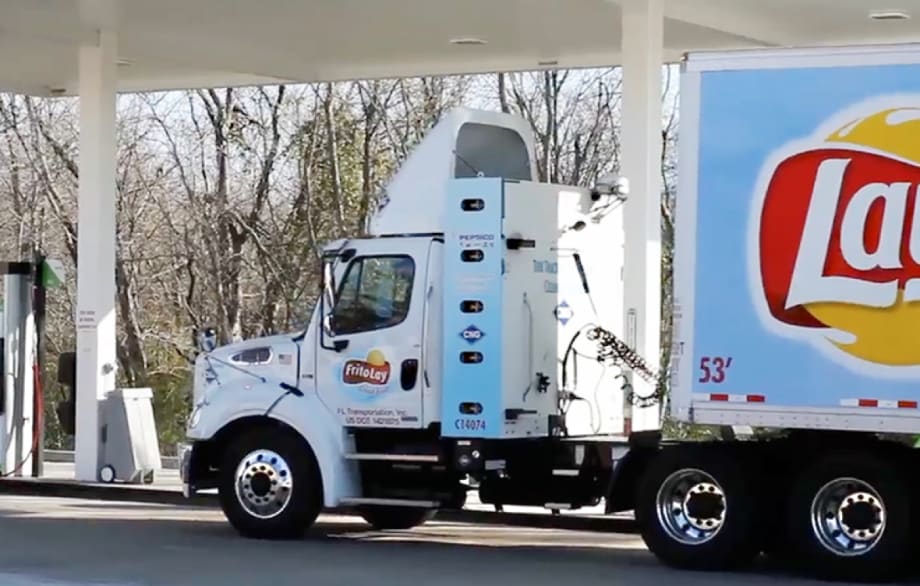
Fleets and natural-gas engine makers are already taking steps to address methane leakage. Photo: Frito-Lay
Fleets and natural-gas engine makers are already taking steps to address methane leakage.Photo: Frito-Lay
A recent study by West Virginia University’s Center for Alternative Fuels, Engines, and Emissions found significant challenges for natural gas vehicles to deliver on their promise of emissions reductions, primarily due to the amount of methane they emit.
The study, Future Methane Emissions from the Heavy-Duty Natural Gas Transportation Sector for Stasis, High, Medium, and Low Scenarios in 2035, focused on NGVs currently in production, which researchers believe could significantly populate fleets by 2035.
Drawing on data gathered from a January 2017 study, WVU researchers looked at ways to reduce emissions during the pump-to-wheel process by using operational best practices.
Methane, which is more potent than carbon dioxide (CO2), contributes to 25% of manmade climate change, according to the Environmental Defense Fund. In 2015, the Environmental Protection Agency found that 31% of methane emissions came from petroleum and natural gas systems.
While methane has a shorter lifetime in the atmosphere — 12 years compared to CO2’s 30 to 95 years — it traps more heat than CO2, according to EPA. However, lifetime in the atmosphere doesn’t mean the time after which all the methane is gone, only that 63% of the initial amount of gas has been removed. Additionally, methane’s global warming potential is 21, meaning it will trap 20 times more heat than CO2 over a 100-year period.
A 2015 study, published in Environmental Science & Technology, concluded that commercial fleets that converted from diesel to natural gas power could potentially accelerate the rate of climate change over the next 50 to 90 years before providing benefits to counteract it.
Similarly, the U.S. Energy Information Administration has reported that methane emissions grew by 27% from 1990 to 2009 due to natural gas consumption.
While methane leaks happen throughout the supply chain, the WVU study found that heavy-duty vehicles emit 79% of the total emissions compared to fueling stations. Additionally, 39% of the emissions leaked from heavy-duty vehicles occurred through the crankcase.
For fleets running older vehicles, WVU researchers said the best thing to do is to use operational best practices. The study suggested that NGV fleet operators immediately close spark-ignited crankcases and minimize manual venting of truck tanks before refueling. For fleets using newer model trucks, EPA approved spark-ignited engines with closed crankcases last year.
Fleets are already taking steps to address methane leakage, said Karen Hamberg, vice president of industry and government relations for fuel-system supplier Westport. Technological advances in vehicles, engines, and fueling stations have been explored and implemented to address methane leakage, such as closed crankcases and high-pressure direct injection natural gas engines.
“On the pump-to-wheel side, industry has advanced since even this in-use testing was done,” she said. “And so we see fleets operating those vehicles in the most environmentally sound way… it’s in their best economic interest as well to ensure those vehicles are operated to minimize any sort of fuel loss.”
Today, trade association NGVAmerica estimates that are around 165,000 NGVs on the road with 39,500 being heavy-duty vehicles and 25,800 being medium-duty vehicles.
Hamberg said that leading fleets are taking the initiative on making sure best practices are de facto standards within their operations.
“You get emissions reductions with natural gas vehicles, you get even further emission reductions when you run those vehicles on renewable methane,” she said. “It is in the best interest of those operators to ensure that vehicles are vented back to station, that we minimize any sort of unplanned venting activities, etc. And the best fleets are using all those operational best practices.”
However, the WVU study concluded that while NGVs are the biggest source of methane emissions in the heavy-duty trucking industry, to fully reap the climate benefits of NGVs, emissions must be reduced across the entire supply chain.
The EPA offers suggestions in its 2010 Managing Supply Chain Greenhouse Gas Emissions: Lessons for the Road Ahead, and even has a Supply Chain Leadership Award category as part of its Climate Leadership Awards program to recognize organizations that are leaders in reducing greenhouses gases throughout their supply chains.
Aside from monitoring their own vehicle emissions and following best practices, the EDF suggested fleet operators work with fueling station operators to ensure that they are following their own best practices, such as meeting minimum throughput standards and avoiding manual venting.
More Fuel Smarts

How Volvo Updated Its D13 for EPA 2027 [Watch]
Volvo’s updated D13 promises lower emissions without sacrificing performance or fuel economy. Take a closer look at what changed inside the engine in this HDT Spotlight video.
Read More →
Diesel Price Spike Shortens Payback for Natural Gas Trucks, Report Says
Energy Vision estimates fleets could recover the higher purchase price of an RNG-fueled Class 8 tractor in 1.3 to 2.8 years under current fuel-price scenarios.
Read More →
Calstart Becomes Catalyst Mobility, Reflecting Broader Focus
Calstart is now Catalyst Mobility, reflecting the nonprofit’s growing national role in clean transportation, including zero-emission trucks, infrastructure and incentive programs.
Read More →

Record Diesel Prices Squeeze Trucking Fleets
Average U.S. diesel prices have climbed to nearly $6 a gallon, surpassing the 2022 record as tight refinery capacity and Middle East disruptions keep fuel costs elevated.
Read More →
How Fuel Delivery Shapes Engine Performance
Fuel delivery depends on more than what happens at the injector. For fleet, maintenance and technical professionals, looking at the full path from pump to injector can provide useful context for understanding engine performance.
Read More →
East Coast Port Launches $45M Electric Truck Push
The Port Authority of New York and New Jersey announced millions in incentives for zero-emission drayage trucks, yard tractors, and new charging hubs near the port.
Read More →
California Bill Could Shed Light on Electric Truck Prices
Why do battery-electric Class 8 trucks remain so expensive? A California bill headed to Gov. Gavin Newsom would give fleets and state agencies more visibility into what manufacturers charge.
Read More →
Detroit Opens Orders for EPA 2027 Engines
Detroit isn’t starting from scratch to meet EPA 2027 diesel emissions standards. Its Gen 6 DD13 and DD15 engines keep much of today’s platform while updating the fuel and aftertreatment systems.
Read More →
Zero-Emission Truck Corridor Planned for West Coast
California, Oregon, Washington, British Columbia and Baja California are coordinating plans for truck charging and hydrogen fueling from Canada to Mexico.
Read More →
A Closer Look at Kenworth’s Electric T880E Vocational Truck [Video]
Learn more about Kenworth's T880E battery-electric vocational truck at the Paccar Technical Center, including its range, applications, upfitting considerations, and PTO options, in this HDT Spotlight video.
Read More →