




RNG: The Energy Source No One’s Talking About
While batteries and hydrogen fuel cells get headlines, renewable natural gas is quietly slashing carbon emissions for its users.
October 19, 2020

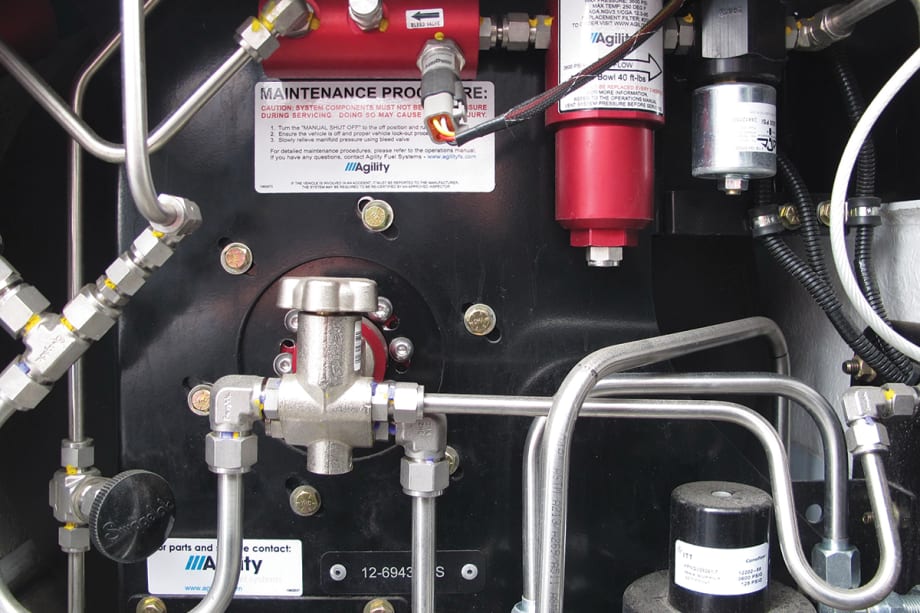
Current natural-gas-powered trucks can burn renewable natural gas.
Photo: Jim Park
7 min to read
We have a problem with methane. It’s a highly potent greenhouse gas – much more potent than carbon dioxide, the gas we’re falling all over ourselves trying to eliminate from the transportation waste stream.
The Environmental Protection Agency, the California Air Resources Board and others peg methane released by the biological decomposition of organic materials at 30 to 60 times more potent than CO2 when vented to atmosphere.
One solution is using methane to fuel vehicles. Using it as fuel also replaces other carbon-based fuels that produce their own share of hydrocarbon emissions. It’s renewable, and it’s plentiful.
Lifecycle analysis by CARB shows that organic waste-derived biomethane is the lowest-carbon commercially available transportation fuel option that exists. In fact, when made from food waste or animal manure, the fuel is “net-carbon-negative.” Measured in grams of CO2 equivalent per megajoule, with diesel and gasoline at 100, RNG from landfill sources is 50, while biogas from dairy manure is -250. This low carbon intensity makes it a very attractive alternative to carbon-intensive processes, such as electrical generation from fossil fuel, or the steam-methane reforming that is widely used to produce hydrogen for use in industrial processes and soon in fuel-cell electric vehicles.
There are some downsides, including questions about the viability of the long-term supply, suggests Hugh Donnell, Cummins Westport’s North American OEM truck business and market segment leader. “In my discussions with several government people, their impression has been that there’s just not enough renewable natural gas to be meaningful,” he says. “That would have been a viable concern six or eight years ago, but the level of awareness, and demand, has changed considerably in the past two or three years.”
Cummins Westport, of course, makes engines that burn natural gas, so you could accuse Donnell of having a bias. But he’s also well-positioned to explain how the market for renewable natural gas is developing.
Natural Gas in Name Only
Regular natural gas has some challenges in the “green” fuel category, including its fossil origins and concerns about fracking. But renewable natural gas is quite different. And, it can be used in any current natural gas engine.
Natural gas has already proven itself as a vehicle fuel. Aside from the occasional low-power complaint, it holds its own against diesel in almost every operational criterion. With suitable onboard storage, it can provide range of up to 600 miles. A fast-fill procedure nets the truck about 85% capacity in 15 minutes or so. Overnight slow-filling gets you 100%. But even at 85% full, lanes and operating radii are more than competitive.
The engines are well understood by fleets, though maintenance requirements are said to be somewhat more critical. Cummins Westport says oil drains and spark plug change intervals, for example, must be adhered to carefully. The company recently released an upgraded version of its 12L natural gas engine, the ISX12N. It boasts 400 hp and 1,450 lb-ft torque, and it’s certified 90% below EPA emission levels and CARB certified at 0.02g Near Zero NOx. Best of all, the engines burn fossil or renewable natural gas.
“The current generation 12L natural gas trucks are absolutely built for prime time, which is why we plan to add another 20 to our fleet by mid-2021,” says Vic LaRosa, CEO and president of Total Transportation Services Inc. TTSI has been hauling freight with natural gas trucks since 2008, adding more than 100 of them to its fleet over the past 12 years. “With both battery-electric and fuel cell trucks also running in our fleet, I can tell you that today’s natural gas trucks are a decade beyond the early pilot and demonstration stage of zero-emission technologies.”
TTSI is a drayage company serving several southern California port facilities with natural gas fueling facilities. Recently, Clean Energy Fuels began supplying some port facilities with 100% renewable natural gas.
Real-World Applications
Estes Express Lines recently purchased 50 RNG trucks through Clean Energy’s Zero Now program, which reduces the price of a natural gas truck to be at par with that of a diesel truck, as well as guaranteeing a fuel discount.
Mike Palmer, vice president of fleet services at the less-than-truckload carrier, says they plan to run the trucks in linehaul service as much as possible to get the maximum benefit from the fuel discount.
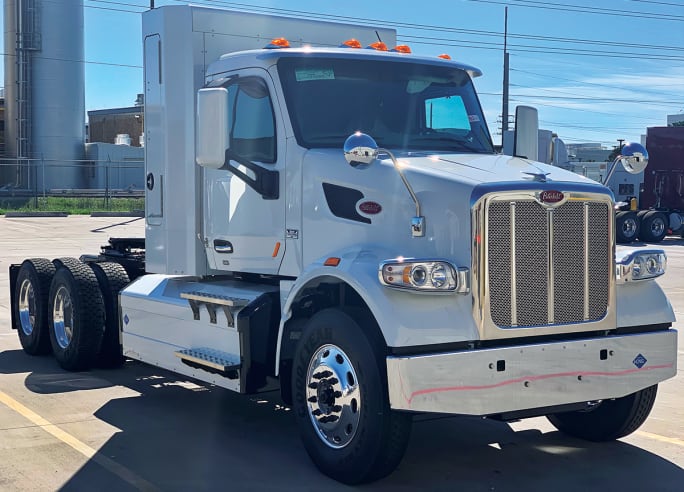
Adding a rack of fuel tanks behind the cab or in a saddle configuration adds some weight to the vehicle, but substantially less than a battery pack that delivers similar range.
Photo: Jim Park
“With the price of diesel in California, this is a much better deal for us,” he says. “It’s a triple-win for us, with the cost of the fuel, the fact that it’s zero emissions, and the tax structure on [near] diesel.”
RNG will also be used (where available) in Hyliion’s new Hypertruck Electric Range Extender (ERX) hybrid. It will use a natural gas engine strictly to power a generator that charges the vehicle’s battery pack. The drivetrain is 100% electric with no mechanical connection to the engine.
“The advantage to this is that we can run the engine in its fuel economy sweet spot to produce electricity for the motors, rather than deal with the transients you get with an engine running on flat ground and transitioning to hills and so on,” says Hyliion CEO and Founder Thomas Healy. “We can also run strictly on batteries for a significant distance. So if we were operating at a port facility or some other urban environment, we can shut off the engine and run emission-free on the batteries.”
That principal would work equally well with diesel, but the operator wouldn’t see the emissions reduction benefits (and credits) of using a low-carbon fuel like RNG.
Perhaps the best imaginable use for RNG is in the waste-hauling sector, where fleets hauling trash to landfill can literally dump a load of garbage at one side of the facility and drive around the other side and fuel up with the biomethane produced onsite.
“There’s a landfill operation near Louisville, Kentucky, that serves about 600,000 households. It’s been in operation for only two years and it’s already producing 18,000 diesel-equivalent-gallons of RNG per day,” says Donnell. “That’s 6.5 million gallons a year, and that site is permitted until 2055 at least.”
Donnell says there are about 2,000 landfills in the United States with the potential to supply biomethane for transportation and other needs. Additional capacity is readily accessible from wastewater treatment facilities and the waste produced by large-scale cattle farming.
A dairy farm operation near Cummins’ headquarters in Columbus, Indiana, produces enough biomethane in a closed-loop system to fuel its 50-truck tanker fleet with energy to spare. That spare methane runs generators to produce electricity that the farm sells back to the grid.
Of course, there’s infrastructure required to capture the gas, clean it to pipeline quality standards, distribute and store it, but that investment pales in comparison to the infrastructure required to support some electric vehicle development.
Just a Bridge Fuel?
Critics of RNG often dismiss it as a bridge fuel, something that will get us between diesel and some developing technology such as battery electric or fuel cells. Many current consumers of RNG would probably disagree. It’s here now, it works, and it’s already near-zero, in some cases sub-zero. And the technology is relatively inexpensive compared to some of the alternatives.
Where RNG fits into the grand scheme is less clear. It’s currently sitting in what the North American Council for Freight Efficiency has taken to calling the “messy middle,” where multiple low- or lower-carbon options presently exist.
NACFE Executive Director Mike Roeth sees RNG as a good short-term option, but he worries that it might interfere with the eventual roll-out of “cleaner” battery-electric technologies.
“Methane is really bad stuff, so putting to it to better use than simply venting it to atmosphere is a really good thing,” he says. “But to do that, fleets will need to install fueling infrastructure, upgrade maintenance facilities, retrain technicians and so on. What worries us a little bit is that the same companies that are now doing renewables [RNG] are probably the same ones that will be thinking about electric trucks. We worry that once they have all that natural gas stuff in place, that could push out their use of batteries, which we think are zero-emissions and a much better choice. We like RNG, but it might shorten fleets’ options for electric down the road.”
Several large national and multinational companies are currently using RNG, including Anheuser-Busch and UPS. Both are also evaluating alternatives such as battery-electric and fuel cells, but for the time being, RNG suits their sustainability and operational requirements.
If you believe that eventually a single alternative to diesel will emerge, then RNG might look like a distraction. But if you see a future where different fuels are appropriate for different regions and applications, then RNG certainly has a future.
Subscribe to Our Newsletter
More Fuel Smarts

How Volvo Updated Its D13 for EPA 2027 [Watch]
Volvo’s updated D13 promises lower emissions without sacrificing performance or fuel economy. Take a closer look at what changed inside the engine in this HDT Spotlight video.
Read More →
Diesel Price Spike Shortens Payback for Natural Gas Trucks, Report Says
Energy Vision estimates fleets could recover the higher purchase price of an RNG-fueled Class 8 tractor in 1.3 to 2.8 years under current fuel-price scenarios.
Read More →
Calstart Becomes Catalyst Mobility, Reflecting Broader Focus
Calstart is now Catalyst Mobility, reflecting the nonprofit’s growing national role in clean transportation, including zero-emission trucks, infrastructure and incentive programs.
Read More →

Record Diesel Prices Squeeze Trucking Fleets
Average U.S. diesel prices have climbed to nearly $6 a gallon, surpassing the 2022 record as tight refinery capacity and Middle East disruptions keep fuel costs elevated.
Read More →
Sponsored•September 9, 2026
How Fuel Delivery Shapes Engine Performance
Fuel delivery depends on more than what happens at the injector. For fleet, maintenance and technical professionals, looking at the full path from pump to injector can provide useful context for understanding engine performance.
Read More →
East Coast Port Launches $45M Electric Truck Push
The Port Authority of New York and New Jersey announced millions in incentives for zero-emission drayage trucks, yard tractors, and new charging hubs near the port.
Read More →
California Bill Could Shed Light on Electric Truck Prices
Why do battery-electric Class 8 trucks remain so expensive? A California bill headed to Gov. Gavin Newsom would give fleets and state agencies more visibility into what manufacturers charge.
Read More →
Detroit Opens Orders for EPA 2027 Engines
Detroit isn’t starting from scratch to meet EPA 2027 diesel emissions standards. Its Gen 6 DD13 and DD15 engines keep much of today’s platform while updating the fuel and aftertreatment systems.
Read More →
Zero-Emission Truck Corridor Planned for West Coast
California, Oregon, Washington, British Columbia and Baja California are coordinating plans for truck charging and hydrogen fueling from Canada to Mexico.
Read More →
A Closer Look at Kenworth’s Electric T880E Vocational Truck [Video]
Learn more about Kenworth's T880E battery-electric vocational truck at the Paccar Technical Center, including its range, applications, upfitting considerations, and PTO options, in this HDT Spotlight video.
Read More →