




Lawfare: The Legal War on Trucking, Part 2
In Part 2 of HDT's in-depth look at the plague of nuclear verdicts devastating the North American trucking industry, defense attorney Jennifer Akre details how unscrupulous lawyers outrage juries to get big settlements — and what you can do to protect your fleet.
December 1, 2024


Consistent policies, a strong safety narrative, and a good relationship with a trucking defense attorney are key to preventing nuclear verdicts.
Image: HDT Graphic
6 min to read
HAVE YOU BEEN INJURED BY A BIG TRUCK?
CALL THE LAW FIRM OF SQUISHY, SQUALLAS AND SQUIRMY TO GET YOUR BIG SETTLEMENT! WE FIGHT FOR YOU!
The legal war on trucking rages on.
In Part 1 of this two-part series on nuclear verdicts and trucking, Jennifer Akre, a defense attorney with the law firm of Tyson and Mendes, detailed how trucking is in the crosshairs of a sustained legal war that threatens its very existence.
Tyson and Mendes specializes in defending trucking companies in high-risk litigation cases. And Akre has defended trucking companies big and small against plaintiff attorneys out to score huge settlements for their clients.
And Akre is adamant that trucking's nuclear verdict problem is getting exponentially worse by the year.
Recently, plaintiff attorneys have moved passed trucking fleets. Increasingly, they are targeting suppliers, vehicle manufacturers and even truck OEMs.
But what, exactly, is going on here?
Why are juries returning such devastating settlements against trucking companies and manufacturers?
And what can you do to help protect your fleet -- and livelihood -- should an accident occur and a letter from an ambulance-chasing law firm appears on your desk?
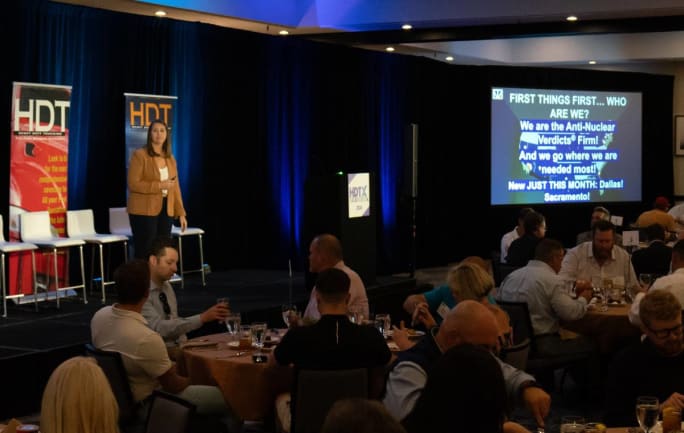
Attendees at the 2024 Heavy Duty Trucking Exchange came away buzzing about insights from trucking defense attorney Jennifer Akre.
Photo: Ross Stewart Photography for HDTX
Build a Relationship With Your Trucking Defense Attorney
Obviously, getting a good defense lawyer is critical when an accident occurs, Akre said, speaking at the Heavy Duty Trucking Exchange fleet management event in Scottsdale, Arizona, in September.
Ideally, she added, you want to have that lawyer in place before the unthinkable happens.
And Akre definitely has some thoughts on what motor carriers should – and should not – be looking for when it comes to an attorney.
“If your defense lawyer has never been to your place of business, invite them to come visit,” she said. “And if your defense lawyer has never sat down with the person who physically hired a driver involved in an accident, make that happen.
"And if your defense lawyer tries to prep a corporate representative or anyone in your company via a zoom call, run in the other direction.”
She stressed that it is critical for your fleet to have a solid, in-depth and personal relationship with your defense counsel.
Turning Over Tables is Not a Good Look in a Trucking Deposition
“It is wildly important for your defense lawyer to be intimately familiar with your people and how you will present and your temperament,” she said. “Because the plaintiff lawyer is basically going to call you a jerk who’s bad at your job. And they’re going to tell a jury that you just go around murdering people all over the country.
"And if you think that I'm exaggerating, I absolutely am not.”
Akre has been in more than one deposition where a plaintiff lawyer has accused her client of being a “murderer.”
As the defense attorney, of course, she objects and stops the deposition. But plaintiff attorneys are hoping to get a rise out of the defendant so they'll say or do something that can be used in court.
“The best thing that can happen for that plaintiff lawyer is have you lose it and flip a table over, or something like that.
"They would love that. Because they’ll have video, and they might be able to use it at trial. Because – and this is absolutely true, as well – a lot of the judges out there don’t know what the rules are and will allow it.”
Best Intentions Can Backfire When a Trucking Company is in Court
Akre gave a striking example of how even good intentions can backfire.
One year, a safety manager at a fleet she represented decided to reward its million-mile accident-free drivers by letting them skip the fleet’s annual refresher safety training with a paid day off.
“Well, of course, later that year, one of those drivers was involved in an accident,” Akre said. “He testified that he was allowed to skip the fleet safety training session. And that was the only part of that sentence that was played for the jury.
"The part where he mentioned that it was a reward for driving 1 million miles without an accident and a proven safety record of being an outstanding driver who makes good decisions was left completely out.”
Later in the trial, after battling with the judge over the statement, Akre was able to get the entire statement played for the jury. But the damage had already been done.
“The plaintiff lawyer was able to present that as a progression of events," Akre explained. "He told the jury there had been an exception for safety training. And therefore, that exception had to be the reason for the accident. And that is the narrative that was sold to the jury.”
The lesson here is to always follow through with your safety policies – no matter what.
“You cannot put a policy in place and then not follow it, even if it’s 10 levels beyond what the actual rules require,” she stressed.
“Because if you don’t follow your own policies, you will be presented to a jury as evidence that your company believed that policy was necessary to keep other people on the road safe – and then chose not to follow it.”
Countering the Anti-Truck Narrative
Trials are about telling stories. That's why Akre said it is important for fleets to have a positive story that lawyers can present to counter the ugly narrative being spun by a plaintiff attorney.
“Fleets have to work very hard to create procedures in your company that create a narrative that you care,” she stressed.
“You have to create the perception that you, and everyone at your fleet, is always doing the best job possible to make your operation as safe as possible.”
Another critical part of that narrative is to make a jury understand that they’re not dealing with a no-name, uncaring, company out to make a fast buck.
“The trucking industry as a whole needs to start telling its story,” she said. “We are an integral part of our society. What we do is incredibly important. And we want to be good stewards of our industry and community.”
If you have documented a commitment that reflects those values, Akre said that gives her – or any good defense lawyer – a story that they, in turn, can tell at trial.
"If I can tell that story at trial, and you have documented that through the years at your company, you are putting me light years ahead in the courtroom."
The nuclear verdict landscape is bleak these days. But Akre said that good, old-fashioned common sense can do a lot to dampen the outrage plaintiff attorneys will attempt to stoke in a jury.
“Plaintiff attorneys check their common sense at the courthouse door,” she said. “Because they think that every car accident should be a lottery win and that every truck accident must be the fleet’s fault – simply because a truck is a bigger vehicle.
"And they tell juries all of these things that are absolutely not true, and never present any evidence to support that narrative, because judges let them get away with it.”
Knowing that, Akre urged fleets to start considering jury anger and common sense in every aspect of their operations.
“We all have to be the grownups in the room,” she said. “And now that we know that anger is the key to a plaintiff attorney’s argument, we can start to make decisions based on countering that narrative.”
Subscribe to Our Newsletter
More Safety & Compliance

FMCSA Pauses Biennial-Update Enforcement Amid Motus Transition
Carriers whose updates were due on or after June 1 have more time, while FMCSA works to stabilize its new registration system and warns of phishing sites impersonating its new carrier registration system, Motus.
Read More →
ZF Expands Commercial Vehicle Push in North America
ZF is expanding its North American commercial-vehicle presence with new transmission applications, electrification, trailer technology and autonomous-driving systems.
Read More →
Truck Drivers Need More Than Another Alert
Fleets have more visibility into truck health, safety events, and driver activity than ever. The next challenge is turning all that information into useful guidance for the person who has to decide what to do next.
Read More →
Tesla Wants a Self-Driving Semi. Are Cameras Enough?
Could Tesla’s camera-only autonomous driving technology work on an 80,000-pound Semi? In this commentary, HDT's Deborah Lockridge takes a look at Tesla, Cybercab, and how autonomous trucks see the road.
Read More →
What DOT’s Automated Vehicle Strategy Means for Trucking
The U.S. Department of Transportation issued a new automated-vehicle strategy that outlines plans for driverless-truck regulations, cross-state freight corridors, and federal safety standards.
Read More →
NYC Expands Speed, Pedestrian Safety Tech Across Fleet
New York City is expanding intelligent speed assistance and pedestrian-alert systems across its municipal fleet, moving the technologies from pilot programs into vehicle procurement and retrofit requirements.
Read More →
FMCSA Removes 110 Truck Driver Training Schools from Certified ELDT List
Federal regulators also are targeting more than 160 additional training providers and launching a nationwide audit of third-party CDL skills testers as part of a broader crackdown on trucking fraud.
Read More →
Beyond DOT Compliance: What Makes a Trucking Fleet Truly Safe?
A trucking fleet can follow every rule and still make unsafe decisions. The real test comes when safety conflicts with freight, productivity, or cost.
Read More →
Hours of Service Pilot Programs: FMCSA Readies for 2027 Rollout
Two pilot programs could eventually reshape hours-of-service rules, giving truck drivers options to pause their 14-hour clock or use longer split sleeper rest periods.
Read More →
New Guide Offers Pet Safety Tips for Truck Drivers
Hundreds of thousands of pets travel in truck cabs. A new safety guide from Volvo Trucks and the Center for Pet Safety offers practical advice for truck drivers who bring dogs and cats along for the ride.
Read More →