




Hot Laps in Texas with the Peterbilt Model 579EV
Peterbilt’s careful, considered development of electric vehicles has led to the quick, nimble and capable Model 579EV, as Jack Roberts discovered recently behind the wheel of this battery-electric truck.

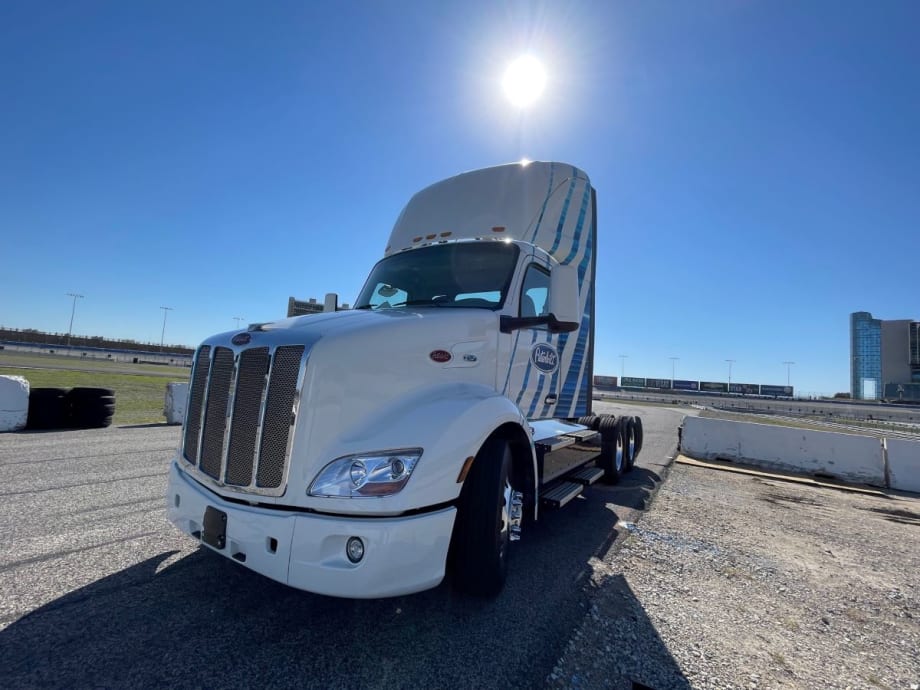
A Peterbilt Model 579EV waits to head out on a road course at the Texas Motor Speedway during a customer event.
Photo: Jack Roberts
Peterbilt electric vehicles are ready to roll, and I got the chance to drive one at a Peterbilt customer event in Denton, Texas, in early November.
It was a gleaming white, serial-production Peterbilt Model 579EV battery-electric truck, and I was able to take the truck around a road course at the Texas Motor Speedway for a few hot laps.
I first drove a pre-production model of this truck at the Paccar Innovation Center in Sunnyvale, California, in 2018. This was an early take on Peterbilt’s EV philosophy. That early version used a conventional Eaton automated transmission mated to a Dana electric powertrain. At the time, the Paccar engineers at Sunnyvale told me this was an arrangement that optimized the torque from the two sequenced electric motors powering the truck while saving space and weight.
It was an interesting concept, but one that Peterbilt eventually shelved, as I saw for myself at the Texas Motor Speedway.
Another early Peterbilt EV drive was at the Technology & Maintenance Council's 2019 annual meeting. I was behind the wheel of a Peterbilt Model 220EV in heavy, hilly, Atlanta rush hour traffic when I realized that, outside of range and weight limitations, an electric truck was just a truck. It's a commercial vehicle fully capable of doing anything a gas- or diesel-powered vehicle can do.
These experiences with Peterbilt EVs were crucial in helping me understand this technology when it was brand new.
They also illustrate how meticulous Peterbilt has been in developing its electric truck models. The company's engineers have tried different powertrain and transmission combinations. But their eyes have always been firmly locked on customer expectations.
Fast Acceleration, Empty or Loaded
During the presentations at the customer event, I picked up a bit of an odd detail that intrigued me: Peterbilt engineers and product managers kept referring to the Model 579EV as an “electric vehicle,” instead of an “electric truck.” Given that Peterbilt is about as focused and committed a commercial truck OEM as you’ll find anywhere on the planet, I wanted to know why that was the case.
“The term ‘EV,' short for ‘electric vehicle,' is universally understood to mean a plug-in, battery-powered vehicle,” explained Patrick Wallace, marketing manager, electric vehicles. “Of course, all of our electric vehicles are commercial trucks. But we want customers to know immediately when reading or hearing the model name, such as 579EV, that this is the fully electric version of our model 579.”
Fair enough. With that minor point cleared up, it was time to take the latest version of the Model 579EV out for a few quick laps.
Unfortunately, the truck was bobtail. But the truck I’d driven in California back in ’18 was pulling a loaded trailer. So, I was already familiar with how the truck performs with a load of cargo behind it.
The funny thing about electric trucks is that there’s not a whole lot of difference in how they perform in terms of acceleration and braking, whether they are loaded or not. That’s because their electric drivetrains and regenerative braking systems are so efficient at providing instantaneous torque to the drive wheels.
In fact, a key enabler for electric trucks was developing sophisticated energy management systems to manage all that torque. Without those onboard electronic control modules metering out all that power, you could put an electric truck accelerator pedal to the floorboard at a full stop and burn up your drive tires in a burnout that would make professional drag racers green with envy.
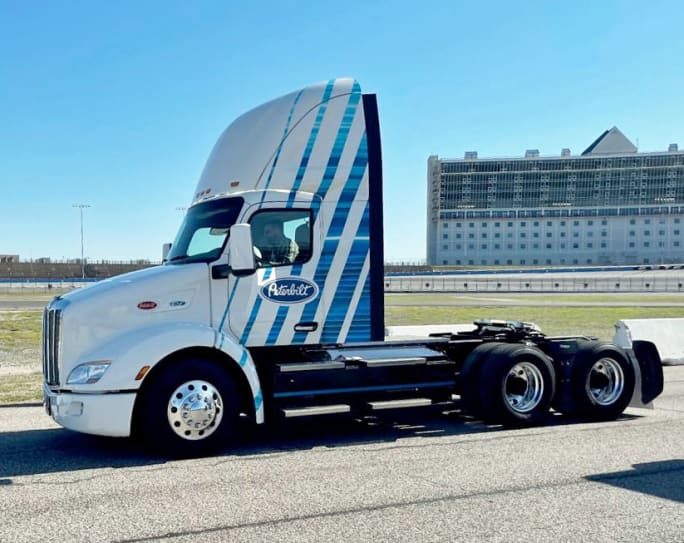
The Peterbilt Model 579EV was bobtail — but it really doesn't matter, since electric trucks perform about the same with or without a load behind them.
Photo: Jack Roberts
Behind the Wheel of the Peterbilt 579EV
Climbing up in the cab, you’re confronted with a pretty standard Model 579 interior. The main difference is the EV-specific cluster in front of the driver. Featuring brightly lit and color-coded digital graphics, this display gives the driver all the information they need to safely operate the truck at a glance.
I did have to deal with an electronic gremlin before I could get out on the track, though.
Electric trucks don’t really “start” the way a diesel truck does. You just switch them “on.” But when I turned the key to the right, the instrument cluster lit up as expected, but that was about all. The truck didn’t want to go.
One of Peterbilt's engineers eventually managed to reset the system, and we were soon good to go.
I don't think this reflects any production or design deficiencies with the truck. It's not unusual in a pre-production specimen to find something amiss. It's happened a number of times over my years of test-driving diesel trucks, too. But it begs the question, what's a driver to do under a hot load when the truck fails to launch?
Well, basically, the same as drivers do now with cantankerous diesels: Call it in and go for coffee. Nothing new here, except a different problem with a different solution.
The engineers will learn from it, and that learning will carry forward with subsequent software updates.
One-Pedal Control
The other difference between this truck and a diesel-powered Model 579 is that the right-hand control stalk coming off of the steering column controls the truck’s regenerative braking system instead of an exhaust engine brake. Just like a diesel truck, there are three settings that let the driver determine how aggressively they want the regenerative brakes to engage. Which, of course, also determines how much captured kinetic energy gets fed back into the truck’s batteries.
That brings up another interesting difference between electric trucks and diesel-powered ones. With the regenerative braking system fully engaged, you tend to find yourself driving the truck with the accelerator pedal only. Rarely do you engage the truck’s service brakes. Usually, that’s only necessary when coming to a complete stop at a traffic light or stop sign. The rest of the time, you tend to simply feather the accelerator pedal in conjunction with the regenerative brakes to slow the truck down.
It takes a little time to master this technique. The regenerative braking system can be surprisingly aggressive when you take your foot completely off of the accelerator. But, with just a little practice, smoothly accelerating and decelerating the truck using only one pedal quickly becomes second nature.
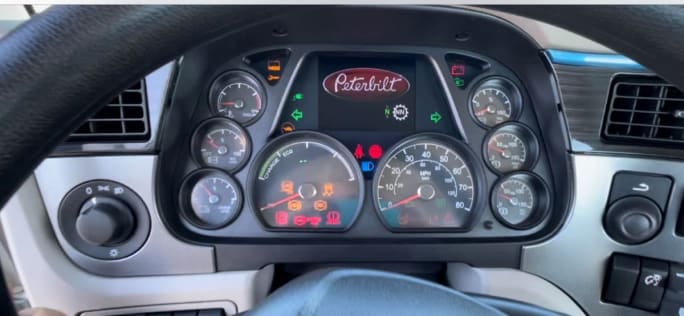
The main difference inside the cab of the Model 579EV is the brightly lit, colorful, EV-specific instrucment cluster.
Photo: Jack Roberts
On the road course inside the oval at the Texas Motor Speedway, the Model 579EV greased through the hairpin turns with ease. As noted, electric trucks don’t dilly-dally when you hit the throttle. If you haven’t driven an electric truck yet, prepare to be surprised at the amount of power instantly coming from the drivetrain. Then there's the fact that there is virtually no noise accompanying all that power, aside from a quiet, golfcart-like whine coming from somewhere under the floorboard.
The truck’s handling is superb. Views from the cab are outstanding.
In short, the Model 579EV offers everything you appreciate about the Model 579 — without a noisy diesel engine roaring away in front of you.
That’s a pretty apt summation of Peterbilt’s approach to electric trucks: All the performance, capability, and comfort you expect from Peterbilt in a quiet, smooth, and surprisingly quick package.
It's been said many times that electric trucks aren’t for every fleet out there. But trucks like the Model 579EV have been convinced that fleets that do put them to work will not be disappointed in how they perform out on the road and in the real world.
More Fuel Smarts

How Volvo Updated Its D13 for EPA 2027 [Watch]
Volvo’s updated D13 promises lower emissions without sacrificing performance or fuel economy. Take a closer look at what changed inside the engine in this HDT Spotlight video.
Read More →
Diesel Price Spike Shortens Payback for Natural Gas Trucks, Report Says
Energy Vision estimates fleets could recover the higher purchase price of an RNG-fueled Class 8 tractor in 1.3 to 2.8 years under current fuel-price scenarios.
Read More →
Calstart Becomes Catalyst Mobility, Reflecting Broader Focus
Calstart is now Catalyst Mobility, reflecting the nonprofit’s growing national role in clean transportation, including zero-emission trucks, infrastructure and incentive programs.
Read More →

Record Diesel Prices Squeeze Trucking Fleets
Average U.S. diesel prices have climbed to nearly $6 a gallon, surpassing the 2022 record as tight refinery capacity and Middle East disruptions keep fuel costs elevated.
Read More →
How Fuel Delivery Shapes Engine Performance
Fuel delivery depends on more than what happens at the injector. For fleet, maintenance and technical professionals, looking at the full path from pump to injector can provide useful context for understanding engine performance.
Read More →
East Coast Port Launches $45M Electric Truck Push
The Port Authority of New York and New Jersey announced millions in incentives for zero-emission drayage trucks, yard tractors, and new charging hubs near the port.
Read More →
California Bill Could Shed Light on Electric Truck Prices
Why do battery-electric Class 8 trucks remain so expensive? A California bill headed to Gov. Gavin Newsom would give fleets and state agencies more visibility into what manufacturers charge.
Read More →
Detroit Opens Orders for EPA 2027 Engines
Detroit isn’t starting from scratch to meet EPA 2027 diesel emissions standards. Its Gen 6 DD13 and DD15 engines keep much of today’s platform while updating the fuel and aftertreatment systems.
Read More →
Zero-Emission Truck Corridor Planned for West Coast
California, Oregon, Washington, British Columbia and Baja California are coordinating plans for truck charging and hydrogen fueling from Canada to Mexico.
Read More →
A Closer Look at Kenworth’s Electric T880E Vocational Truck [Video]
Learn more about Kenworth's T880E battery-electric vocational truck at the Paccar Technical Center, including its range, applications, upfitting considerations, and PTO options, in this HDT Spotlight video.
Read More →