




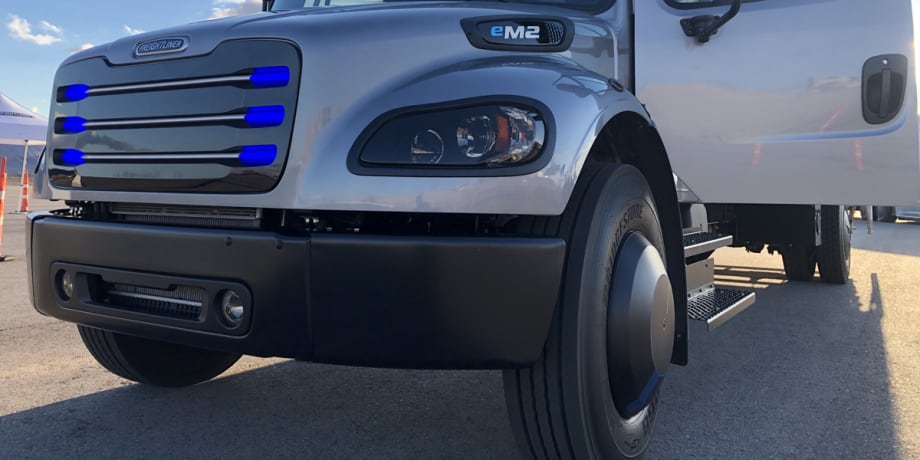
The operating characteristics of electric drivetrains, coupled with heavy battery loads, will change the way tires for electric trucks are built. In addition to providing good traction, low rolling resistance and long miles to removal, drive tires for battery-electric trucks will need to withstand higher torque loads, while steer tires will be subject to higher vertical loads than traditional tires.
What Will Electrification Mean for Truck Tires?
Tire designs for electric trucks will need to account for greater stresses from weight and torque — but they will need to remain interchangeable with existing tires and be retreadable.

Traditional tire designs will need to change to accommodate the impact of electric drivetrains. Increased vehicle weights and higher bi-directional torque loads will force tire makers to rethink tire design and construction with a focus on reducing rolling resistance.
Photo: Jim Park
Those operational factors will apply not only to heavy-duty Class 8 trucks, but also to lighter Class 5 and 6 delivery vehicles. The tare weights of the vehicles will increase, probably compromising payloads slightly. It will also tighten the margin on load carry capacity for some tires, particularly steer tires (see sidebar at the end of the story).
Torque loads on drive tires will increase not only thanks to the higher output of electric motors compared to internal combustion engines, but also because regenerative braking will impart torsional forces on tires in the opposite direction. This will affect tire tread wear as well as sidewalls. And it will be more of a consideration in high stop-and-go applications — the exact type of local delivery operations that many see as one of the best applications for electric vehicles.
“Higher torque on the drive axle will result in higher wear rate,” says Hinnerk Kaiser, Continental’s head of product development. “In addition, a higher share of braking torque can increase the risk of irregular wear phenomena — heel and toe wear. Both criteria are key performance factors for drive tire development anyway, but we have to set a higher focus for electric trucks. This can lead to an adapted pattern and contour layout, such as groove design, void distribution, tread pattern depths, etc.”
We may also have to rethink directionality in drive tires. Aside from being logistically annoying (getting the right tire going in the right direction during installation), such tires were designed to handle torque from only one direction.
“When they design directional tires, they don’t look at brake torques,” says Mahesh Kavaturu, Goodyear’s commercial technology director. “It’s not a constant feature, but regenerative braking will produce more sustained brake torques.”
Minimize Wear, Improve Performance
While truck makers and driveline engineers will come up with ways of managing or mitigating torque at launch, the additional brake torque due to constant regenerative braking will put additional energy to the tire, manifesting itself as tread wear.
“That’s where we really have to innovate,” says Goodyear’s Kavaturu. “We are focused on bringing new reinforcement materials like silica [and] carbon black, as well as new steel reinforcements to our tires, to ensure that in the face of all those additional demands, we can maintain tread wear to the degree experienced by ICE vehicles.”
While fleets operating electric vehicles may tolerate shorter tread life or higher degrees of irregular wear during the development phase, they will expect those issues to be sorted out in the near term. But fleets and truck makers will also be looking for even lower rolling resistance to prolong battery life.
“While rolling resistance is a factor for diesel-powered vehicles for fuel efficiency, for electric trucks it relates to the range of miles the vehicle can travel before it needs to be recharged,” explains Mike Steiner, Michelin field engineer. “Rolling resistance may take on an even higher level of importance in order to meet the range needs of the fleets operating the electric trucks.”

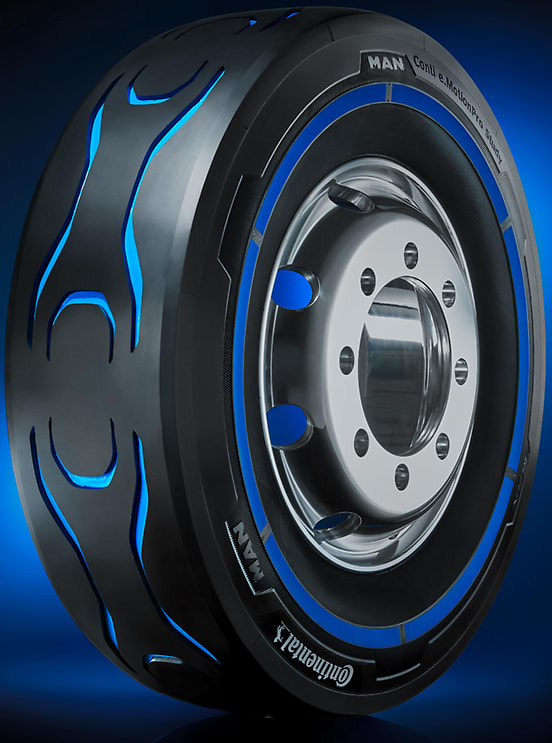
Continental presented this hand-made prototype tire for electric trucks at the Frankfurt Motor Show in 2018. In line with the “tall-and-narrow” concept, wherever practical, tires with a large diameter can help to keep rolling resistance down.
Photo: Continental
The quest for lower rolling resistance could take us into hitherto unknown territory. In testing at its research and development facilities in Europe, Continental has been experimenting with “tall and narrow” tires to reduce rolling resistance. A hand-built prototype 205/65R22 tire has already proven successful in improving rolling resistance, but the size is not something we’re likely to adopt readily here in North America.
“That particular size was chosen based on preferences from [European truck maker] MAN for their concept electric vehicle,” a Continental spokesperson told HDT. “So far, OEMs have not indicated that this tire size will be used on serial production vehicles. However, we do anticipate that tall and narrow tires will become more popular on electric trucks. Tires with a large diameter can help keep rolling resistance down on account of their size alone, amplifying the effects of tread compounding and other initiatives.”
Repositioning and retreading
While we are still in early days of development of tires for electric trucks, there’s no need to begin fretting about repositioning those tires to trailer positions or even about retreadability. They will both obviously be design considerations. Goodyear’s Kavaturu indicated that maintaining traditional tire sizing is of paramount importance.
That said, if, as Goodyear suggests, steer tires migrate out from 11-inch tread widths to 12 or 12.5 inches, there will be mixing concerns, which might limit repositioning and ultimately the value in retreading such tires. The same goes for tall and narrow tires, should they find their way into service here.
Today we enjoy all-position exchangeability, where any tire can be repurposed, repositioned and retreaded. If we wind up with short, fat steer tires and tall, narrow drive tires, one wonders what will become of the traditional feedstock for trailer tires. But it’s probably a bit too early to worry about that.
More Equipment

SAF-Holland Introduces SmartSto System for Safer Tractor-Trailer Uncoupling
The system combines a fifth-wheel air release with stowage for air and electrical connections, helping prevent damage and reducing driver injury risk.
Read More →
SAF-Holland’s BrakeSight Aims to Take the Guesswork Out of Air Disc Brake Maintenance
New Haldex sensor technology from SAF-Holland integrates with telematics systems to give fleets continuous insight into air disc brake condition.
Read More →
Vanair Introduces Solar, Battery Power Ecosystem for Class 8 Trucks
The company’s expanded EPEQ ecosystem includes flexible solar panels, lithium batteries, hydraulic power systems, and a portable fast charger for electric trucks.
Read More →
Phillips Connect Expands Smart Trailer Platform with New Safety, Cargo and Equipment Intelligence
Phillips Connect Smart Trailer enhancements give fleets deeper operational insights from trailers -- even when another provider supplies basic GPS tracking.
Read More →
Accuride Unveils ProShield XGT Aluminum Wheel Coating at TMC
Accuride’s patent-pending surface-coating technology targets filiform corrosion and promises easier cleaning, longer-lasting gloss, and greater durability for aluminum truck wheels.
Read More →
Valvoline, Cummins Extend X15 Oil Drain Intervals to 100,000 Miles
New approval for Valvoline Premium Blue One Solution Gen2 allows fleets running Cummins X15 engines to extend oil drain intervals by up to 25,000 miles -- reaching intervals as high as 100,000 miles.
Read More →
A New Approach to Lighting Reliability
Peterson’s Genesis lighting system and repairable J560 connector target two persistent fleet problems: LED light failures and costly electrical connector downtime.
Read More →
The Hidden Cost of Delaying Truck Replacement
Many fleets extended truck replacement cycles during recent market disruptions. But holding equipment too long can lead to higher repair costs, longer downtime, and new operational risks.
Read More →
Mack Unveils CommandView Safety and Productivity System for Granite
Mack Trucks’ CommandView is a new suite of integrated onboard technologies designed to enhance jobsite safety, improve operational efficiency for fleet operators.
Read More →
Daimler Adds Cummins Engines to 2027 Powertrain Lineup
Freightliner and Western Star models will offer a broader mix of gasoline, diesel and natural gas engines designed to meet EPA 2027 emissions standards.
Read More →









