




HDT Emerging Leader: Driving Change One Truck at a Time
A monster storm turned IMF Vice President Chris Grato into an advocate for intermodal and electric trucks.

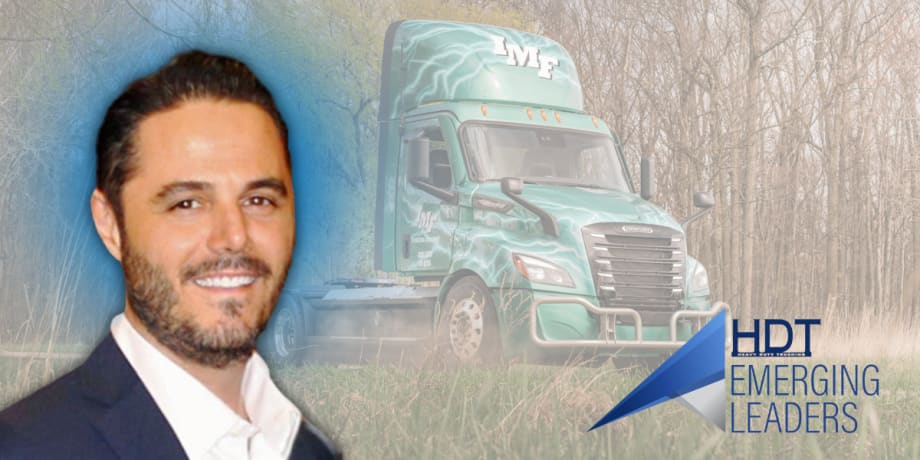
Chris Grato’s leadership philosophy is built on mutual respect and high expectations.
Image: HDT Graphic
When Superstorm Sandy struck New Jersey on October 29, 2012, it could easily have been the end of the road for port drayage provider International Motor Freight. Twelve years later, IMF vice president and HDT Emerging Leader Chris Grato remembers it as a defining moment.
The storm swept ashore with heavy rains, 80-mph sustained winds and a record-breaking storm surge. More than 80 people were killed. At Port Newark, Intermodal containers were toppled, and the family-owned business saw its trucking fleet nearly wiped out.
“I think the port was closed at midnight on that Sunday with no access,” he recalls. “No one was anticipating a storm surge.”
10 Trucks Survived
The company had spread the fleet out in different parts of the 7-acre facility trying to reduce the number of trucks that might be affected.
“I think we got a storm surge of almost 8 feet.”
Only 10 trucks survived out of a 90-truck fleet.
“We had loads in the yard, customers waiting for their freight,” he says.
During the week following the storm, the port was closed. IMF managed to get enough rental trucks to continue operations once the port reopened, but the next six months were a whirlwind of rebuilding.
“That was just around-the-clock mayhem,” he says, powered by adrenaline.
Grato is proud of how his company bounced back.
“If we didn’t take pride in what we do, I don’t think we would have continued,” he says. “I wouldn't be talking to you today, if they weren't filled with as much passion as we were.”
The Family Business
Grato joined IMF after graduating college in 2008, working with his father, uncles, and cousins.
“I was down here from when I was a baby,” he says. “We've been in the same port location for 40 years, and I just got addicted to it.”
He takes pride in the vital role his company and the rest of the trucking industry play in putting goods on the shelves.
“It's been this infatuation to be better every day,” he says. “That's really why I am where I am, where we are, this self-drive, this pride.”
IMF handles import and export freight out of the Port of Newark and the Port of Philadelphia. New Jersey is its primary focus, with a few customers in eastern Pennsylvania and Maryland.
“Big box, but boutique service,” is how Grato describes what IMF does. There are a little over 100 trucks in the day cab operation, running to and from the port and to customers’ distribution centers.
“We're really local,” he says. “We are home at night, multiple runs a day.”
Grato is responsible for drivers, safety, and for the 7-acre facility, as well as handling insurance for the company. And, in a down importing year, he’s been working on sales as well.
Electric Trucks
In addition to the company’s response to Sandy, the other big thing he’s proud of is the company’s adoption of battery-electric trucks.
“That's been years and years of grant research, and that's been much of my time.”
Currently IMF has four heavy-duty EVs in limited deployment, and it’s working on building the charging infrastructure that will allow it to expand to 10 electric trucks.
The seed of the EV venture goes back to a spur-of-the-moment conversation Grato had with someone at a truck conference, who predicted it would be a number of years before the East Coast saw electric trucks.
He took that as something of a challenge.
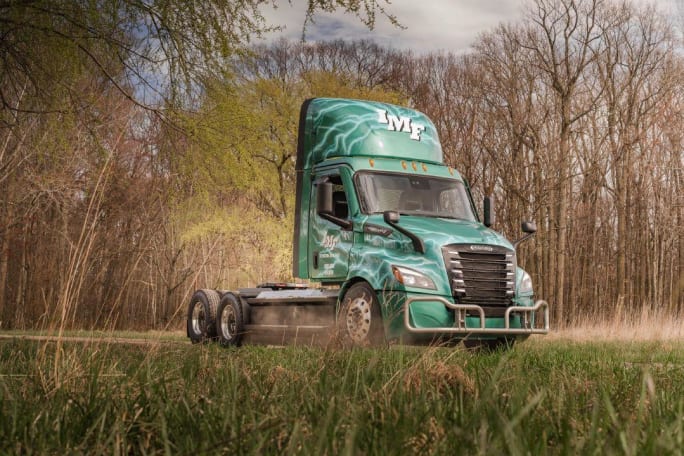
Currently, IMF has four electric trucks working in limited deployments.
Photo: IMF
IMF has a big customer known for its aggressive sustainability goals, which “really forced us to be green and be ahead of the curve,” Grato says.
“They've always challenged us for the last decade to have the best equipment.”
In 2019, he says, IMF talked to its OEM about trying an electric truck in a project for this customer.
And a challenge it has been, he says. IMF had one of the first electric trucks on the East Coast. Working with the utility on the charging infrastructure and applying for grant programs has been frustrating at times.
“It’s like every time you get to the one-yard line of grant money to pay for these things, there's another problem,” he says.
“It's almost like being picked for grade school dodgeball. You have to have the best project, and if they don't like one piece of it, you don't get the grant money.”
There are Buy America provisions to meet, being forced to revamp proposals in a limited time frame, and byzantine bureaucracy to navigate.
“One legislative branch in New Jersey, they're eager to get the grant going, but we don't have the infrastructure because of another department of New Jersey,” he says. “They don't speak to each other. It's a competition of who's going to be first on the block, literally first on the block to get the power.”
Being the little guy on the block isn’t easy.
“But you have to keep going and keep going and keep going. And somehow, we are where we are today, and it's progressing.”
A few other customers are interested, as well, Grato says, and some are talking about hydrogen-powered trucks.
Others, however, “just want their box delivered timely where it’s supposed to go.”
Intermodal Leader
Grato’s leadership philosophy is built on mutual respect and high expectations. He prioritizes clear communication and trust with his team. He leads by setting high standards and respecting his employees and expects the same in return.
“Being an owner’s son, you can lose a lot of respect quickly,” he says. “I expect you to respect me, and I will respect you back. It’s a two-way street.”
“I don't yell...I just have high expectations, like there was expectations of me.”
Grato was nominated by Lisa Yakom, president of the Association of Bi-State Motor Carriers, who called him “a tireless advocate for the intermodal transportation community.”
He has donated his time and energy for over 10 years serving as a member of the Bi-State Executive Board, she said — the youngest to hold that distinction.
As someone who grew up in the business, he works to foster relationships and ensure continuity within the industry.
He’s troubled by the fact that most of the smaller motor carriers, their leaders are generally older. Grato says there’s only a handful of younger leaders like himself who have enough experience to step up and take on leadership in the local intermodal trucking industry.
“The respect isn’t just handed to us by the terminals or the customers,” he says. “We had to earn it. So we’d better do something with it.”
Future Growth
Asked about future goals, Grato says it’s important to keep offering IMF’s boutique service.
“We’re not a Walmart,” he explains. “We’re that shop downtown that offers one-on-one service. It’s worked for our parents, it’s working for us, and we really respect it.”
There’s a reluctance to expand too much for fear of losing that level of personal service.
“We don't want to break what is working. But I think every day we wake up [wanting] to be better than our parents. We want to move more freight than them. We want to do it more efficiently. And we want more customers. We want to make them proud.
“That's where we think we'll be in in 30 years — more trucks, but the same physical footprint — doing a better job because [our parents] gave us more opportunities to be better.”
More Fleet Management

Color Match Smarter: Tools That Restore & Perform
For fleet managers and collision repair professionals keeping heavy-duty trucks on the road, getting the color right the first time isn't just about appearance — it's about efficiency, turnaround time, and bottom-line results. Discover how today's digital color tools are transforming the repair process from guesswork to precision.
Read More →
FMCSA Pauses Biennial-Update Enforcement Amid Motus Transition
Carriers whose updates were due on or after June 1 have more time, while FMCSA works to stabilize its new registration system and warns of phishing sites impersonating its new carrier registration system, Motus.
Read More →
2026 Blueprint for Countering Smarter Supply Chain Theft
Cargo theft is no longer just the cost of doing business. It's a multi-billion-dollar criminal enterprise exploiting vulnerabilities across your fleet, drivers, and supply chain.
Read More →


How Telematics Improves Visibility, Control, and Performance in Refrigerated Fleets
Explore how telematics help refrigerated fleets improve visibility, uptime, efficiency, compliance, and cargo protection across connected cold chain operations.
Read More →
What the U.S.-Canada Trade War Means for Trucking
Escalating U.S.-Canada tariffs could disrupt cross-border freight, reduce truck volumes, raise costs, and create new uncertainty for carriers on both sides of the border.
Read More →
What Are Trucking’s Top Concerns for 2026?
The American Transportation Research Institute wants to know what's worrying trucking fleet managers, drivers, and other stakeholders in its annual Industry Issues survey.
Read More →
American Trucking Associations Looks for a New Leader
ATA President and CEO Chris Spear abruptly left his job at the association on August 21, at a pivotal time for the trucking industry.
Read More →
Public Wi-Fi Cybersecurity Risks: How Truck Drivers and Fleets Can Protect Their Data
Public Wi-Fi can expose truck drivers and fleets to credential theft, malware, and other cyber threats. Here’s how to reduce the risk on the road.
Read More →
For Nicky Cupp, Fleet Innovation Starts With Frustration
HDT Truck Fleet Innovator Nicky Cupp turns everyday pain points at Fraley & Schilling into opportunities for better technology and smarter processes.
Read More →
Adam Buttgenbach’s Approach to Electric Trucks: Start With Where They Fit
HDT Truck Fleet Innovator Adam Buttgenbach helped PepsiCo build one of North America’s largest EV fleets by focusing on where electric trucks make operational sense.
Read More →