




Getting Your Cooling System Ready for Winter
As temperatures dip and the leaves change from green to yellow and red, it’s time to think about winterizing your trucks for the siege ahead.

Jim Park
Photos: Jim Park
You can almost hear the cooling systems of the nation heaving a sigh of relief as the hot summer weather abates in most parts of the country. But don’t kid yourself – winter isn’t any easier on the cooling system. As temperatures dip and the leaves change from green to yellow and red, it’s time to think about winterizing your trucks for the siege ahead.
As a resource for cooling system maintenance, the American Trucking Associations’ Technology and Maintenance Council offers Recommended Practice 313 C. You won’t go wrong following these guidelines.
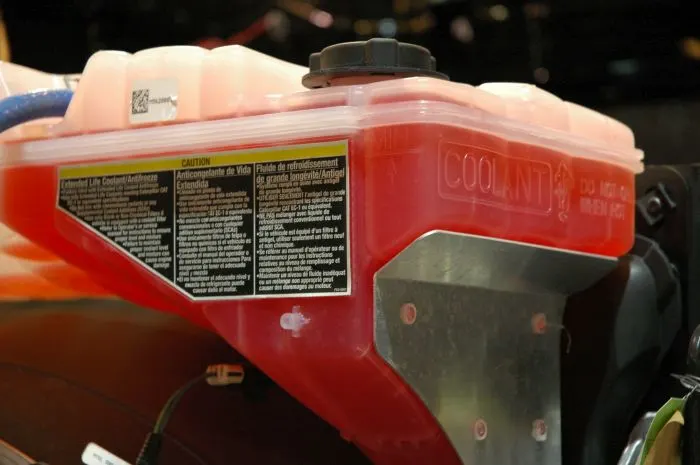
Of primary importance this time of the year is the coolant mixture. You need adequate freeze protection, especially in the north where ambient temperatures of 10 or 20 below zero are common for several months.
If the trucks stay in the South, you can get away with a leaner mixture, but you have to consider the likelihood of them straying north. The standard recommendation is a 40%-60% coolant-to-water blend, which will provide freeze protection down to minus 10 to minus 60 degrees.
TMC’s RP 313C cautions that any coolant blend of 60% or more could cause the fluid to thicken at very low temperatures, reducing cooling system performance. A 50/50 mix will protect the system from freezing down to 34 degrees below zero.
That RP recommends using an optical refractometer to check the coolant/water ratio rather than a hydrometer because of its accuracy, speed and simplicity.
That’s the easy part. Sorting out which type of coolant the truck is using could be tricky, and have more serious implications if you get it wrong. It used to be easy when all we had was the traditional low-silicate coolants, says Peter Woyciesjes, worldwide RD&E manager, coolants, for Prestone Products Corp.
“Today we have several types of coolant in common use in heavy-duty diesel engines,” he says. “They are commonly differentiated by color, but that’s not always a reliable guide. There are companies that differentiate their product types by color. Unfortunately there are some manufacturers that will use three different colors for the same fluid or technology. That can create problems.”
Getting the Wrong Coolant
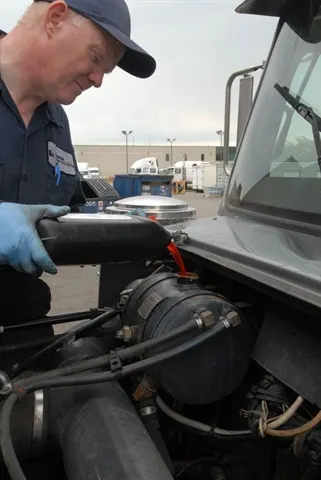
Check when adding top-off fluid that it’s compatible with what’s in the engine. Color isn’t always a reliable guide.
Jim Park
Woyciesjes says mixing two different types of coolant should be avoided, but notes that a mix isn’t the end of the world.
“If you inadvertently mix red organic acid coolant and green conventional coolants, you won’t have any problems in terms of the key parameters – specifically its heat transfer properties,” he says.
“The product will still cool the engine and you’ll have your freeze and boil-over protection. However, you’re now starting to mix chemistries, and you won’t get optimum performance from the coolant.”
TMC and most of the coolant manufacturers say a mix of up to 15% of a different type of coolant won’t cause any difficulties. If you have more than that, you should consider flushing the system and restoring the coolant that you want in the engine.
Maintenance staff should communicate with drivers the importance of preventing mixes, and urge them to report on-road top-offs so they can be alerted to a possible mix.
“Blends can happen when there a leak in the system and the driver is constantly adding make-up coolant of perhaps the wrong type,” cautions Woyciesjes. “It never hurts to monitor the coolant chemistry at PM time or any time after repairing a leaking cooling system.”
Homer Hogg, manager of technical development at TA Petro Stopping Centers, says some of coolants are compatible with each other, but not all.
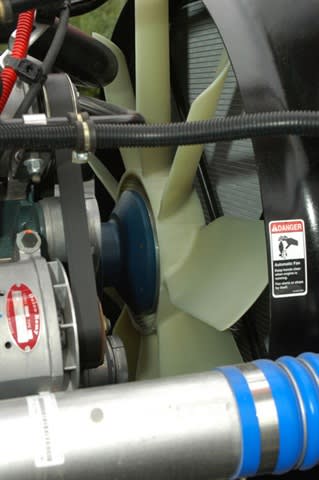
Physically check the clamps for tightness and make sure the fan shroud is properly attached to the radiator and aligned with the fan.
“Metals protection is really the issue today,” Hogg explains. “These coolants are formulated with additive packages to prevent cavitation corrosion on wet-sleeve cylinder liners. Different OEMs take different approaches to this and so their coolant formula recommendations can be different.”
Hogg cites Detroit Diesel as one OE that is moving away from extended-life nitrite coolants.
“They have traditionally used the red extended-life coolants, but they have decided to move to a non-nitrite extended life formulation,” Hogg says.
The switch has a lot to do with the introduction of aluminum radiators into the heavy-duty fleet.
“Those radiators are assembled with a process called controlled atmosphere brazing, and some of the coolants on the market will react with the surface of the weld and not perform as well,” Woyciesjes explains. “The non-nitrited fluids are more compatible with the newer radiator designs.”
The choice of coolant was probably made by the manufacturer of the truck you’re working on, but in mixed fleets or those with newer engines alongside legacy engines, coolant maintenance requires a little extra vigilance.
System Inspection
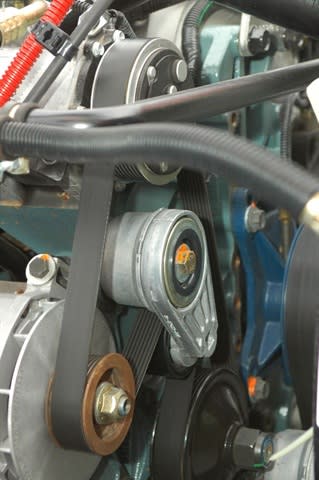
Belts should be checked with a proper gauge, as today’s newer belts don’t show the same wear characteristics as yesterday’s belts.
With the high heat load on today’s engine, even in cold weather, the need to maintain the cooling system has never been more pressing. That means the entire system needs a trained eye cast over it a couple of times a year.
Things like fan shrouds can work loose over time, compromising air flow through the radiator core and possibly jeopardizing the fan blades in a worst-case scenario.
And of course the belts are critical to proper operation of the cooling system and a few other components.
“The types of belts in use today are much different from the old neoprene belts and their wear patterns and indicators are different,” notes Hogg. “You won’t see the cracking we used to see. Consequently, it’s much harder to tell a belt’s condition just by looking at it.”
Hogg says you need to use a belt gauge to measure the depth in the peaks and valleys of the belt.
“There’s some training required to use a belt gauge properly, so it really does require a properly trained technician using the proper tools to evaluate the condition of the belts,” Hogg says.
And let’s not overlook what are perhaps the three most important bits: thermostats, radiator caps, and the humble hose clamp.
The cap, Hogg says, is designed to maintain a certain pressure in the engine.
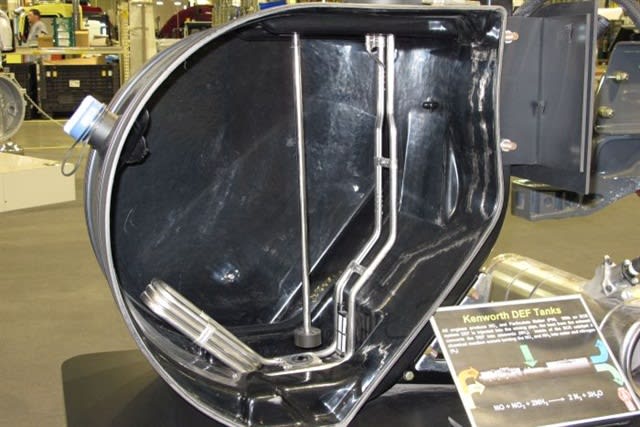
DEF tanks are designed to accommodate the expansion of frozen diesel exhaust fluid. Contents are heated by coolant loops.
“Coolant will boil at a higher temperature when it’s under pressure. If the cap allows the pressure to drop, the engine will overheat, just like when you operate the engine at higher altitudes. If the cap isn’t doing its job, the system could display all sorts of systems that might lead one to think it’s a more expensive problem.”
Hogg says leaks are most likely to appear when temperatures plunge because the metal of the engine, including the fittings coolant hoses are attached to. When the metal contracts, the clamps aren’t as tight and they could start leaking.
He suggests checking the torque on the clamps, being careful not to over-tighten them when it’s really cold. The engine metal will expand again when it gets hot, and if the clamp is too tight, the expanding metal fitting could snap the clamp.
While cooling system maintenance is anything but discretionary, its importance may not be fully appreciated.
“The engine makers tell me that about 40% of the major engine failures today are related to coolant,” says Hogg. “Particularly poor cooling system maintenance.”
More Maintenance

Color Match Smarter: Tools That Restore & Perform
For fleet managers and collision repair professionals keeping heavy-duty trucks on the road, getting the color right the first time isn't just about appearance — it's about efficiency, turnaround time, and bottom-line results. Discover how today's digital color tools are transforming the repair process from guesswork to precision.
Read More →
Wrong Repair Prompts Recall of Freightliner, Western Star 4x2 Trucks
DTNA is recalling more than 2,400 trucks that received an incompatible software fix instead of the hardware repair required to address brake valve corrosion.
Read More →
Truck Drivers Need More Than Another Alert
Fleets have more visibility into truck health, safety events, and driver activity than ever. The next challenge is turning all that information into useful guidance for the person who has to decide what to do next.
Read More →
The Maintenance Checks Trucking Fleets Should Prioritize Before Fall Freight Picks Up
Making it through August isn’t the same as being ready for the next several months of operation. Find out what systems may have suffered from summer heat and need to be checked out before fall.
Read More →
What Three Fleets Are Doing Differently When Buying Truck Parts in 2026
With freight improving but costs still climbing, fleet maintenance executives explain how they're balancing price, quality, and supplier relationships.
Read More →
Paccar Recalls 2027 Trucks Built This Summer for Possible Electrical Problem
The nearly 6,000 Kenworth and Peterbilt trucks in the recall could potentially lose engine power, among other things.
Read More →
Will API PC-12 Oil Change Trucking Fleet Maintenance?
The new API PC-12 heavy-duty engine oil category reflects the changing demands of modern diesel engines. But fleets like Foodliner are looking to getting their own data before making decisions on adopting the new oils and questions such as extending oil drain intervals.
Read More →
Brake Safety Week to Focus on Drums and Rotors
Commercial vehicle inspectors are focusing on truck brakes during CVSA's Brake Safety Week, August 23-29.
Read More →Possible Battery-Cable Fires Prompt Recall of 15,000+ International MV and HV Trucks
On the recalled vehicles, manufacturing variations can cause the battery interconnect cable to contact the auxiliary stud and hold down the bracket.
Read More →
Rush, MCT Team Up to Grow Refrigeration Service Network
The joint venture will operate MCT's network of Carrier Transicold dealerships and mobile service locations, with the companies promising greater service capacity and uptime for refrigerated fleets.
Read More →