




Do Electric Powertrains Need Transmissions?
Multi-speed transmissions are utterly necessary with diesel engines to keep engine operating speed within a very limited bandwidth for performance and efficiency. Electric motor have much broader power and efficiency curves, demanding far fewer gear ratios.

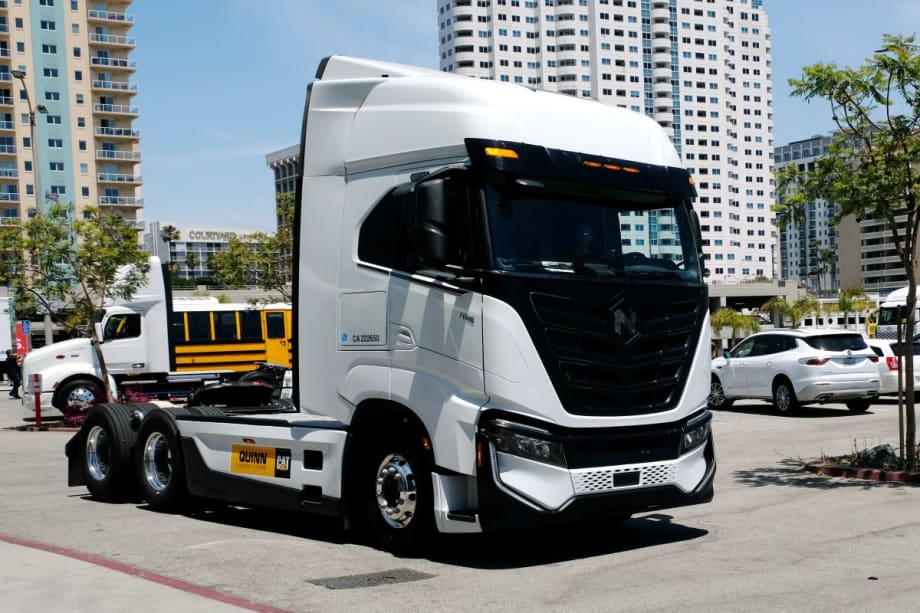
Nikola's Tre BEV powertrain boasts continuous power output of 645 hp (at the middle area of the motor's power curve), while advertising 1,069 instantaneous hp at the peak of the motor's power band. It uses a 1:21.6 gear ratio.
Photo: Jim Park
In a world where dragons lurk anywhere north of 1,500 rpm on diesel engine power curves, electric motors spinning at 18,000 to 20,000 rpm might take some getting used to. That's Formula One territory. Few big diesel engines would survive more than a few seconds at such speeds. But electric motors have just one moving part. And it's supposed to spin really, really fast.
Despite their physical differences, operating criteria for electric motors are similar to diesels. Each have their own operating ranges for maximum torque and optimum efficiency. Truck makers use various levels gear reduction to match engine speed to wheel speed, but there are always compromises.
Diesels have narrow ranges of peak torque and efficiency, usually between 900 and 1,400 rpm, which require transmissions with from 10 to 18 different gear ratios to keep the engine in the optimum range at various road speeds.
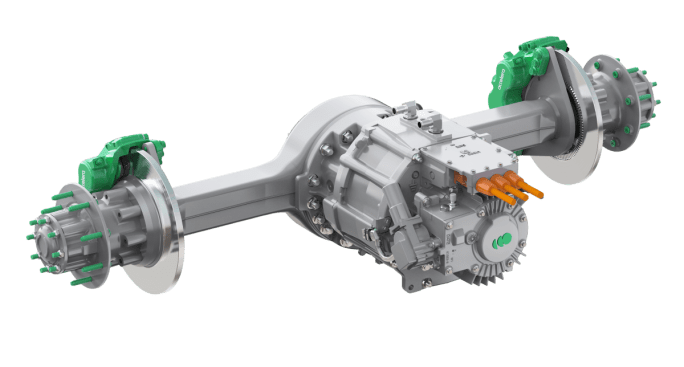
Integrated e-axles, like this 12XE from Cummins-Accelera, house both the motor and the transmission, if equipped. It can be adapted to fit various electric powertrains based on the vehicle application and duty cycle.
Photo: Cummins Accelera
Electric motors, on the other hand, have very broad maximum torque ranges and efficiency varies much less than a diesel across that wide band. Consequently, electric powertrains need far fewer gear ratios to maintain power and efficiency.
"There's little difference between an e-powertrain and a conventional powertrain, except in degree," says Chris Keeney, Sr. Chief Engineer, ePowertrain Platform & Systems Engineering, Accelera by Cummins.
"A typical electric traction motor of a similar continuous power rating has a far larger usable operating speed range, max torque – max speed envelope, and wider efficiency range than an internal combustion engine. That translates into far fewer necessary transmission ranges."
Keeny says the trend is towards 2- and 3-speed transmissions in the heavy-duty sector, while many medium-duty and lighter heavy-duty applications are addressed well with 2-speed transmissions.
"Three-speed transmissions offer additional performance envelope with more gear ratio flexibility to run the motor more efficiently at highway cruising speeds."
There are always some small concessions to be made considering the power density (size and weight) of the motor and the possible packaging challenges of a geared solution. Operating conditions are factored in too, such as top speed, startability, or gradability.
"With box trucks and vans for example, you can get by with a single speed or direct drive because they don't go 90 mph on the highway, and they're not usually fully loaded trying to climb a hill where they need 40% gradability," says Dana's senior director of commercial vehicle engineering, Jeremy Frenznick.
"On the heavy side, there's just not a motor that's large enough to provide either all the torque or all the power, or to get it up to the top speed that the vehicle requires. That's where the multi-speed configuration comes into play."
Electric Motor Operating Range
There's a sweet spot for every electric motor, just as a diesel has a sweet spot, but you can stray further from that spot with an electric motor without experiencing drastic losses in torque or efficiency. Performance of the motors can vary significantly based on their type and size.
Two key operational ranges are of particular concern to design engineers: the range of speed for maximum torque and the range for optimum efficiency.
"The range of maximum torque typically occurs at the lower end of the motor's full speed spectrum. Conversely, the range for peak efficiency is generally found around the midpoint of this spectrum," says Raj Dogra, functional leader, powertrain systems at Nikola. "For instance, in a motor with a speed range of 0-20,000 RPM, the maximum torque is typically delivered between 0-5,000 RPM, while maximum efficiency is achieved between 5,000 to 9,000 RPM."
Dogra says Nikola's motor offerings include products designed for 0-14,000 rpm, with several options within this range based on the application – port drayage to long-haul, for example. Staying within the optimal rpm range can significantly increase the vehicle's energy efficiency, thus increasing range.
Conversely, operating outside that optimal range can introduce undesirable implications, such as thermal challenges, which might demand more sophisticated cooling systems.
"Based on the application, the gear ratios of the transmissions must be optimized so that the vehicle spends maximum time in the areas of maximum motor efficiency," Dogra says. "In the dynamic world of automotive engineering, tuning the powertrain is a balancing act between durability, performance, and efficiency."
Low-, Medium-, & High-Speed Motors
Truck makers have options with powertrain designs, and they always come down to a series of compromises. A bit more of this will cost you a bit more of that. The common starting point is the required motor power rating derived from gradeability requirements. "Gradeability is independent of and unaltered by transmission gearing," says Keeney.
Once you choose a motor that delivers the required gradeability, you can start tuning for efficiency or torque by considering various motor characteristics and gearing options.
Typically, but not universally, physically smaller motors tend to operate at higher speeds (rpm), and thus generate higher horsepower. That's why we see some extraordinarily high horsepower numbers reported in the truck makers marketing material. But all those horses don't necessarily make it to the wheels. And those big numbers come at the top end of the motor's speed range -- where it is not typically operated. It's simply a characteristic of a high-speed motor.
Low- and medium-speed motors tend to be physically larger and operate at lower speeds (rpm). These tend (again, not universally) to deliver more consistent torque output across the speed range of the motor they but may have a narrower peak efficiency range and lower horsepower.
Depending on the application — think medium-duty package delivery trucks — a particular medium speed motor will deliver best torque and efficiency at a road speed of less than, say, 30 mph, where that vehicle will operate most of the time.
Achieving that is done through drive axle ratios. Engineers optimize the gearing to keep the motor in the desired speed range for the highest percentage of time in a particular duty cycle.
On the heavy-duty side, a typical approach is to minimize the traction motor size and supplement it with transmission gear ranges since the motor and motor drive is the most expensive part of the ePowertrain.
"Relatively small, higher speed electric motors are able to generate sufficient power for a commercial vehicle, but are not able to provide the required max torque and max speed is a single-speed configuration," notes Keeney. "So, multiple transmission gear ratios are applied to extend the torque and speed envelope of the ePowertrain system."
D
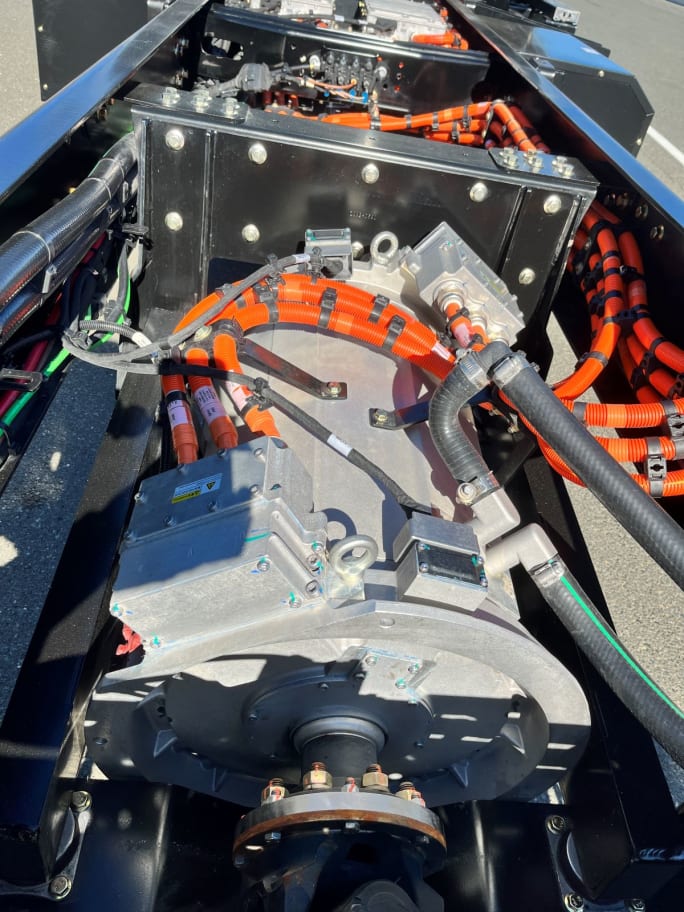
Some e-powertrain configurations, like the Mack MD Electric, use a mid-ship motor and a conventional driveline. This model uses no gearbox. The axle isdriven directly from the motor.
Photo: Jim Park
ana's Frenznick says the high-speed motors are where engineers can get to the sweet spot of efficiency and power density.
"But, with high-speed motors, you're doing more with gear reduction," he points out."The geared solution becomes a bit more complex, but you have a whole lot more efficiency and packaging concessions that you can make.
"How much space do we have? Where do these products and systems need to live? What's the customer or OEM preference, whether it's something that fits in between frame rails with the direct drive motor, or a transmission option. Is a single speed option a good option for the truck? Or does it need to cover a wider range of speeds and performance metrics? And there's always the idea of cost. Sometimes direct drive options can be quite cost effective, but not always."
There's an almost endless number of variations.
What You Do is What You Get
It doesn't look like fleets will get much of a say in what sort of transmission they want for their battery electric trucks. The spec will be determined mostly by the truck's configuration and intended duty cycle. Powertrain engineers and OEMs already have a pretty good idea of what works best for given applications.
And while one OEM might offer a mid-ship motor with a two-speed gearbox, and other might opt for a single speed e-axle setup. It's probably too early to predict if either setup will prove better than the other. It's all about the best compromise between power, efficiency, packaging and of course cost.
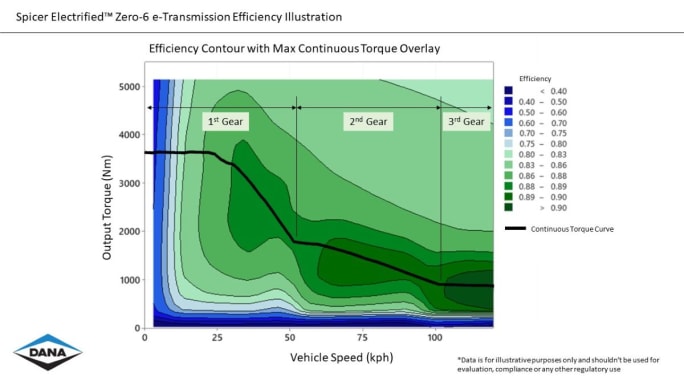
The graph, from Dana's Zero-6 e powertrain illustrates the transmission's ability to deliver high torque at launch and maintain sufficient torque and power across a wide speed range. The darker areas indicate the motor's highest efficiency.
Graphic: Dana
"The efficiency quest leads many OEMs to forego the complexity of a multi-gear transmission system," says Dogra. "This decision, while advantageous in terms of cost reduction, weight, and a simpler Bill of Materials (BOM), is not without its trade-offs."
It's all about compromise.
More Fuel Smarts

How Volvo Updated Its D13 for EPA 2027 [Watch]
Volvo’s updated D13 promises lower emissions without sacrificing performance or fuel economy. Take a closer look at what changed inside the engine in this HDT Spotlight video.
Read More →
Diesel Price Spike Shortens Payback for Natural Gas Trucks, Report Says
Energy Vision estimates fleets could recover the higher purchase price of an RNG-fueled Class 8 tractor in 1.3 to 2.8 years under current fuel-price scenarios.
Read More →
Calstart Becomes Catalyst Mobility, Reflecting Broader Focus
Calstart is now Catalyst Mobility, reflecting the nonprofit’s growing national role in clean transportation, including zero-emission trucks, infrastructure and incentive programs.
Read More →

Record Diesel Prices Squeeze Trucking Fleets
Average U.S. diesel prices have climbed to nearly $6 a gallon, surpassing the 2022 record as tight refinery capacity and Middle East disruptions keep fuel costs elevated.
Read More →
How Fuel Delivery Shapes Engine Performance
Fuel delivery depends on more than what happens at the injector. For fleet, maintenance and technical professionals, looking at the full path from pump to injector can provide useful context for understanding engine performance.
Read More →
East Coast Port Launches $45M Electric Truck Push
The Port Authority of New York and New Jersey announced millions in incentives for zero-emission drayage trucks, yard tractors, and new charging hubs near the port.
Read More →
California Bill Could Shed Light on Electric Truck Prices
Why do battery-electric Class 8 trucks remain so expensive? A California bill headed to Gov. Gavin Newsom would give fleets and state agencies more visibility into what manufacturers charge.
Read More →
Detroit Opens Orders for EPA 2027 Engines
Detroit isn’t starting from scratch to meet EPA 2027 diesel emissions standards. Its Gen 6 DD13 and DD15 engines keep much of today’s platform while updating the fuel and aftertreatment systems.
Read More →
Zero-Emission Truck Corridor Planned for West Coast
California, Oregon, Washington, British Columbia and Baja California are coordinating plans for truck charging and hydrogen fueling from Canada to Mexico.
Read More →
A Closer Look at Kenworth’s Electric T880E Vocational Truck [Video]
Learn more about Kenworth's T880E battery-electric vocational truck at the Paccar Technical Center, including its range, applications, upfitting considerations, and PTO options, in this HDT Spotlight video.
Read More →