




Cummins Commits to Long-term Sustainability Plan: Planet 2050
Cummins is stepping up the fight against climate change and pollution with a series of short- and long-term goals that will produce reductions waste from its manufacturing facilities worldwide as well as strategies to reduce the carbon footprint from its internal combustion engine products.

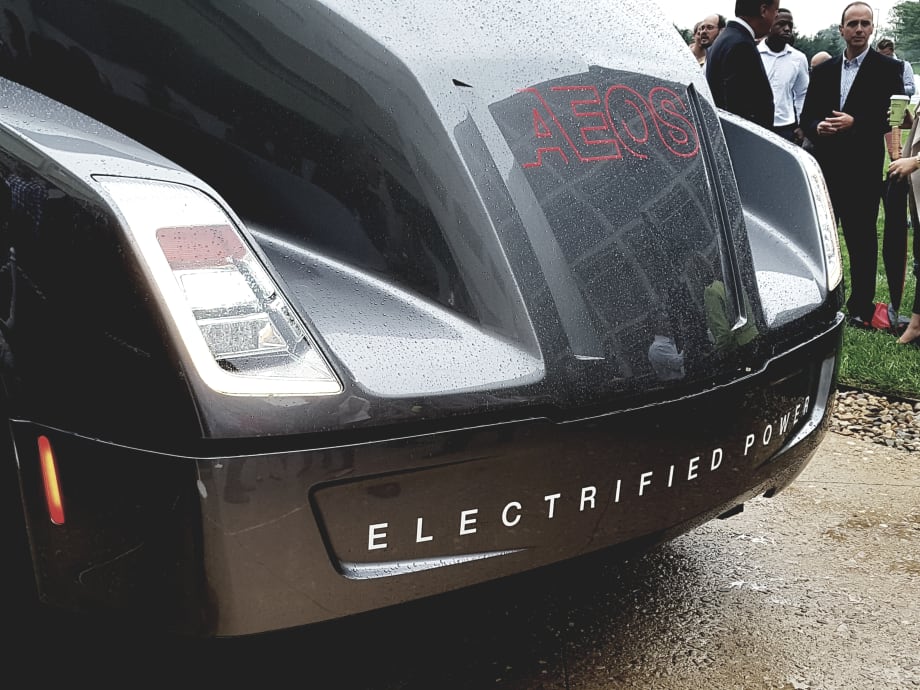
In June 2017, Cummins said it would bring the right technology to markets - not just trucking - that will help its customers win while being a leading provider of those products in the future. The company unveiled the AEOS concept truck two months later.
Photo: Jim Park
Cummins is looking ahead to a net-zero carbon future with a new environmental sustainability strategy. The Columbus, Indiana-based global engine maker says it will set quantifiable goals for 2030 along with visionary longer-term aspirations to 2050. The strategy is science-based and intended to meet or exceed the goals in the United Nations Paris agreement on climate change.
The sustainability initiative was unveiled Friday, November 15 during a press call by Cummins chairman and CEO, Tom Linebarger.
“Cummins is committed to making people's lives better by powering a more prosperous world,” Linebarger said during his introductory remarks. “When we say a more prosperous world, we mean a world that has wealth and growth and people's lives are better this year than last year. But we also mean environmental sustainability because there's no point in growing and increasing wealth if it's a planet that you don't want to live in.”
The strategy, called Planet 2050, is focused on three priority areas: addressing climate change and air emissions, using natural resources in the most sustainable way, and improving communities. It includes eight specific goals, timed to 2030, as well as targets for 2050 and is the most comprehensive and ambitious environmental sustainability strategy ever pursued by the company.
Climate change and emissions goals include:
Reduce absolute greenhouse gas emissions from facilities and operations by 50%.
Reduce absolute lifetime greenhouse gas emissions from newly sold products by 25%.
Partner with customers to reduce greenhouse gas emissions from products in the field by 55 million metric tons.
Reduce volatile organic compounds emissions from paint and coating operations by 50%.
Sustainable natural resource use goals include:
Create a circular lifecycle plan for every part to use less, use better, use again.
Generate 25% less waste in facilities and operations as a percent of revenue.
Reuse or responsibly recycle 100% of packaging plastics and eliminate single-use plastics in dining facilities, employee amenities and events.
Reduce absolute water consumption in facilities and operations by 30%.
"Our products have a large environmental footprint. They contribute significantly to climate change and they also contribute significantly to economic goals and strong communities," Linebarger pointed out, adding, "We need to figure out ways to continue that contribution to growth in strong communities while reducing the environmental footprint. We have to be part of this solution and we need to do our full part of that improvement."
The latest report from the intergovernmental panel on climate change says to keep warming below 2 degrees Celsius we meet to reach net-zero emissions by 2050 in the U.S. and soon after that worldwide, said Fred Krupp, president of the environmental defense fund, who was also on the call.
"Net-zero mean producing no more climate pollution into the air than we can remove," he said. "Net-zero by 2050 is ambitious but it's achievable, but we'll need a serious commitment, not just from governments, but also from businesses that want to be part of the solution."
Linebarger mentioned Cummins' recent investment in fuel cell technology, calling it "extremely promising in a wide range of applications," but he also stressed that the internal combustion engine is no where near extinction.
"We cannot overlook the role of internal combustion engine as a bridge to a cleaner future and we believe that in some applications that internal combustion engine will not have a substitute for many, many years," he said. "Therefore, we will continue to enhance the efficiency of the diesel engine and we can continue to improve our natural gas engines that are delivering near zero emissions levels today. Our advancements in advanced powertrains, biofuels and connectivity will also drive efficiencies further and carbon down."
Cummins has been and will continue to focus on reducing waste in its manufacturing processes using six Sigma and other processes to design out waste and products and processes at every step. Linebarger also committed to using less water in its processes and to return it cleaner to the community whenever possible.
As part of its focus on communities and natural resources, Cummins has joined the CEO Water Mandate, a United Nations Global Compact initiative that mobilizes business leaders on water, sanitation, and the Sustainable Development Goals. Its focus is to address global water challenges through corporate water stewardship, in partnership with the United Nations, governments, civil society organizations, and other stakeholders.
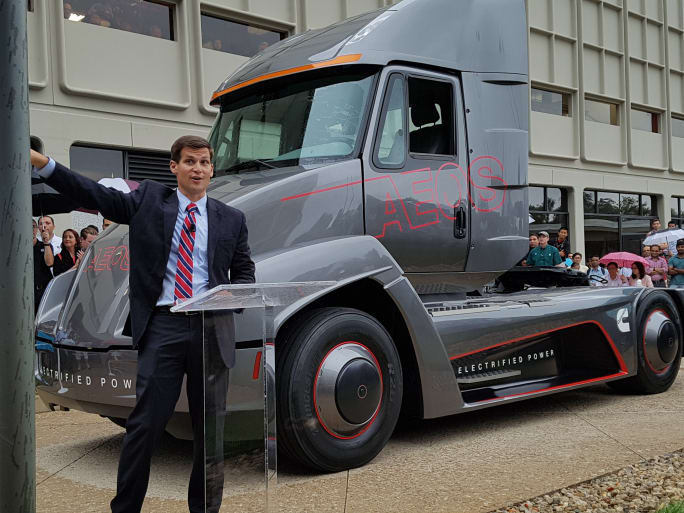
Rich Freeland, then Cummins’ president and chief operating officer, hails the company's first steps toward electrification with the unveiling of the AEOS electric concept truck in August 2017.
Photo: Jim Park
Near-term objectives
Cummins set its first environmentally focused goals in 2006 and unveiled a more comprehensive and challenging plan in 2014. While work on the 2014 plan continues, new goals have been set for 2020. You can rear more about those goals here. In 2017 Cummins formally committed to developing these science-based targets under the direction of the science based target initiative, said Brian Mormino, executive director, environmental strategy and compliance, Cummins Inc.
"This initiative provides a framework for the calculation of greenhouse gas goals for products and facilities that are aligned with recommendations by climate scientists," he said. "Here, the approach was to use a publicly vetted approach, rooted in what the experts say is needed. They laid out the de-carbonization path for sectors and we applied that to the Cummins areas of businesses and our operations, and those targets have now been validated and approved by the science-based target initiative."
Cummins will publicly report on its progress toward the goals annually. The progress on the 2030 goals will be periodically evaluated and communicated, including consideration of whether more can or should be done in line with global energy and environmental challenges.
Cummins' 2030 quantitative goals are a step to the ultimate 2050 objectives, Mormino said. "We believe this framework allows us to deliver on real gains and adjust to a changing world. If we can move faster we will. Right now our work is focused on figuring out how to achieve these 2030 goals because we don't have all of the answers today."
Linebarger outlined some of the challenges to achieving carbon neutrality and near-zero pollution, noting that about 99% of Cummins' greenhouse gas footprint comes from the product they produce.
"Several technologies under development today aren't yet economically viable and won't even be the right solution in the future," he said. "Moreover, the transition will take a long time given the need for new infrastructure. Thus, if we are going to make a significant impact, we must reduce the environmental footprint of all the products in our portfolio today as well as those in the future from diesel to natural gas to electrified power and fuel cells."
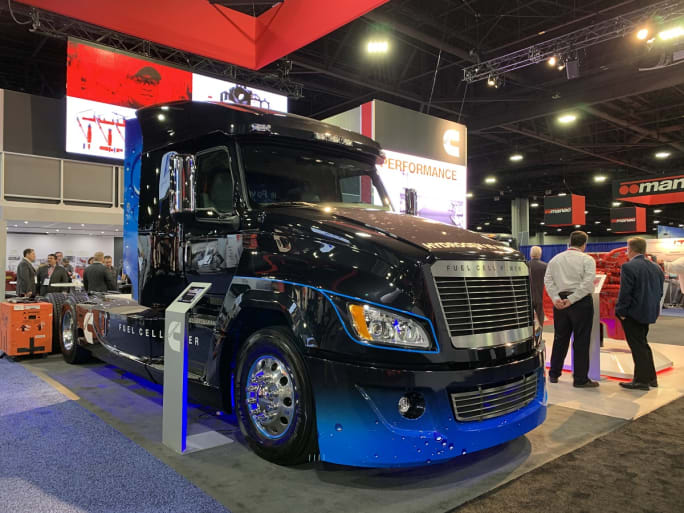
Cummins showed a concept Class 8 day cab at the North American Commercial Vehicle Show featuring a hybrid fuel cell-battery electric drivetrain.
Photo: Deborah Lockridge
On top of its internal and external plans to reduce its environmental impact, Cummins will be pushing for tough, clear and enforceable regulations around the globe to address emissions, and for science-based, economy-wide climate policies.
"Earlier this year, two Cummins executives that testified before two congressional committees advocating for this approach and we will continue to do that," said Mormino. "We recognize that achieving our strategy requires strong implementation and enforcement of regulations to drive down economy-wide air and greenhouse gas emissions. And we will continue to work with trade associations, our customers, suppliers, community leaders, and other stakeholders to advocate for these policies."
Leadership is essential from business that make and use heavy-duty vehicles, which are among the fastest growing pollution sources globally. In our view, electrification of heavy-duty transportation offers great promise as a long-term way to drive down pollution from this sector. We urge Cummins and other manufacturers to bring zero-emissions solutions to the market as soon as possible.
"I'm really pleased that Cummins has made very explicit that it's committed to advocating for tough, clear, enforceable regulations that will address climate and air pollution, and to working with its trade associations, customer, suppliers, community leaders and other stakeholders to advocate for these policies," said Krupp in his remarks. "Leadership is essential from businesses that make and use heavy-duty vehicles, which are among the fastest growing pollution sources globally. In our view, electrification of heavy-duty transportation offers great promise as a long-term way to drive down pollution from this sector. We urge Cummins and other manufacturers to bring zero-emissions solutions to the market as soon as possible."
Cummins is working in exactly that direction. In 2017, it announced plans to develop electric powertrains, and announced plans earlier this year to expand its electrification efforts with a substantial investment in infrastructure and technology at its Columbus, Indiana engine plant. More recently, Cummins reaffirmed its commitment to their hydrogen fuel cell research and development efforts by displaying a concept Class 8 truck with hybrid Cummins fuel cell and battery electric power at the North American Commercial Vehicle Show in Atlanta.
"Cummins is in a strong position to help," Linebarger said. "We're a big company serving customers in 190 countries. Our employees are experts in power and innovation, and we can partner with customers and suppliers to increase the scale of everything we do to have a bigger impact. What's more, it's our duty to help."
More Fuel Smarts

How Volvo Updated Its D13 for EPA 2027 [Watch]
Volvo’s updated D13 promises lower emissions without sacrificing performance or fuel economy. Take a closer look at what changed inside the engine in this HDT Spotlight video.
Read More →
Diesel Price Spike Shortens Payback for Natural Gas Trucks, Report Says
Energy Vision estimates fleets could recover the higher purchase price of an RNG-fueled Class 8 tractor in 1.3 to 2.8 years under current fuel-price scenarios.
Read More →
Calstart Becomes Catalyst Mobility, Reflecting Broader Focus
Calstart is now Catalyst Mobility, reflecting the nonprofit’s growing national role in clean transportation, including zero-emission trucks, infrastructure and incentive programs.
Read More →

Record Diesel Prices Squeeze Trucking Fleets
Average U.S. diesel prices have climbed to nearly $6 a gallon, surpassing the 2022 record as tight refinery capacity and Middle East disruptions keep fuel costs elevated.
Read More →
How Fuel Delivery Shapes Engine Performance
Fuel delivery depends on more than what happens at the injector. For fleet, maintenance and technical professionals, looking at the full path from pump to injector can provide useful context for understanding engine performance.
Read More →
East Coast Port Launches $45M Electric Truck Push
The Port Authority of New York and New Jersey announced millions in incentives for zero-emission drayage trucks, yard tractors, and new charging hubs near the port.
Read More →
California Bill Could Shed Light on Electric Truck Prices
Why do battery-electric Class 8 trucks remain so expensive? A California bill headed to Gov. Gavin Newsom would give fleets and state agencies more visibility into what manufacturers charge.
Read More →
Detroit Opens Orders for EPA 2027 Engines
Detroit isn’t starting from scratch to meet EPA 2027 diesel emissions standards. Its Gen 6 DD13 and DD15 engines keep much of today’s platform while updating the fuel and aftertreatment systems.
Read More →
Zero-Emission Truck Corridor Planned for West Coast
California, Oregon, Washington, British Columbia and Baja California are coordinating plans for truck charging and hydrogen fueling from Canada to Mexico.
Read More →
A Closer Look at Kenworth’s Electric T880E Vocational Truck [Video]
Learn more about Kenworth's T880E battery-electric vocational truck at the Paccar Technical Center, including its range, applications, upfitting considerations, and PTO options, in this HDT Spotlight video.
Read More →