





Find out how fleets can reduce unscheduled downtime on the HDT Talks Trucking podcast.
4 Ways to Improve Fleet Uptime
How fleet maintenance managers can cut the number of roadside breakdowns and the frequency of component failures.
May 17, 2021
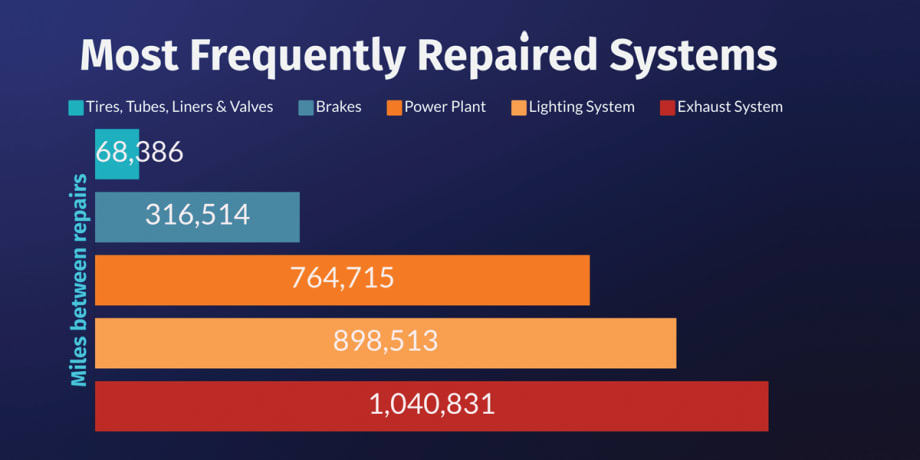
These five components/systems accounted for 72% of all roadside repairs in the third quarter of 2020, according to recent data from TMC/FleetNet. This graph represents the number of miles between repairs for each system. The lower the number, the more frequent the repair.
Source: TMC/FleetNet
6 min to read
With the average cost of roadside repairs at its highest for the second consecutive quarter, keeping trucks up and running and reducing the frequency of repairs is more important than ever.
Between July and September 2020, the average fleet operated 34,629 miles between unscheduled roadside repairs, according to recent data from the American Trucking Associations’ Technology & Maintenance Council and FleetNet America’s Benchmarking Report. The report tracks roadside breakdowns of participating truckload, less-than-truckload and tank fleets.
Those numbers are in line with previous quarters of reporting – however, the average cost per mechanical repair was higher.
LTL fleets in particular experienced the highest cost per repair ($642). That makes sense considering LTL’s top five system repairs were the power plant and cranking system, both with the highest cost per repair ($734 and $545, respectively.)
The top-performing truckload fleets experience 54% fewer breakdowns than the average truckload fleets. And the top-performing LTL fleets experience 34% fewer breakdowns than the average LTL fleets in the study.
These figures indicate there are maintenance practices and uptime strategies used by the best-performing fleets that are not necessarily being used by the masses, says Jack Poster, TMC’s service manager of vehicle maintenance reporting standards. Poster is involved with the benchmarking report.
Understanding the frequency of roadside failures, and the major components and systems that lead to them, may help fleet maintenance managers identify opportunities to improve their operations, and ultimately increase uptime.
Following are four strategies to increase uptime, gleaned from the TMC data and conversations with maintenance managers for high-performing fleets.
1. Keep on top of preventive maintenance
The top five components/systems that lead to roadside breakdowns across all the fleets TMC tracks are:
- tires, tubes, liners and valves;
- brakes;
- powerplant;
- lighting system; and
- exhaust system.
Participating fleets in the benchmarking study managed to improve the miles between lighting system repairs from every 356,211 miles in the third quarter of 2019 to every 898,513 miles in the third quarter of 2020, a 744% improvement. Meanwhile, participating fleets have struggled in the tire department. Fleets experienced a 20% increase in tire repairs in Q3 2020 compared with Q2 2019.
Fleets are most likely to realize a better return on maintenance time invested by focusing on these top five systems, Poster says.
“I always expect to see my preventive maintenance costs in my top three to top four expenses in any given month on trailers and trucks,” explains Jarit Cornelius, vice president of asset maintenance and compliance at Sharp Transport. “And that tells me the shops are doing a good job of scheduling the equipment in when it due.”
Sharp Transport is a 125-truck fleet based in Nashville, running Freightliner, International and Kenworth tractors, and 350 53-foot dry van trailers.
2. Give special attention to driver education
While premature component failures on trucks or trailers can certainly lead to roadside breakdowns, that’s not always the cause, explains Cornelius.
“99% of the things that happen over the road truly are preventable with good pre-trip and post-trip inspections.”
That’s why in addition to tracking component and system failures in his breakdown report, he also records the unit numbers and dates of each failure, which in turn can help connect the breakdowns to a certain driver.
Are there certain drivers in a fleet who are experiencing more roadside breakdowns than others? This could indicate that a driver needs more training on what to look for during pre- and post-trip inspections.
“You can tell anyone to do an inspection, but if they don’t know what they’re looking at, that’s not going to do you much good,” Cornelius says.
He adds: “I’ll make notes and I’ll catch those drivers when they come through, say for a preventive maintenance service or for a safety training,” he says. “I’ll touch base with them on what they’ve endured equipment-wise for the last three, six months, or a year. I’ll try to find out what I think their skill set is with the equipment.”
During new driver orientation, Cornelius says he also goes over the bells and whistles of the equipment they will be driving so they’re aware of the systems, from aerodynamics to the auxiliary power unit. This ensures that they’re comfortable with the equipment – and what to look for during an inspection – before they leave for their first dispatch.
From there on, Cornelius keeps tabs on all his drivers to ensure they have the support and education they need to keep their trucks safe and running.
3. Use fault monitoring capabilities
A big part of maximizing uptime is increasing maintenance efficiency. Using the full potential and power of telematics, engine fault monitoring and remote diagnostics can save fleets time and money.
At Averitt Express, a Tennessee-based freight provider, two maintenance employees monitor fault codes for nearly 5,000 units. The fault codes can indicate whether a failure will warrant either a tow or the need to direct a driver to a nearby shop or vendor.
Being able to directly schedule units at shops where they have the capability and parts to service a particular failure cuts down tremendously on downtime, says Doug Lloyd, director of maintenance at Averitt.
“Averitt has financially benefited from by running everything through our shop network, reducing labor and part costs,” he explains. Averitt has a fleet of about 4,600 trucks and 14,900 trailers in the less-than-truckload and truckload verticals, running Volvo, Freightliner and Tico yard tractors.
At Sharp, Cornelius says fault monitoring capabilities through the engine manufacturers has been beneficial to reducing roadside breakdowns. But the most important part is to manage the program and have a plan set in place for when those fault codes come in.
“That’s where it seems some people may struggle,” Cornelius says. “They either don’t know they have it, or they have it and they don’t manage it; they don’t have a program designed around it.”
He adds: “Nine times out of 10 the trucks are going to tell you what’s wrong with it before anything goes down. Downtime is inevitable, but you can severely reduce the amount of downtime if you put things in place from that point on.”
4. Don’t skip diesel aftertreatment systems
Twelve years ago, many in the industry were under the impression that they wouldn’t have to touch diesel aftermarket systems up to the 400,000- to 500,000-mile mark, says Bruce Stockton, director of maintenance for flatbed truckload carrier Paul Transportation. Now, he says, they’re seeing that the maintenance requires more frequency in preventive maintenance programs.
Stockton is also interim director of maintenance for Oklahoma-based Melton Truck Lines and serves as a maintenance consultant.
While most fleets were prepared to clean diesel particulate filters, he says, they weren’t prepared to clean all the other sensors that can be clogged up as the exhaust goes through the aftertreatment systems.
“We [as an industry] have suffered a lot of costs in learning about these aftertreatment systems,” he says. “All the sensors and little components that make up these systems, have been plagued with problems.”
Without proper attention, diesel aftertreatment systems can lead to not only a breakdown, but also to an expensive failure, from the time of the tow after the engine derates to the time a driver can drive out of the shop.
“It’s not uncommon that I see $6,000, $8,000 and $10,000 invoices for systems that have not been taken care of from a preventive maintenance standpoint throughout their life,” Stockton says. And that’s just the time it takes to get them going again and get them back on the road – it doesn’t even include engine parts, he says.
Whether taking advantage of technology to make inevitable roadside breakdowns less disruptive, or taking special care to educate drivers on inspections, every little bit helps.
This article first appeared in the May 2021 issue of Heavy Duty Trucking.
Subscribe to Our Newsletter
More Maintenance

Sponsored•September 16, 2026
Color Match Smarter: Tools That Restore & Perform
For fleet managers and collision repair professionals keeping heavy-duty trucks on the road, getting the color right the first time isn't just about appearance — it's about efficiency, turnaround time, and bottom-line results. Discover how today's digital color tools are transforming the repair process from guesswork to precision.
Read More →
Wrong Repair Prompts Recall of Freightliner, Western Star 4x2 Trucks
DTNA is recalling more than 2,400 trucks that received an incompatible software fix instead of the hardware repair required to address brake valve corrosion.
Read More →
Truck Drivers Need More Than Another Alert
Fleets have more visibility into truck health, safety events, and driver activity than ever. The next challenge is turning all that information into useful guidance for the person who has to decide what to do next.
Read More →
The Maintenance Checks Trucking Fleets Should Prioritize Before Fall Freight Picks Up
Making it through August isn’t the same as being ready for the next several months of operation. Find out what systems may have suffered from summer heat and need to be checked out before fall.
Read More →
What Three Fleets Are Doing Differently When Buying Truck Parts in 2026
With freight improving but costs still climbing, fleet maintenance executives explain how they're balancing price, quality, and supplier relationships.
Read More →
Paccar Recalls 2027 Trucks Built This Summer for Possible Electrical Problem
The nearly 6,000 Kenworth and Peterbilt trucks in the recall could potentially lose engine power, among other things.
Read More →
Will API PC-12 Oil Change Trucking Fleet Maintenance?
The new API PC-12 heavy-duty engine oil category reflects the changing demands of modern diesel engines. But fleets like Foodliner are looking to getting their own data before making decisions on adopting the new oils and questions such as extending oil drain intervals.
Read More →
Brake Safety Week to Focus on Drums and Rotors
Commercial vehicle inspectors are focusing on truck brakes during CVSA's Brake Safety Week, August 23-29.
Read More →Possible Battery-Cable Fires Prompt Recall of 15,000+ International MV and HV Trucks
On the recalled vehicles, manufacturing variations can cause the battery interconnect cable to contact the auxiliary stud and hold down the bracket.
Read More →
Rush, MCT Team Up to Grow Refrigeration Service Network
The joint venture will operate MCT's network of Carrier Transicold dealerships and mobile service locations, with the companies promising greater service capacity and uptime for refrigerated fleets.
Read More →