





NOx emissions rules are not affected by the EPA's recent proposal to end greenhouse gas emissions regulations.
EPA Acts to Curb Sudden DEF-Related Diesel Engine Derates
New guidance to engine manufacturers will reduce "derating," an automatic trigger forcing diesel engines to operate at a reduced capacity when the emissions system runs out of diesel exhaust fluid or there's a DEF-related fault.
August 12, 2025
New EPA guidance will increase the amount of time truckers have to refill the DEF tank or make repairs.
Credit:
HDT Graphic
5 min to read
The Environmental Protection Agency announced it is taking actions to ease the frustration and disruptions around sudden “derates” of diesel engines when they run out of diesel exhaust fluid or have a fault in the system.
For the past 15 years, EPA emissions regulations have required all new on-road diesel vehicles to install technology to reduce nitrogen oxide emissions, or NOx. Engine makers have used selective catalytic reduction technology, which requires diesel exhaust fluid, or DEF, to operate.
EPA’s new guidance to engine manufacturers will reduce "derating," an automatic trigger forcing the engine to operate at a reduced capacity when the DEF system isn’t working right or runs out of DEF.
Problems with DEF sensors that trigger a derate even when the DEF tank is full have been a common complaint among trucking companies.
The new guidance will increase the amount of time truckers have to refill the DEF tank or make repairs.
Zeldin: Addressing 'Unacceptable' DEF Delays
EPA Administrator Lee Zeldin announced the news in a press conference on August 12.
“When DEF runs out or if a sensor fails, vehicles are programmed to automatically lose significant speed and power,” Zeldin explained, “leaving … truckers stuck while transporting America's goods.
"These DEF systems do not always operate as intended and can cause operational delays and economic hardship," he said. "These failures are often quite inconvenient, but worse than that, they threaten operational reliability, delay deliveries, interrupt farm work and halt construction projects. That's unacceptable.”
EPA’s new guidance, he said, empowers manufacturers to revise their DEF system software in existing vehicles and equipment “to prevent sudden, severe derates and eliminate abrupt shutdowns that create real-world disruptions. These modifications provide more flexibility and reliability without compromising air quality or emissions reductions.”
No separate EPA approvals will be required beyond this guidance letter, and Zeldin said “manufacturers have assured EPA they are ready to take action on these changes.”
The Truck and Engine Manufacturers Association issued a statement saying the association and its member companies "welcome the new guidance and are preparing to implement it as quickly as possible."
According to EMA, manufacturers are preparing to make new programming available as retrofits on a staggered basis for legacy engines with SCR across many different model years, configurations, and variants.
Details on EPA’s New Derate Requirements
Under EPA’s new guidance for heavy-duty trucks, after a fault is detected, only a warning light will appear for 650 miles or 10 hours, so there’s no performance impact for at least one workday.
At that point, the engine derates by 15%, but this does not limit speed, allowing trucks to operate normally for up to 4,200 miles or about two work weeks.
Only after 10,500 miles, or about four work weeks, will the vehicle see a speed de-rate down to 25 mph, where it will remain until repaired.
“We expect most operators to repair their vehicles within a couple days or weeks, and all to be able to make the repairs before they reach the 10,500 miles,” Zeldin said.
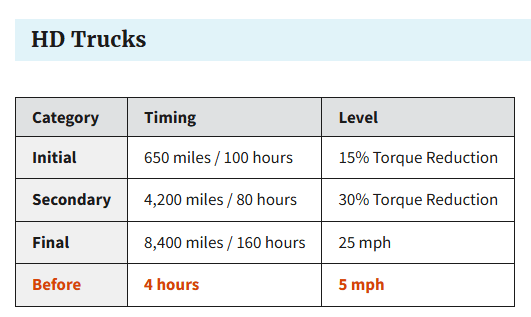
The Environmental Protection Agency published this table showing the derate changes.
Source: EPA
2027 Diesel Engine Emissions
Starting with model year 2027, EPA requirements state that all new diesel on-road trucks must be engineered to avoid sudden and severe power loss after running out of DEF.
To fix the problem for vehicles already in use, EPA’s new guidance, developed in collaboration with manufacturers, will work to ensure that the necessary software changes can be made on the existing fleet.
In addition to providing certainty to manufacturers about how EPA wants this issue resolved, the agency is not requiring separate approvals beyond that provided in EPA’s guidance. This ensures that bureaucratic steps do not delay manufacturers’ ability to put solutions into the field, according to the EPA.
The 2027 emission rules, finalized in 2022, had already set what the EPA called a more “balanced approach to engine derates related to the SCR emission control system” set forth in the 2027 EPA emissions regulations.
At the time that rule was published in 2022, EPA said it believed that giving more advance notice to operators that the SCR system is not working properly would encourage ongoing maintenance while limiting frustration due to unexpected engine derates.
These “SCR inducements” also were expected to reduce the risk of operators completely disabling emission control systems, the EPA said.
Engine Technology Forum Executive Director Allen Schaeffer in a statement regarding the EPA's new guidance noted that "to ensure emissions system integrity, uninterrupted performance, and clean air benefits, maintaining systems is key and this includes the replenishment of diesel exhaust fluid, as well as being attentive to indicators and inducements within a certain timeframe."
EPA's new guidance, he said, allows manufacturers to adjust SCR systems to ensure that truckers and others who rely on diesel engines and equipment "will be able to complete critical work with sufficient lead time for scheduling maintenance and repairs.”
Trucking Industry Reaction
The American Trucking Associations issued a statement applauding the EPA's DEF fix.
“EPA’s new guidance will avoid unnecessary towing costs and equipment downtime while preserving the full environmental benefits that Selective Catalytic Reduction systems provide," said Patrick Kelly, ATA’s vice president of energy and environmental affairs.
The Owner-Operator Independent Drivers Association also issued a statement welcoming the news.
“EPA’s guidance establishes more commonsense inducement schedules that will help drivers maintain safe control of their vehicles as they diagnose and remedy faulty DEF/SCR systems," said OOIDA President Todd Spencer.
"More flexible inducement speeds and times will help truckers finish their trips, plan for necessary maintenance, and avoid parking their truck for an extended period simply because of a false alarm.”
More Equipment

How Volvo Updated Its D13 for EPA 2027 [Watch]
Volvo’s updated D13 promises lower emissions without sacrificing performance or fuel economy. Take a closer look at what changed inside the engine in this HDT Spotlight video.
Read More →
Michelin Tire Improves Efficiency and Durability for Regional Fleets
The Michelin X Multi Energy D2 is a regional haul drive tire engineered to help fleets improve fuel efficiency, durability and traction in demanding stop-and-go operations.
Read More →
ZF Expands Commercial Vehicle Push in North America
ZF is expanding its North American commercial-vehicle presence with new transmission applications, electrification, trailer technology and autonomous-driving systems.
Read More →
Tesla Wants a Self-Driving Semi. Are Cameras Enough?
Could Tesla’s camera-only autonomous driving technology work on an 80,000-pound Semi? In this commentary, HDT's Deborah Lockridge takes a look at Tesla, Cybercab, and how autonomous trucks see the road.
Read More →
Kodiak: Driverless Long-Haul Truck Launch on Track for 2026
Kodiak AI says its driverless long-haul safety case is 93% complete and it remains on track to begin commercial operations by year-end 2026.
Read More →
What DOT’s Automated Vehicle Strategy Means for Trucking
The U.S. Department of Transportation issued a new automated-vehicle strategy that outlines plans for driverless-truck regulations, cross-state freight corridors, and federal safety standards.
Read More →
East Coast Port Launches $45M Electric Truck Push
The Port Authority of New York and New Jersey announced millions in incentives for zero-emission drayage trucks, yard tractors, and new charging hubs near the port.
Read More →
PlusAI Going Public to Fund Autonomous Truck Launch
A SPAC deal could provide PlusAI with up to $300 million as it works toward a 2027 commercial launch of factory-built autonomous trucks.
Read More →
NHTSA Moves to Rewrite Truck Fuel-Economy Rules
The National Highway Traffic Safety Administration says it lacks authority to regulate medium- and heavy-duty truck engines separately from complete vehicles, but the existing standards have not yet been eliminated.
Read More →
Detroit Opens Orders for EPA 2027 Engines
Detroit isn’t starting from scratch to meet EPA 2027 diesel emissions standards. Its Gen 6 DD13 and DD15 engines keep much of today’s platform while updating the fuel and aftertreatment systems.
Read More →