




Ensuring the Correct Tire Replacement
Incorrect remote tire replacements when trucks get road service have nagged fleets since the beginning of trucking.

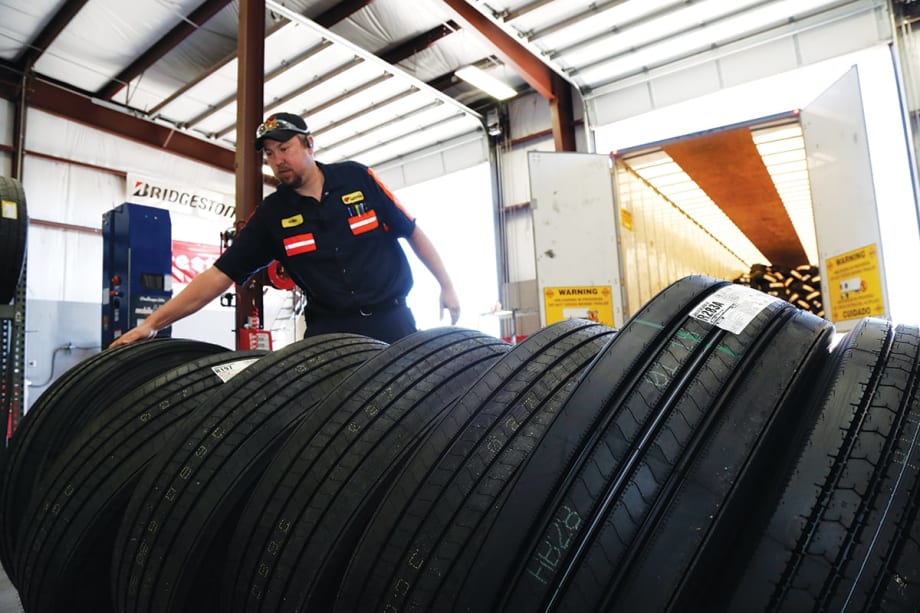
Love’s Travel Stops has set up a digital communication network to help its fleet customers ensure they get the right tires, regardless of location or time of day.
Photo: Love’s Travel Stops
The number of tires even a small fleet can go though in a year’s time is staggering. Just ask Bryan Golden, director of fleet maintenance for Southeast Logistics, based in Tuscaloosa, Alabama.
Southeast runs around 160 company-owned tractors as well as a number of leased power units and 452 flatbed trailers throughout the Southeast. The fleet’s average length of haul is approximately 385 miles. During a year’s time, Golden says the fleet puts on anywhere from 1,200 to 2,000 tires purchased from remote vendors. But to his ongoing frustration, many times the replacement tires his technicians find on the trucks when they roll back into the yard are not the ones he wants.
Golden has spent years working out his preferred tire choices. Moreover, he’s a firm believer in the value of retreads. “We run spread axles,” he says. “So, I need a very high scrub value on my tires. And if my tires are spec’ed correctly, I can expect to get 13 or 14 months’ service from them, and have a good casing left over to retread and use two or three more times on the drive axles and, eventually, the trailer axles.”
The problem is that many times, when a truck comes in after a remote tire replacement, the new tire is not one from his approved replacement tire spec sheet.
“I have one terminal here in Tuscaloosa,” he says, “so we totally rely on outside vendors to help us get the right tires on the trucks and trailers.”
Too often the trucks come in with low-scrub-value tires that not only wear out stunningly fast, but also rob him of a usable retread casing.
“If they don’t have an approved tire on our spec list in stock, I’ll happily pay for a more expensive virgin tire that meets the spec in terms of scrubbing, tread design and tread depth,” he says. “Because even though it costs a bit more money, I actually come out ahead in the long run, because I at least have a reusable casing I can retread. But most of these incorrect tires have low scrub values and completely burn up in six to eight months. And usually the casing is destroyed as well. So, I’ve just shelled out $325 for a tire that will be gone in six months — and I’ll have literally nothing to show for it once it’s gone.”
Buyer Beware
One might suspect this could be traced back to drivers sweet-talking a technician late at night into putting a premium brand on the vehicle. But Golden says that scenario is rare. “We have pretty good controls in place that keep drivers from bypassing our preferences and putting a different tire on,” he says. “It does happen from time to time. But I really think the problem is training on the technician side of the issue.”
Golden believes most technicians don’t understand the nuances of tire specs. “They don’t understand why a high-scrub value is important to a fleet that’s running spread axles,” he says. “And in the normal course of a shift, they primarily deal with dry van trailers. So they’re in a hurry, running behind — they need a tire. This one is round, black and it rolls. And it’s good enough for most of the long-haul, dry van fleets they deal with, so they slap it on and don’t think about it again.”
“It’s ‘buyer beware’ away from your home base,” agrees Darry Stuart, president of DWS Fleet Services in Wrentham, Massachusetts, who serves as a limited-time executive helping fleets with their maintenance programs. “The problem with remote tire replacements is that the buyer usually isn’t aware until the truck comes back to home base.”
Stuart advises clients running spread-axle trailers to negotiate second- or third-tier new rubber for remote purchases. “I’m a ‘deep rubber’ guy and have been for years,” he says with a chuckle. “But, on the other hand, good used casings are getting harder to find,” he notes. “Everybody wants them. And a lot of them ended up going to China. So part of the problem in getting high-scrub retreads could be that the tires are hard to find.”
Love’s Travel Stops has emerged as a major remote tire service center for fleets since opening its first Truck Tire Care location in 2008. Eric Daniels, Love’s director of shop operations, says the company works hard to make sure fleets large and small get the tires they need when a failure hits away from home.
“At Love’s, we stock the same tire brands and models at our over 370 Love’s Truck Care Center and Speedco locations across the country,” he notes. “We also have our own retread centers so we can offer high-quality retread products at affordable prices. We want to ensure we can meet our customers’ needs and get them back on the road quickly.”
To help make sure fleets are getting the tires they’ve spec’d, Daniels says all Love’s Truck Care Center and Speedco locations let customers set up specification profiles so all shop personnel can see what a fleet’s requested products and procedures are. “From oil changes to tire replacements, we can outline exactly what the fleet wants and ensure consistency across our network,” he says.
Another option he suggests, for fleets that are having trouble with correct specs, is the Love’s Shop Connect digital communications solution. “This is a one-stop-shop for fleets to manage accounts and schedule maintenance and inspections at any Love’s Truck Care Center or Speedco location,” Daniels explains. “With Shop Connect, fleets can dispatch repairs, chat with our team and approve repair estimates prior to work being completed. We also have a 24/7 dispatch center that makes it easy for a fleet to communicate with our locations.”
Love’s, of course, is not the only remote tire provider offering digital tools these days to help fleets manage the work on the road. TA/Petro, for instance, has TA Truck Service eShop, which allows fleets to authorize work orders and purchase orders online and get detailed cost estimates before work is completed. If you’re not already using such tools with your on-the-road tire providers, check to see what they offer.
Confront, Address, and Correct
Stuart says remote repairs in general, not just tires, have been a frustration for fleets since trucks first hauled goods away from their home bases. “We’ve got better means of communicating today. But the frustration for fleet managers is understandable. You can over-communicate, monitor and even change your specs. But all it takes is for one guy out there somewhere to not care, and it all goes out the window.”
It’s a sentiment Golden can relate to. “It’d be one thing if I was asking for crazy, exotic stuff,” he says. “But I’m not. This is just everyday trucking. And it just drives us crazy because this happens all the time.”
For now, he says, he’ll keep on coaching his techs to let him know when a non-spec tire rolls into the shop, and keep his staff working the phones to confront, address and correct the issue when one does.
More Maintenance

Color Match Smarter: Tools That Restore & Perform
For fleet managers and collision repair professionals keeping heavy-duty trucks on the road, getting the color right the first time isn't just about appearance — it's about efficiency, turnaround time, and bottom-line results. Discover how today's digital color tools are transforming the repair process from guesswork to precision.
Read More →
Wrong Repair Prompts Recall of Freightliner, Western Star 4x2 Trucks
DTNA is recalling more than 2,400 trucks that received an incompatible software fix instead of the hardware repair required to address brake valve corrosion.
Read More →
Truck Drivers Need More Than Another Alert
Fleets have more visibility into truck health, safety events, and driver activity than ever. The next challenge is turning all that information into useful guidance for the person who has to decide what to do next.
Read More →
The Maintenance Checks Trucking Fleets Should Prioritize Before Fall Freight Picks Up
Making it through August isn’t the same as being ready for the next several months of operation. Find out what systems may have suffered from summer heat and need to be checked out before fall.
Read More →
What Three Fleets Are Doing Differently When Buying Truck Parts in 2026
With freight improving but costs still climbing, fleet maintenance executives explain how they're balancing price, quality, and supplier relationships.
Read More →
Paccar Recalls 2027 Trucks Built This Summer for Possible Electrical Problem
The nearly 6,000 Kenworth and Peterbilt trucks in the recall could potentially lose engine power, among other things.
Read More →
Will API PC-12 Oil Change Trucking Fleet Maintenance?
The new API PC-12 heavy-duty engine oil category reflects the changing demands of modern diesel engines. But fleets like Foodliner are looking to getting their own data before making decisions on adopting the new oils and questions such as extending oil drain intervals.
Read More →
Brake Safety Week to Focus on Drums and Rotors
Commercial vehicle inspectors are focusing on truck brakes during CVSA's Brake Safety Week, August 23-29.
Read More →
Possible Battery-Cable Fires Prompt Recall of 15,000+ International MV and HV Trucks
On the recalled vehicles, manufacturing variations can cause the battery interconnect cable to contact the auxiliary stud and hold down the bracket.
Read More →
Rush, MCT Team Up to Grow Refrigeration Service Network
The joint venture will operate MCT's network of Carrier Transicold dealerships and mobile service locations, with the companies promising greater service capacity and uptime for refrigerated fleets.
Read More →