





Related: Getting Guidance on Electric Trucks
NACFE Predicts a Zero-Emissions Freight Future
A "messy middle" period of new alternative-fuel technology trials has already begun, a new report says. In a couple of decades, fleets will be moving freight in a zero-emissions mode both profitably and productively, it predicts.
December 10, 2019
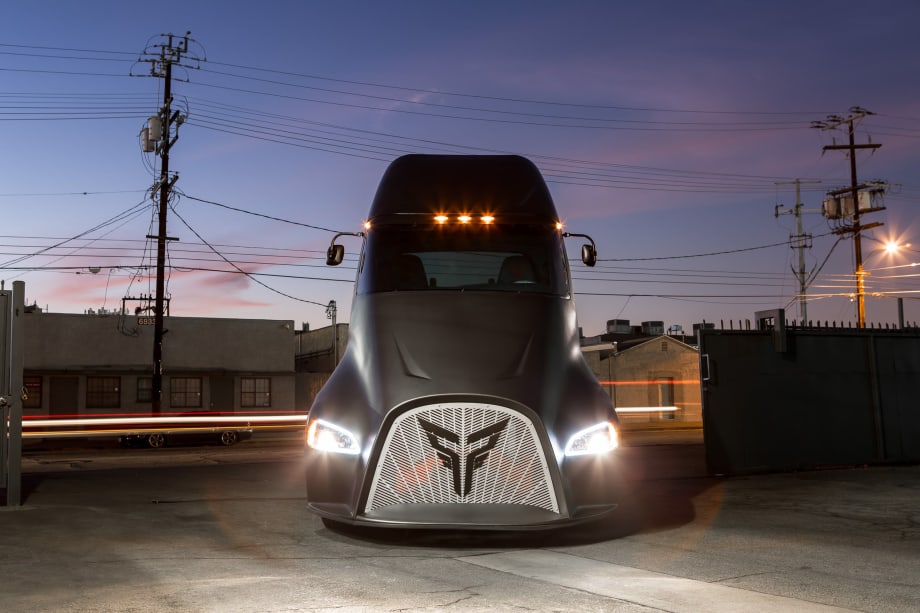
The "elegant simplicity" of electric trucks are poised to usher in a new era of zero emissions freight movement, according to a new NACFE report.
Photo: Xos
5 min to read
A "messy middle" period of new alternative-fuel technology trials has already begun, a new report says. In a couple of decades, fleets will be moving freight in a zero-emissions mode both profitably and productively, it predicts.
As trucking moves into a new future of fuels, fleet managers are being presented with a litany of new technologies to consider for their operations. And, as always, the North American Council for Freight Efficiency is on hand to provide guidance as these new options arise.
NACFE released a new Guidance Report, Viable Class 7 and 8 Hybrid and Alternative Fuel Tractors, to help fleet managers parse through new fuel and propulsion systems.
Mike Roeth, executive director, noted during a telephone press conference that many fuels are branded variously as “green,” “clean,” “near zero emission” and “renewable” – but that there is with no clear agreement on what these terms mean.
The spectrum of new fuel and power choices covered by the NACFE report includes:
Commercial battery electric (CBEV)
Fuel cell hybrid electric (FCEV)
Compressed natural gas (CNG)
Renewable natural gas (RNG)
Liquefied Natural Gas (LNG)
Propane (LPG)
Hybrid diesel electric (HDE)
Renewable diesel (RD)
Roeth noted that there is growing interest in such options, both for economic reasons and because of lower emissions than traditional powertrains – both critical factors for today’s fleets in the face of competitive pressures and regulatory agencies pushing toward zero-emission requirements.
However, in many cases, these alternative fuels have a host of currently unknown operational factors, such as:
Unproven reliability
Unproven maintainability
Unknown obsolescence rate
Unproven product life
Unknown all-season/all-region capabilities
Higher list price
Unknown lifecycle costs
Need for infrastructure investment
Unknown insurance costs
Unknown residual value
A true apples-to-apples comparison of alternative fuels to conventional diesel or gasoline vehicles is difficult, Roeth added, since alternative-fueled vehicles are inherently not identical. Moreover, each factor that is not kept similar has ramifications that impact the validity of the comparison. In order for fleet managers to to do an accurate comparison between conventional and alternative fuels, Roeth said, the following factors have to be taken into consideration:
Energy content of fuels
Tare weight
Payload capacity
Vehicle packaging
Energy conversion efficiency
Duty cycles
Freight-ton efficiency
Freight cube
Energy pricing
Fuel-source-to-use
Fill times
System cost
Maintenance
Incentives
The 'Messy Middle'
Current difficulties aside, Roeth said the NACFE Guidance Report clearly shows a bright future for new fuel and propulsion systems. He noted that North American freight movement is becoming more predictable, with dedicated routes enabled by e-commerce and other technologies offering better duty cycles for alternative powertrains.
Given the “elegant simplicity” of electric trucks, Roeth said that looking ahead, NACFE now has high confidence of a greener future for fleets that is both profitable and economical. "In a couple of decades, moving freight in zero-emissions mode is going to both possible and profitable for fleets,” he said. “I’m not sure we would have said that a couple of years ago. But as costs fall and reliability of solar, wind and other sustainable energy sources rise, we think that this vision of the future will become reality.”
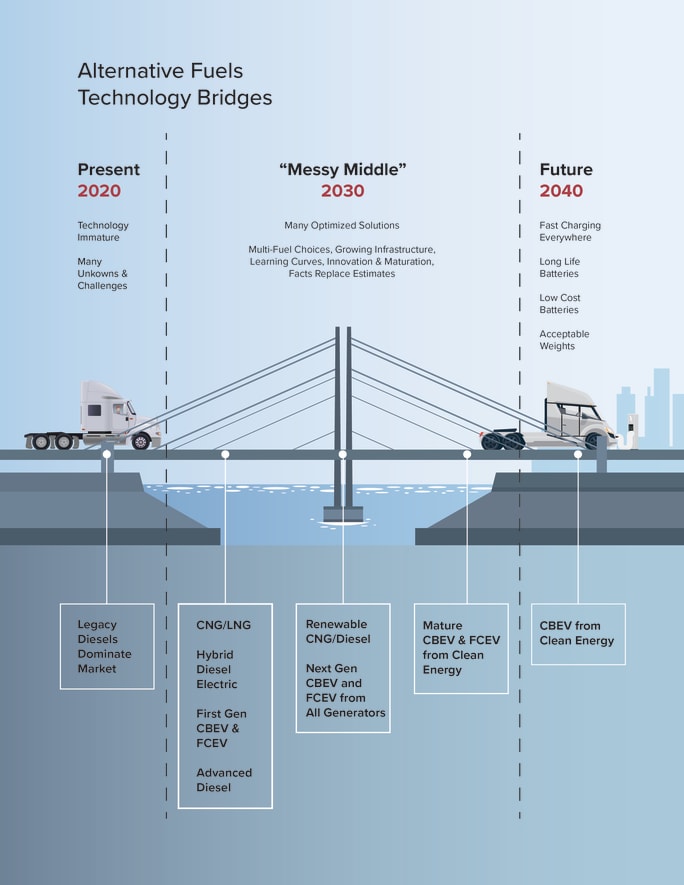
A "messy middle" period of alternative fuel adoption has already begun, NACFE said, and will likley last for another two decades.
Graphic: NACFE
Each alternative fuel or powertrain offers benefits in the short term compared to current diesel powertrains and may have enough duty cycle scale to offer benefits in both total cost of ownership and emissions, Roeth noted. The report predicts that commercial battery-electric vehicles and fuel-cell-electric trucks will be capable of lower total cost of ownership in the 2030 timeframe.
All that said, there will be a “messy middle”’ period – which the industry has already entered – until batteries and fuel cells alone power these trucks, as alternatives offer significant improvements over the diesel and gasoline baselines, Roeth noted.
“A future zero-emission freight world will only have electric-based vehicles (CBEV, FCEV, or catenary electric) powered well-to-wheel from truly renewable sources such as hydro, solar and wind,” he added.
The study team offered these six major findings:
North American freight movement is becoming more predictable, with dedicated routes enabled by e-commerce and other technologies, offering better duty cycles for alternative powertrains.
Each alternative fuel powertrain offers benefits in the short term compared to current diesel and may have enough duty-cycle scale to offer total cost of ownership and emissions savings.
Commercial battery electric vehicles and fuel cell trucks will be capable of lower total cost of ownership in the 2030 time frame.
Vehicle specifications will be better optimized for the duty cycle and technology of the first user, limiting the applicability of the equipment for second or third users.
There will be a “messy middle” until battery-electric and fuel cell electric powertrains alone power these trucks.
A future zero-emission freight world will have only electric-based vehicles (CBEV, FCEV, or catenary electric), powered well-to-wheel from truly renewable sources, such as hydro, solar, and wind.
“Fleets should not delay engaging with these new technologies," Roeth said. "By exploring the use of these technologies and adopting where possible, they will help optimize these technologies for their own duty cycles and applications and take advantage of all the benefits of the various choices.”
The report includes two parity charts comparing these emerging technologies with current diesel or gasoline vehicles. One looks at the current situation with alternative fueled vehicles, and the other looks at parity in 2030.
This guidance report is the fourth in a NACFE series on commercial battery electric vehicles. Reports are available individually or as a package at www.nacfe.org/future-technology.
More Fuel Smarts

California Bill Could Shed Light on Electric Truck Prices
Why do battery-electric Class 8 trucks remain so expensive? A California bill headed to Gov. Gavin Newsom would give fleets and state agencies more visibility into what manufacturers charge.
Read More →
Detroit Opens Orders for EPA 2027 Engines
Detroit isn’t starting from scratch to meet EPA 2027 diesel emissions standards. Its Gen 6 DD13 and DD15 engines keep much of today’s platform while updating the fuel and aftertreatment systems.
Read More →
Zero-Emission Truck Corridor Planned for West Coast
California, Oregon, Washington, British Columbia and Baja California are coordinating plans for truck charging and hydrogen fueling from Canada to Mexico.
Read More →
A Closer Look at Kenworth’s Electric T880E Vocational Truck [Video]
Learn more about Kenworth's T880E battery-electric vocational truck at the Paccar Technical Center, including its range, applications, upfitting considerations, and PTO options, in this HDT Spotlight video.
Read More →
Kenworth T880E Brings EV Power to Vocational Trucks
A closer look at the Kenworth T880E’s range, charging, powertrain and upfit options — and where fleets are showing the most interest.
Read More →
Jennie Abarca Is Proving Electric Trucks Can Do the Job
HDT Truck Fleet Innovator Jennie Abarca is building confidence in fleet electrification one load at a time while openly sharing the challenges she encounters along the way as a small-fleet owner.
Read More →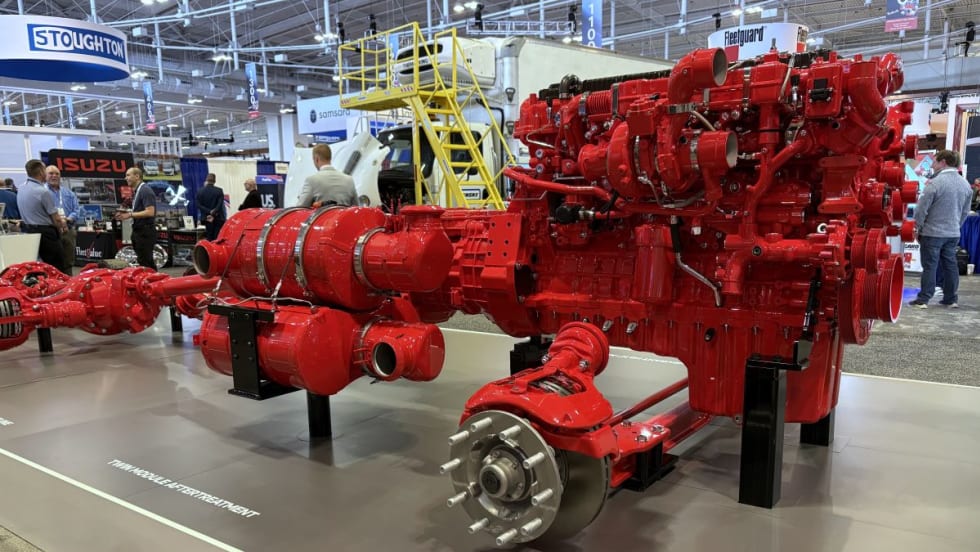
Cummins Adjusts 2027 Engine Rollout After EPA Proposal
The engine maker will gradually introduce its new Model Year 2027 diesel engines while continuing to offer current models during the transition, citing the EPA's proposed emissions rule changes.
Read More →
EPA Proposal Could Ease 2027 Truck Costs and Buying Uncertainty
The proposal doesn't change the tougher NOx standard, but it would revise key implementation requirements that manufacturers say have driven up costs and complicated fleet purchasing decisions.
Read More →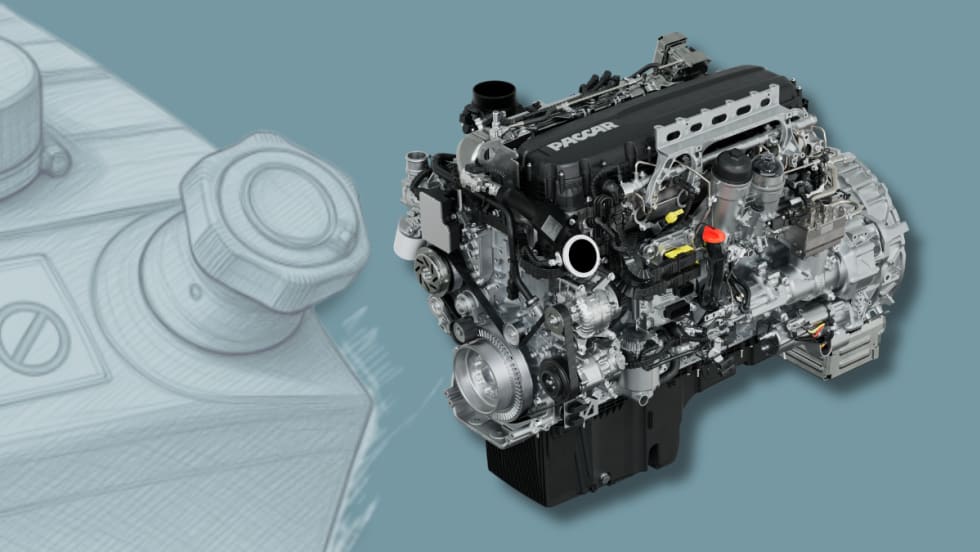
Cummins, Paccar Ease DEF Derates After EPA Guidance
Updated diesel engine software gives truck operators more time to address emissions-system issues while staying compliant with EPA emissions standards.
Read More →
Maintenance in the Messy Middle Part 3: Biodiesel
Biodiesel can reduce emissions, improve fuel-system lubricity and use existing diesel infrastructure. But NACFE’s Messy Middle maintenance report says fleets must actively manage storage, cold-weather operation, filters and oil drain intervals to avoid problems.
Read More →