





2023 Update:VTTI Sharing the Road Program Growing
High Schoolers See the Road From a Truck Driver’s Point of View
Researchers at the Virginia Tech Transportation Institute are teaching driver’s education students about truck safety through interactive demonstrations at 25 high schools in Virginia, West Virginia, and Delaware.
January 18, 2019
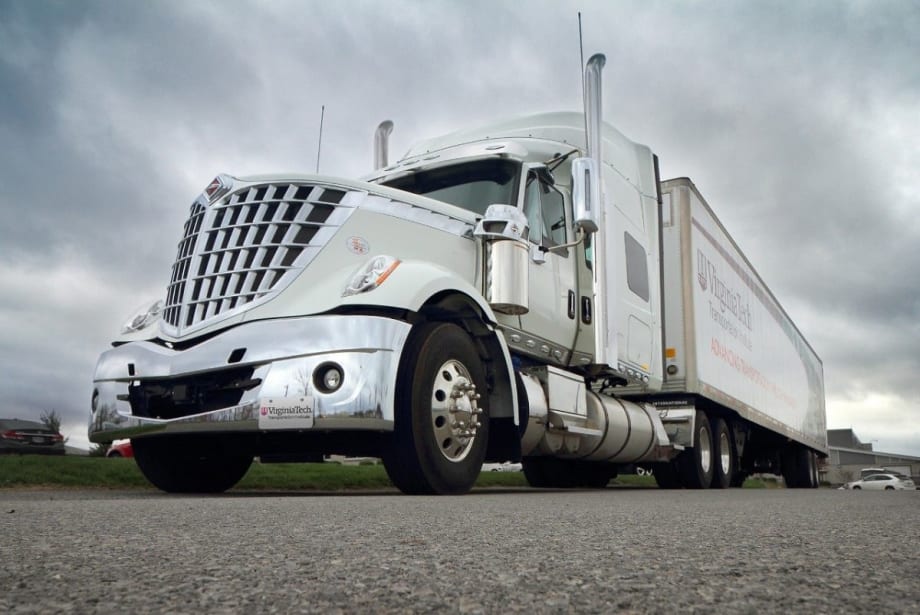
Researchers from Virginia Tech Transportation Institute are teaching high school students in driver's education classes about truck safety by showing them what the road looks like from a driver's point of view.
Photo courtesy Virginia Tech Transportation Institute
5 min to read
Almost 80% of tractor-trailer crashes and near crashes are caused by someone driving a car. Occupants in the car often do not survive, accounting for four out of every five fatalities in this type of collision. However, most driver’s education courses offer little guidance on how to drive safely around large trucks.
To help address this gap in driver education, researchers at the Virginia Tech Transportation Institute are teaching driver’s education students about truck safety through interactive demonstrations at 25 high schools in Virginia, West Virginia and Delaware.
The program, called Sharing the Road, is funded by a $107,820 grant from the Federal Motor Carrier Safety Administration.
Hands-on Learning
After listening to a brief presentation, students rotate through several educational stations around VTTI’s tractor-trailer to learn firsthand about blind spots, proper following distances and other road sharing tips. They also take turns sitting behind the wheel of the cab so they can see for themselves the lack of visibility a truck driver has compared to other drivers.
“Based on our research, students tend to retain driver safety information better when they learn it in a hands-on way as opposed to just reading about it in a textbook," said Matthew Camden, senior research associate for VTTI’s Center for Truck and Bus Safety. "Our goal is to demonstrate proper procedures for sharing the road with large trucks and to give students a better idea of what the road actually looks like from the driver’s seat of a heavy vehicle."
Camden believes this first-hand experience helps students to contextualize the information they learned during the presentation. For instance, the average tractor-trailer is about 8 feet wide and 65 feet long. It could also weigh up to 80,000 pounds — roughly, as much as 10 elephants. When such a colossal vehicle is pulsing along at 55 mph on the highway and needs to brake, it will travel the length of an entire football field before it can fully stop.
The truck’s size and height also creates large blind spots for the driver. To illustrate this point, the researchers strategically place cones and other vehicles in the truck’s “no zones” — in front, behind, and to the sides. When the students arrive, Scott Tidwell, senior field research technician for the Center for Truck and Bus Safety, takes groups inside of the truck cab. He asks the students one by one to climb into the driver’s seat and tell him what they can see.
“The students are typically shocked that they can’t see very much. A lot of them will say something like, ‘Wait, there’s another truck back there?’ There is a big misconception, especially with novice drivers, about how well a truck driver can see. Giving these students the opportunity to get inside of the truck gives them a better sense of the challenges truck drivers face every day on the road. It is a real eye-opener for them,” said Tidwell.
Teen Driver Takeaways
What are the main takeaways from Camden and Tidwell’s demonstration?
Do not hang out in any of the truck’s “no zones.”
Pass trucks on the left at a steady pace but do not cut it short when merging back over.
Do not try to squeeze past trucks that are getting ready to turn or back up.
Maintain a safe following distance.
All drivers, not just teenagers, can stand to benefit from this advice, according to the institute’s data. The institute’s naturalistic research footage indicates that young and older drivers have some misconceptions when it comes to driving around trucks.
The most common mistake drivers seem to make is merging over too quickly, according to Camden.
“Our data suggests that drivers in general tend to misjudge how much space they should allow in order to pass a tractor-trailer," he explained. "We have been telling the students that they need to be able to see the entire front of the truck, from the bumper to the top of the cab, before merging. This equates to about 80 feet of space, which should provide enough room in the event of an emergency, such as car failure or a deer darting out into traffic."
Future of the Program
Since the project began last spring, Camden and Tidwell’s team have visited high schools in Montgomery, Roanoke and Bedford counties in Virginia; Mercer county in West Virginia; and most recently, Sussex county in Delaware. Overall, the researchers have received enthusiastic feedback on their demonstrations from teachers and students.
“Many of the teachers have asked us back and told us that they find this to be a good supplement to their curriculum. The students are engaged overall, typically asking a lot of questions and answering ours. It seems to be a positive experience for them,” said Tidwell.
The Center for Truck and Bus Safety will achieve its goal of speaking to 25 schools by the end of the academic year. However, the center hopes to continue its educational outreach efforts after the project’s completion. Camden and Tidwell are currently exploring additional grant opportunities to continue this educational program.
“We’ve shown this hands-on program helps teens remember important safety information about driving around tractor-trailers. Our challenge now is to find additional opportunities to double down on what works and continue this important program,” explained Camden.
“VTTI houses the largest group of driving safety researchers in the world and so we feel we can be a great resource for the community,” he continued. “We are also very interested in expanding the program to additional regions and demographics, such as adult drivers. If we can change one person’s driving behavior, it is worth it.”
For more information on “Sharing the Road,” visit www.cmvroadsharing.org.
This article originally appeared on VTnews.vt.edu and was edited according to the standards of HDT to provide useful information to our readers.
Subscribe to Our Newsletter
More Safety & Compliance

FMCSA Pauses Biennial-Update Enforcement Amid Motus Transition
Carriers whose updates were due on or after June 1 have more time, while FMCSA works to stabilize its new registration system and warns of phishing sites impersonating its new carrier registration system, Motus.
Read More →
ZF Expands Commercial Vehicle Push in North America
ZF is expanding its North American commercial-vehicle presence with new transmission applications, electrification, trailer technology and autonomous-driving systems.
Read More →
Truck Drivers Need More Than Another Alert
Fleets have more visibility into truck health, safety events, and driver activity than ever. The next challenge is turning all that information into useful guidance for the person who has to decide what to do next.
Read More →
Tesla Wants a Self-Driving Semi. Are Cameras Enough?
Could Tesla’s camera-only autonomous driving technology work on an 80,000-pound Semi? In this commentary, HDT's Deborah Lockridge takes a look at Tesla, Cybercab, and how autonomous trucks see the road.
Read More →
What DOT’s Automated Vehicle Strategy Means for Trucking
The U.S. Department of Transportation issued a new automated-vehicle strategy that outlines plans for driverless-truck regulations, cross-state freight corridors, and federal safety standards.
Read More →
NYC Expands Speed, Pedestrian Safety Tech Across Fleet
New York City is expanding intelligent speed assistance and pedestrian-alert systems across its municipal fleet, moving the technologies from pilot programs into vehicle procurement and retrofit requirements.
Read More →
FMCSA Removes 110 Truck Driver Training Schools from Certified ELDT List
Federal regulators also are targeting more than 160 additional training providers and launching a nationwide audit of third-party CDL skills testers as part of a broader crackdown on trucking fraud.
Read More →
Beyond DOT Compliance: What Makes a Trucking Fleet Truly Safe?
A trucking fleet can follow every rule and still make unsafe decisions. The real test comes when safety conflicts with freight, productivity, or cost.
Read More →
Hours of Service Pilot Programs: FMCSA Readies for 2027 Rollout
Two pilot programs could eventually reshape hours-of-service rules, giving truck drivers options to pause their 14-hour clock or use longer split sleeper rest periods.
Read More →
New Guide Offers Pet Safety Tips for Truck Drivers
Hundreds of thousands of pets travel in truck cabs. A new safety guide from Volvo Trucks and the Center for Pet Safety offers practical advice for truck drivers who bring dogs and cats along for the ride.
Read More →