





Related: Drive to Zero Program Pledges Faster Clean Vehicle Adoption
EPA Aims to Cut NOx Emissions from Heavy-Duty Trucks
Seemingly acting out of character, the Environmental Protection Agency on Nov. 13 announced it will launch a rulemaking to further cut the emission of nitrogen oxide from diesel-powered heavy-duty trucks.
November 13, 2018
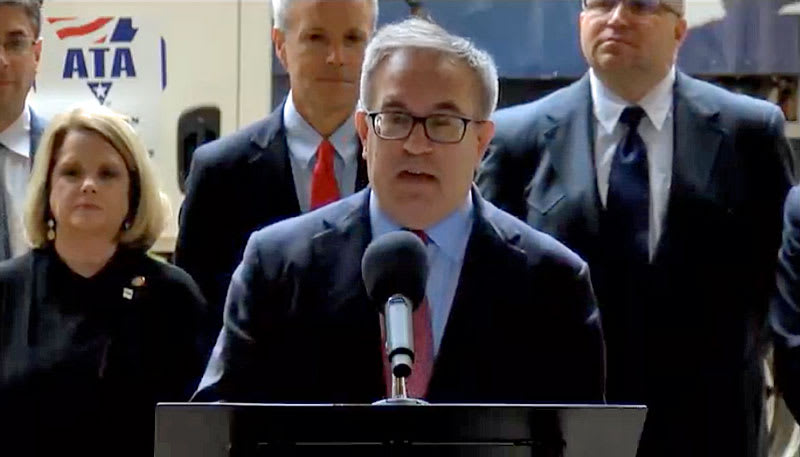
EPA Acting Administrator Andrew Wheeler announcing the agency's "Cleaner Trucks Initiative" on Nov. 13.
Photo: Screenshot of EPA live announcement
6 min to read
Seemingly acting out of character, the U.S. Environmental Protection Agency on Nov. 13 announced it will launch a rulemaking to further cut the emission of nitrogen oxide from diesel-powered heavy-duty trucks. EPA said it intends to publish a proposed NOx rule in early 2020.
While the EPA under President Trump has beenheavily engaged in rolling back dozens of environmental rules, the agency could now be said to be aiming to promulgate a single federal rule to forestall a patchwork of federal and state rules on NOx emissions from commercial vehicles.
Indeed, even as California moves toward writing new state emissions rules, trucking and truck-manufacturing lobbying groups along with state environmental officials have been pushing EPA to set a new nationwide rule on allowable NOx emissions for diesel trucks. California would actually prefer a national rule, if it is tight enough, as more than half the trucks delivering goods there are registered in other states.
EPA has tagged its new effort as the “Cleaner Trucks Initiative,” which Acting Administrator Andrew Wheeler said will include a “future” rulemaking that will update the existing (federal) NOx standard, which was last set in 2001. In addition, he said the new rule would “streamline” compliance and certification requirements.
“The Cleaner Trucks Initiative will help modernize heavy-duty truck engines, improving their efficiency, and providing cleaner air for all Americans,” said Wheeler, speaking at a public announcement in Washington that was shown live online.“The U.S. has made major reductions in NOx emissions, but it’s been nearly 20 years since EPA updated these standards. Through rulemaking and a comprehensive review of existing requirements, we will capitalize on these gains and incentivize new technologies to ensure our heavy-duty trucks are clean and remain a competitive method of transportation.”
“Today’s announcement makes clear that reducing NOx emissions from heavy-duty vehicles is a clean air priority for this administration,” said EPA Office of Air and Radiation Assistant Administrator Bill Wehrum. “EPA’s Cleaner Trucks Initiative is an important signal to all interested stakeholders that we will work hard on reducing emissions while producing a more effective and efficient program.”
EPA is not required by statue to update the NOx standard. However, in a news release, the agency asserted that although U.S. NOx emissions fell by more than 40% from 2007 to 2017, “there is more work to be done.” EPA estimates that heavy-duty trucks will be responsible for one-third of NOx emissions from the transportation sector in 2025. The agency said “any update to the standards will result in significant mobile source NOx reductions, which will aid communities across the country in the attainment of ozone and particulate matter standards.”
Referencing the agency’s rollback already of over two dozen regulations since Trump took office, EPA said that in addition to NOx emissions standards, the “CTI will cut unnecessary red tape while simplifying certification of compliance requirements for heavy-duty trucks and engines.”
The agency said that “areas of deregulatory focus will include onboard diagnostic requirements, cost-effective means of reassuring real world compliance by using modern and advanced technologies, the deterioration factor testing process, and concerns regarding annual recertification of engine families.”
Commenting on the EPA initiative, John Mies, manager of corporate communications for Volvo Group North America (parent of Volvo Trucks North America and Mack Trucks) told HDT that the OEM “supports the agency’s decision to investigate whether additional NOx reductions are needed to address any of the nation’s last remaining air quality challenges.
“This is a great opportunity to update and streamline the certification and compliance processes, ensuring a focus on real-world emissions control with minimal impediment to market vitality,” he continued.
Mies added that, historically speaking, trucking has “delivered dramatic emissions reductions in response to EPA’s leadership in developing challenging but practical national emissions regulations.”
The American Trucking Associations also applauded EPA for “taking the first step” toward issuing new NOx standards. “As an industry engaged in interstate commerce, ATA strongly favors a single national emission pathway as opposed to a patchwork of state standards,” ATA Executive Vice President of Advocacy Bill Sullivan said in a statement.
He pointed out that trucking has “repeatedly demonstrated that it can work proactively and in partnership with the federal government in achieving these aims. We look forward to working with the EPA in developing a standard that achieves nationwide air quality improvements across the country while maintaining a strong and robust economy.”
Global diesel engine maker Cummins Inc. also announced support for the EPA effort. “Cummins has a long history of working with regulators to help develop tough, clear and enforceable standards that lead to a cleaner, healthier and safer environment,” said Jennifer Rumsey, vice president and CTO. “We can and should do more to reduce NOx. This is an important step forward because a streamlined, national regulatory program brings consistency across the country allowing manufacturers to develop cleaner, more cost-effective solutions for our customers.”
The Diesel Technology Forum advocacy group said that EPA’s action “follows petitions for rulemaking from a number of state and local air agencies, as well as support for a new low NOx standard from truck and engine makers. The EPA last revised these standards in January 2001. The CTI proposal [rulemaking] is slated to be released in 2020.”
DTF added that it expects the planned low-NOX rulemaking for trucks will “help bring today's generation of diesel even nearer to zero emissions than ever before.”
Truck and Engine Manufacturers Association President Jed Mandel called the Cleaner Trucks Initiative “a tremendous opportunity. We – EPA and the manufacturers – have done this before, and we’re ready to step forward to do it again. We ask the agency to follow that same successful roadmap by leading a collaborative, open regulatory process involving all stakeholders.”
Mandel also stated that adopting a national low-NOX truck program with sufficient regulatory lead time, stability and certainty will be essential to provide a clear path for [truck and engine] manufacturers to succeed. “By working together,” he said, “we believe we can reduce emissions and improve and streamline the compliance program while at the same time preserve the necessary diversity of the commercial vehicle marketplace and protect the needs of our customers for durable, reliable products.”
Daimler Trucks North America, in a statement issued on Nov. 14, said it “strongly supports the EPA’s initiative to streamline regulatory requirements and improve air quality, while maintaining a regulatory framework that encourages reliable, durable products with low total cost of ownership.”
Sean Waters, DTNA’s director of regulatory compliance, said the OEM is “confident that the Cleaner Air Initiative will provide real world emission reductions, streamline certification and compliance, and continue to enable us to provide vehicles with the best TCO.”
EPA has set up a website devoted to its new Cleaner Trucks Initiative.
Updated Nov. 15 at 4:10 pm EST to add Daimler Trucks North America comments.
More Fuel Smarts

How Volvo Updated Its D13 for EPA 2027 [Watch]
Volvo’s updated D13 promises lower emissions without sacrificing performance or fuel economy. Take a closer look at what changed inside the engine in this HDT Spotlight video.
Read More →
Diesel Price Spike Shortens Payback for Natural Gas Trucks, Report Says
Energy Vision estimates fleets could recover the higher purchase price of an RNG-fueled Class 8 tractor in 1.3 to 2.8 years under current fuel-price scenarios.
Read More →
Calstart Becomes Catalyst Mobility, Reflecting Broader Focus
Calstart is now Catalyst Mobility, reflecting the nonprofit’s growing national role in clean transportation, including zero-emission trucks, infrastructure and incentive programs.
Read More →

Record Diesel Prices Squeeze Trucking Fleets
Average U.S. diesel prices have climbed to nearly $6 a gallon, surpassing the 2022 record as tight refinery capacity and Middle East disruptions keep fuel costs elevated.
Read More →
Sponsored•September 9, 2026
How Fuel Delivery Shapes Engine Performance
Fuel delivery depends on more than what happens at the injector. For fleet, maintenance and technical professionals, looking at the full path from pump to injector can provide useful context for understanding engine performance.
Read More →
East Coast Port Launches $45M Electric Truck Push
The Port Authority of New York and New Jersey announced millions in incentives for zero-emission drayage trucks, yard tractors, and new charging hubs near the port.
Read More →
California Bill Could Shed Light on Electric Truck Prices
Why do battery-electric Class 8 trucks remain so expensive? A California bill headed to Gov. Gavin Newsom would give fleets and state agencies more visibility into what manufacturers charge.
Read More →
Detroit Opens Orders for EPA 2027 Engines
Detroit isn’t starting from scratch to meet EPA 2027 diesel emissions standards. Its Gen 6 DD13 and DD15 engines keep much of today’s platform while updating the fuel and aftertreatment systems.
Read More →
Zero-Emission Truck Corridor Planned for West Coast
California, Oregon, Washington, British Columbia and Baja California are coordinating plans for truck charging and hydrogen fueling from Canada to Mexico.
Read More →
A Closer Look at Kenworth’s Electric T880E Vocational Truck [Video]
Learn more about Kenworth's T880E battery-electric vocational truck at the Paccar Technical Center, including its range, applications, upfitting considerations, and PTO options, in this HDT Spotlight video.
Read More →