





From the HDT archives: Opposed-Piston Diesels About Five Years Away
Opposed-Piston Diesels Enter Limited Production
A pair of heavy duty opposed-piston engines will be produced for an emissions-reduction project in California, officials with the program announced November 8 at a press event in San Diego.
November 9, 2018
3 min to read
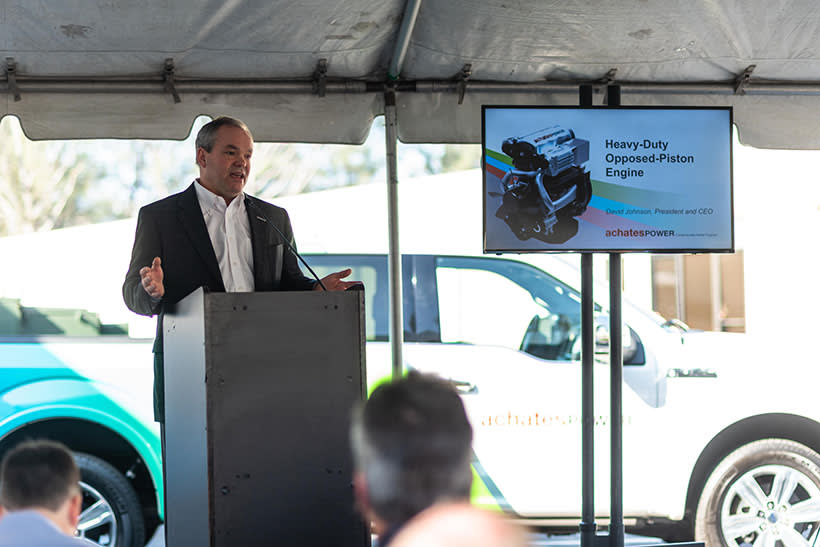
A pair of heavy-duty opposed-piston engines will be produced for an emissions-reduction project in California, officials with the program announced Nov. 8 at a press event in San Diego.
The two 10.6L, 450-hp engines designed by Achates Power will run in Peterbilt tractors in regular service to prove the low-emissions performance that they’ve demonstrated in laboratory simulations, officials said. They will be operated within the state by the transportation arms of Tyson Foods and Walmart, and will be running by late 2019.
Achates’ heavy-duty engine met the ultra-low nitrogen oxide standard of 0.02 gram per brake-horsepower-hour, which is 90% less than the current federal limit, said David Johnson, the firm’s president and CEO. That’s also up to 15-20% below the greenhouse gas requirement for carbon dioxide.
The 0.02 grams per brake horsepower-hour (g/bhp-hr) Ultra-Low NOx standard target has been achieved in natural gas engines but not yet in a production diesel engine, according to a company announcement.
The project team has started building the engines that will run in the Peterbilt demonstration vehicles.
Achates is a development company whose engineers have been working to perfect the opposed-piston, or OP, concept since 2004. It expects to license designs to existing engine manufacturers but will assemble the in-service test engines at its San Diego facility.
The demonstration project is funded by the California Air Resources Board (CARB) and several air-quality districts, and managed by CalStart, a Pasadena-based non-profit organization that encourages use of sustainable transportation methods.
The Achates OP engine also achieves superior fuel efficiency by virtue of its lower heat losses, improved combustion and reduced pumping losses, Johnson said. An OP engine has two pistons per cylinder, facing each other, and a central combustion chamber. Explosive fuel burn pushes the pistons apart and their connecting rods twist separate crankshafts at each end of the cylinder. Through pulleys and gears, the crankshafts transfer their power to a single output shaft.
It is a two-stroke design with no intake or exhaust valves; fuel-air mix and exhaust enter and leave the combustion chamber through ports in the cylinders.
Achates Power is leading a project team with personnel from Aramco Services, BASF, Corning, Dana, Delphi, Eaton, Faurecia, Federal Mogul, Honeywell, Litens and Federal Mogul, along with the Southwest Research Institute.
Peterbilt will integrate and deploy the new engine in two of its Model 579 Class 8 road tractors for the project.
“This project challenges conventional wisdom in the industry: that ultra-low NOx cannot be combined with ultra-high efficiency in a diesel engine,” said Bill Van Amburg, CalStart’s executive vice president. “This impressive team is showing that you can significantly improve air quality while also making progress on climate change. We can and must do both.
“Success in this project will support widespread commercial adoption of the ultra-low NOx standard in Class 7 and 8 trucks, which will support CARB’s – and the world’s – air quality and environmental goals.”
Said Johnson, “Achates Power is committed to bringing the opposed-piston engine to market to provide a practical solution for ultra-clean, ultra-efficient and cost-effective transportation. Our project with CalStart for CARB shows the need in the market for solutions that will meet the goals we all desire, without forcing solutions on the industry.”
Edited 3:45 p.m. EST 11/12/18 to clarify information about natural gas engines.
More Fuel Smarts

How Volvo Updated Its D13 for EPA 2027 [Watch]
Volvo’s updated D13 promises lower emissions without sacrificing performance or fuel economy. Take a closer look at what changed inside the engine in this HDT Spotlight video.
Read More →
Diesel Price Spike Shortens Payback for Natural Gas Trucks, Report Says
Energy Vision estimates fleets could recover the higher purchase price of an RNG-fueled Class 8 tractor in 1.3 to 2.8 years under current fuel-price scenarios.
Read More →
Calstart Becomes Catalyst Mobility, Reflecting Broader Focus
Calstart is now Catalyst Mobility, reflecting the nonprofit’s growing national role in clean transportation, including zero-emission trucks, infrastructure and incentive programs.
Read More →

Record Diesel Prices Squeeze Trucking Fleets
Average U.S. diesel prices have climbed to nearly $6 a gallon, surpassing the 2022 record as tight refinery capacity and Middle East disruptions keep fuel costs elevated.
Read More →
Sponsored•September 9, 2026
How Fuel Delivery Shapes Engine Performance
Fuel delivery depends on more than what happens at the injector. For fleet, maintenance and technical professionals, looking at the full path from pump to injector can provide useful context for understanding engine performance.
Read More →
East Coast Port Launches $45M Electric Truck Push
The Port Authority of New York and New Jersey announced millions in incentives for zero-emission drayage trucks, yard tractors, and new charging hubs near the port.
Read More →
California Bill Could Shed Light on Electric Truck Prices
Why do battery-electric Class 8 trucks remain so expensive? A California bill headed to Gov. Gavin Newsom would give fleets and state agencies more visibility into what manufacturers charge.
Read More →
Detroit Opens Orders for EPA 2027 Engines
Detroit isn’t starting from scratch to meet EPA 2027 diesel emissions standards. Its Gen 6 DD13 and DD15 engines keep much of today’s platform while updating the fuel and aftertreatment systems.
Read More →
Zero-Emission Truck Corridor Planned for West Coast
California, Oregon, Washington, British Columbia and Baja California are coordinating plans for truck charging and hydrogen fueling from Canada to Mexico.
Read More →
A Closer Look at Kenworth’s Electric T880E Vocational Truck [Video]
Learn more about Kenworth's T880E battery-electric vocational truck at the Paccar Technical Center, including its range, applications, upfitting considerations, and PTO options, in this HDT Spotlight video.
Read More →