




Fuel Smarts: Opposed-Piston Diesels About Five Years Away
Truck users can look forward to 30% better fuel economy at 10% lower production cost, says Achates Power

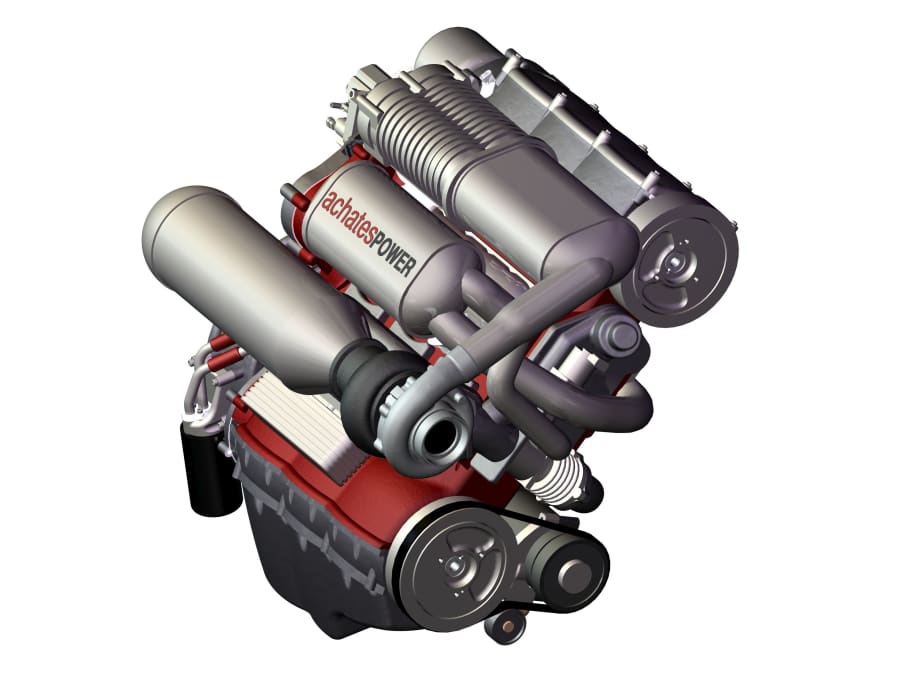
An OP can be configured and packaged to fit the vehicle it’s intended for. For trucks, the cylinders are likely to be vertical or slanted. Photo: Achates Power
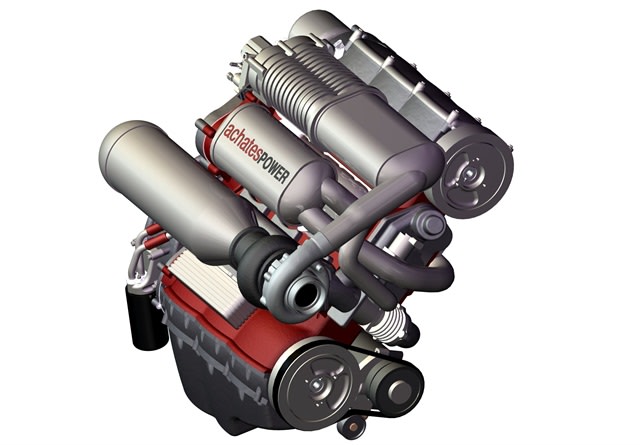
An OP can be configured and packaged to fit the vehicle it’s intended for. For trucks, the cylinders are likely to be vertical or slanted. Photo: Achates Power
Security’s tight at Achates Power Inc. in San Diego, where you don’t just walk into the light-industrial building and expect a tour of the labs — something common where R&D is under way. Before getting beyond the lobby, I had to prove that I’m an American citizen by showing my USA-issued passport.
One of Achates’ clients is the U.S. Army, which has the company’s engineers working on an opposed-piston engine design for possible use in a Hummer-like light/medium-duty utility truck. The military consumes huge quantities of fuel, and much of that has been in distant war zones, like Afghanistan, where fuel has to be shipped in at great expense. It believes the OP engine may be an answer.
An OP engine has two pistons per cylinder, facing each other, and a central combustion chamber. Explosive fuel burn pushes the pistons apart and their connecting rods twist separate crankshafts at each end of the cylinder. Through pulleys and gears, the crankshafts transfer their power to a single output shaft. Ports in the cylinders allow entry of air and expulsion of exhaust gases, and pistons compress and fire every time they meet — a two-stroke design, made famous by General Motors and Detroit diesels starting in the 1930s. Like them, an Achates OP has no intake or exhaust valves, but no heavy cylinder heads, either.
The relatively simple OP design promises a substantial increase in fuel economy — about 30% better than current conventional piston engines, say Achates executives and engineers.
Moreover, they say their OP diesels will meet current and future emissions limits and cost 10% less to manufacture. In contrast, a government-sponsored study concluded that a 23% fuel economy improvement would cost the buyer of a traditional engine about $23,000, says David Johnson, Achates’ president and chief executive officer.
Such financial advantages have the attention of commercial interests, including Fairbanks Morse Engine, a long-time builder of opposed-piston diesels for transportation, industrial, marine and military use. FM, which sells diesel and dual-fuel OP engines, wants the refinement that Achates people are applying to the 80-year-old concept.
No, the opposed-piston concept is not new. The 30% fuel-savings figure was established in the mid 1930s by Junkers of Germany in its Juno 205 OP aircraft engine, Johnson explained.
Achates, co-founded by an aircraft designer and an engineer, began modernizing the OP concept in 2004. It has assembled a team of highly trained and experienced engineers performing intricate design work. They’ve got engines running on test stands, and are working slowly and deliberately to be sure they’re getting every advancement right.
For example, engineers are designing a wrist pin bearing with a contour that reduces friction while still standing up to constant pounding as it transfers power toward the crankshafts. Conventional piston engines have those parts, but how they work in OP engines is subtly different, Johnson said. Of course modern OP diesels have electronic controls. And to further meet emissions limits, an OP diesel uses exhaust-gas recirculation and exhaust aftertreatment devices, but needs less equipment.
One principle responsible for an OP engine’s high efficiency is its large amount of piston travel versus bore size, a ratio of 2.4 to 1, explained Johnson and James Lemke, Achates’ co-founder and chief scientist. Another is the central combustion chamber, which works comparatively slowly and gets multi-metered fuel from two injectors. These reduce heat rejection and use more of a fuel’s energy compared to conventional engines with their single piston and combustion chamber per cylinder.
Brake-thermal efficiency of a 4.9-liter, three-cylinder/six-piston Achates OP diesel now being tested is 47.8%, compared to typical BTEs in the high 30- to low 40% range for conventional midrange diesels. The best current 15-liter truck engine is the Cummins ISX, with 43.4% BTE, but Achates is projecting 51.5% BTE for an engine of comparable power. (A 50% BTE target is one of the goals of the U.S. Department of Energy's SuperTruck program, and so far only one of the research teams developing demo trucks has surpassed that.)
In addition, an OP diesel can burn many fuels, and will readily handle natural gas with just a 1% shot of diesel as the ignition agent.
An Achates heavy truck engine of 11 to 13 liters in displacement will produce 400 to 600 horsepower and 1,475 to 1,625 pounds-feet, Johnson says. An extra port in each cylinder will enable engine braking at similar levels. A heavy-duty engine will have three cylinders and six pistons, but with a larger bore and stroke than that 4.9-liter light-truck engine’s.
The smaller engine, being tested on a dynamometer stand for the military, has horizontal cylinders with accessories cantilevered at various points. But an OP can be configured and packaged to fit the vehicle it’s intended for. For trucks, the cylinders are likely to be vertical or slanted. Without cylinder heads, it’ll sit low in the chassis, allowing a low hood and nose to reduce air drag and improve driver visibility. With reduced heat rejection, the radiator can be relatively small and fit in that small nose.
The Achates team expects to have engines running in trucks in about three years, Johnson said. In five years they’ll probably be in production. Achates, though, won’t build them; instead it will license its patented technology for combustion, piston design, cylinder cooling and air handling to established engine companies who can use existing facilities to produce them. “We’re in touch with just about everybody in the world” who makes engines, Johnson said.
More Fuel Smarts

How Volvo Updated Its D13 for EPA 2027 [Watch]
Volvo’s updated D13 promises lower emissions without sacrificing performance or fuel economy. Take a closer look at what changed inside the engine in this HDT Spotlight video.
Read More →
Diesel Price Spike Shortens Payback for Natural Gas Trucks, Report Says
Energy Vision estimates fleets could recover the higher purchase price of an RNG-fueled Class 8 tractor in 1.3 to 2.8 years under current fuel-price scenarios.
Read More →
Calstart Becomes Catalyst Mobility, Reflecting Broader Focus
Calstart is now Catalyst Mobility, reflecting the nonprofit’s growing national role in clean transportation, including zero-emission trucks, infrastructure and incentive programs.
Read More →

Record Diesel Prices Squeeze Trucking Fleets
Average U.S. diesel prices have climbed to nearly $6 a gallon, surpassing the 2022 record as tight refinery capacity and Middle East disruptions keep fuel costs elevated.
Read More →
How Fuel Delivery Shapes Engine Performance
Fuel delivery depends on more than what happens at the injector. For fleet, maintenance and technical professionals, looking at the full path from pump to injector can provide useful context for understanding engine performance.
Read More →
East Coast Port Launches $45M Electric Truck Push
The Port Authority of New York and New Jersey announced millions in incentives for zero-emission drayage trucks, yard tractors, and new charging hubs near the port.
Read More →
California Bill Could Shed Light on Electric Truck Prices
Why do battery-electric Class 8 trucks remain so expensive? A California bill headed to Gov. Gavin Newsom would give fleets and state agencies more visibility into what manufacturers charge.
Read More →
Detroit Opens Orders for EPA 2027 Engines
Detroit isn’t starting from scratch to meet EPA 2027 diesel emissions standards. Its Gen 6 DD13 and DD15 engines keep much of today’s platform while updating the fuel and aftertreatment systems.
Read More →
Zero-Emission Truck Corridor Planned for West Coast
California, Oregon, Washington, British Columbia and Baja California are coordinating plans for truck charging and hydrogen fueling from Canada to Mexico.
Read More →
A Closer Look at Kenworth’s Electric T880E Vocational Truck [Video]
Learn more about Kenworth's T880E battery-electric vocational truck at the Paccar Technical Center, including its range, applications, upfitting considerations, and PTO options, in this HDT Spotlight video.
Read More →