




The Lowly Fifth Wheel Receives a Technology Boost
Even the fifth wheel, the most basic of trucking components, is finally getting a technological update to make them safer and easier to use.

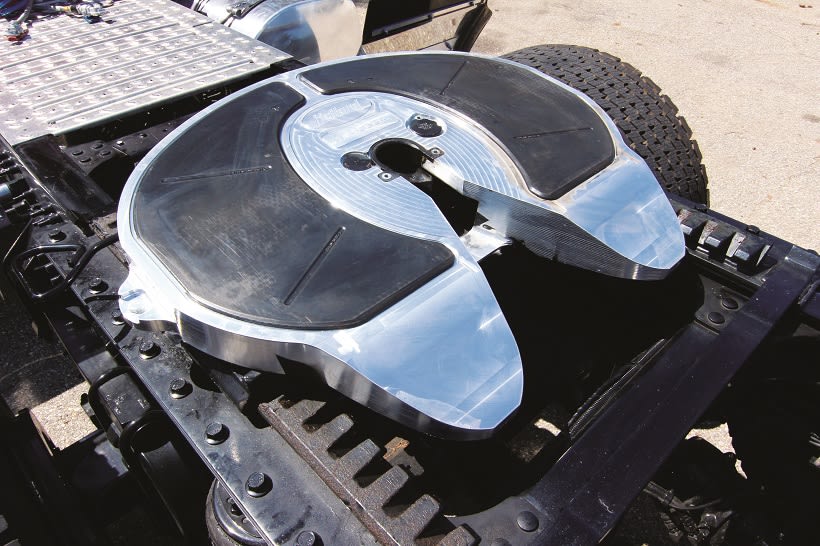
Even this most basic of trucking components is getting a technological update.
Photo courtesy SAF-Holland
Is there any component on a Class 8 tractor less glamorous, but more vital, than the fifth wheel?
Well, maybe the lowly wheel end. But nothing enables the concept of a tractor-trailer more than the fifth wheel. The vital connection it makes between a power unit and a trailer filled with cargo is crucial to safe, efficient, and profitable fleet operations.
Fifth wheels have a brutal job. They must maintain a solid, physical connection between the tractor and trailer, endure enormous stress and shock loads, all the while maintaining full articulation to handle maneuvering in tight surroundings. And yet, despite the simplicity of their design, like almost every other component on a tractor-trailer, fifth wheels are undergoing some rather dramatic changes.
The driver shortage is a prime motivator driving fifth design changes, says Pat McNamara, director of national accounts for fifth wheel manufacturer SAF-Holland. McNamara says as older drivers retire, and newer drivers — often without any previous connection to trucking — enter the industry, ease of use is becoming the defining characteristic driving fifth wheel design. Even telematics systems are starting to come into play as fleets look for new ways to help drivers with the coupling process.
“Our new Holland ELI-te Fifth Wheel Coupling Assistant is a prime example of this trend,” McNamara says. “ELI-te stands for Electronic Lock Indicator-technology enhanced — a new, technology-enabled system that eases the coupling of a tractor and trailer, along with the use of air releases to enable quick disconnects, which has continued to grow year over year.”
Jost International last year introduced a series of air-release fifth wheels with sensor technology that allows the driver to confirm that the fifth wheel is safely and properly coupled. The company says aerodynamic side skirts and other add-ons make it difficult for a driver to access the fifth wheel for uncoupling and visually confirming a safe couple.
These are trends that Aaron Puckett, vice president of regional sales for Fontaine Fifth Wheel, sees as well. “We are seeing definite trends toward a preference for in-cab air release options,” he says, noting that this trend is also driven by driver retention issues. “Fleets are investigating inspection lights, cameras and sensors,” he adds. “But so far, most have not made any commitments on these new technologies based on the added acquisition costs.”
Other trends Puckett sees are shorter air slides and lower fifth wheel heights, which he says are now the normal spec on most new truck purchases. Most of the air slides Fontaine sells today are 12-inch slide lengths with a 6.75-inch fifth wheel height. It is also common to see fleets spec’ing removable slide stops to lock down the air slide — even if it’s an option they never use themselves. “They buy the truck with an air slide for the resale value but lock down all slide movement while the truck is being used in their fleet,” he explains. If you plan to keep your truck for less than six years, you most likely want to go with an air slide system. “If you’re going to keep a truck for more than six years, and really do not require an air slide, then going with a stationary mount will reduce both your acquisition costs and your fifth wheel weight,” Puckett says.
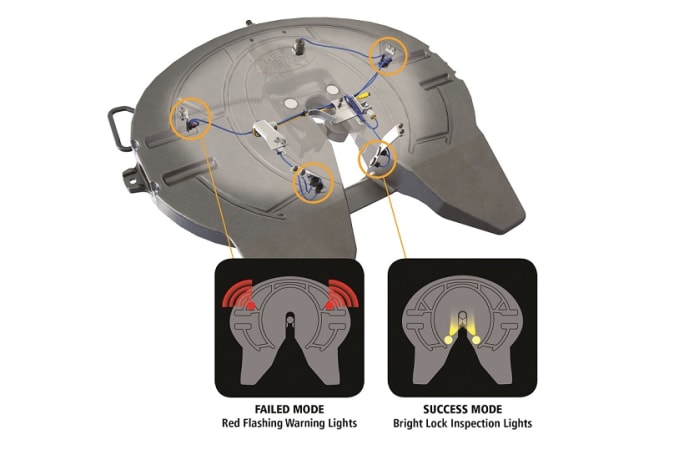
New fifth wheel features are making it easier for drivers, such as Holland’s ELI-te Fifth Wheel Coupling Assistant, which helps drivers know when the fifth wheel is properly locked around the kingpin.
Image courtesy SAF Holland
Do you have the right fifth wheel?
Application remains the top criteria for spec’ing a fifth wheel correctly, both McNamara and Puckett say. There are a multitude of signs fleet managers and technicians can look for that are clues you have the wrong fifth wheel.
You need to start by talking with your drivers, Puckett says, to figure out if your fifth wheel spec is working properly out in the field. If a fifth wheel is improperly spec’d, drivers will often report locking issues or complain of slack they feel between the truck and trailer. And even just eyeballing your trucks can tell you a lot about the fifth wheel, he says, as incorrect fifth wheel heights or specs can cause issues with landing gear deployment or overall trailer height.
Technicians can also give you valuable feedback on fifth wheels, Puckett notes. “Cracks in the fifth wheel that appear over time are another sign you need to reexamine your spec,” he says. “But if a new fifth wheel is being properly maintained and your maintenance team is seeing major repairs within the first 24-36 months, that’s a leading sign of a poorly specified fifth wheel.”
McNamara advises fleet managers to watch for locking components and/or top plates that have excessive wear, cracks, distortion, or loose bracket pin holes or lock pin holes. “If you do find any of these issues, then working closely with the dealer when spec’ing the fifth wheel is vital for assuring the tractor is properly spec’d for the application,” he says. “And in extreme cases, where you’d having difficulty getting the answers you need, you can always reach out to your fifth wheel manufacturer and talk with an application engineer to get help with application issues.”
At the same time, McNamara says, fifth wheels often take the blame for operational issues when other components are actually at fault. “Technicians should inspect for unusual wear on locks as well as the top plate itself,” he says. “In addition to the fifth wheel, it is important that fleets also inspect trailer kingpins to ensure that they meet all wear specifications, ensuring that the fifth wheel can operate properly. Finally, it is key that all PM programs have a visual inspection to check for any broken components. The technician should use the lock tester to ensure the wheel and lock set is operating properly, and that the wheel in use meets the specifications of [the] application.”
Saving weight
In addition to driver issues, another clear trend in fifth wheels in some applications is the push for lighter weight components that can withstand the daily rigors of trucking while helping maximize payload. McNamara says SAF-Holland has been a pioneer in designing lighter-weight fifth wheels with its FWAL aluminum design that weighs in at a featherweight 157 pounds. “That is significantly less than a steel or ductile iron fifth wheel,” McNamara says. “But the FWAL is still rated for 55,000 pounds vertical capacity and has optional air release.”
Fontaine has its own lightweight fifth wheel line, which Puckett says weighs around 60 pounds less than previous designs, but is still tough enough to handle standard to moderately severe applications.
“We do not recommend spec’ing lightweight fifth wheels for most vocational applications, however,” he cautions. “Steel fifth wheels are still the preferred spec for tough vocational jobs. And even when you’re spec’ing a stronger fifth wheel top plate, it is vital to make sure to ask the dealer if the lower mount, air slide or stationary, is rated for vocational applications to ensure durability in the field.”
Lighter, safer, and easier to use, but still tough enough to handle the task at hand. It’s a maxim that holds true across trucking today. And even the lowly, unsung fifth wheel is getting updated as this trend gains speed across the industry.
Related: Why Proper Fifth Wheel Maintenance is Important
More Equipment

How Volvo Updated Its D13 for EPA 2027 [Watch]
Volvo’s updated D13 promises lower emissions without sacrificing performance or fuel economy. Take a closer look at what changed inside the engine in this HDT Spotlight video.
Read More →
Michelin Tire Improves Efficiency and Durability for Regional Fleets
The Michelin X Multi Energy D2 is a regional haul drive tire engineered to help fleets improve fuel efficiency, durability and traction in demanding stop-and-go operations.
Read More →
ZF Expands Commercial Vehicle Push in North America
ZF is expanding its North American commercial-vehicle presence with new transmission applications, electrification, trailer technology and autonomous-driving systems.
Read More →
Tesla Wants a Self-Driving Semi. Are Cameras Enough?
Could Tesla’s camera-only autonomous driving technology work on an 80,000-pound Semi? In this commentary, HDT's Deborah Lockridge takes a look at Tesla, Cybercab, and how autonomous trucks see the road.
Read More →
Kodiak: Driverless Long-Haul Truck Launch on Track for 2026
Kodiak AI says its driverless long-haul safety case is 93% complete and it remains on track to begin commercial operations by year-end 2026.
Read More →
What DOT’s Automated Vehicle Strategy Means for Trucking
The U.S. Department of Transportation issued a new automated-vehicle strategy that outlines plans for driverless-truck regulations, cross-state freight corridors, and federal safety standards.
Read More →
East Coast Port Launches $45M Electric Truck Push
The Port Authority of New York and New Jersey announced millions in incentives for zero-emission drayage trucks, yard tractors, and new charging hubs near the port.
Read More →
PlusAI Going Public to Fund Autonomous Truck Launch
A SPAC deal could provide PlusAI with up to $300 million as it works toward a 2027 commercial launch of factory-built autonomous trucks.
Read More →
NHTSA Moves to Rewrite Truck Fuel-Economy Rules
The National Highway Traffic Safety Administration says it lacks authority to regulate medium- and heavy-duty truck engines separately from complete vehicles, but the existing standards have not yet been eliminated.
Read More →
Detroit Opens Orders for EPA 2027 Engines
Detroit isn’t starting from scratch to meet EPA 2027 diesel emissions standards. Its Gen 6 DD13 and DD15 engines keep much of today’s platform while updating the fuel and aftertreatment systems.
Read More →