Proper fifth wheel maintenance is important to ensure the tractor and trailer stay together.
3 min to read
Proper fifth wheel maintenance is important to ensure the tractor and trailer stay together.
Runaway trailer hits minivan.” That’s what the headline screamed. While the details of why the trailer separated from the tractor in upstate New York have yet to be sorted out, the events underscore the important role the fifth wheel plays in truck safety.
Ad Loading...
Like any safety-related component, the fifth wheel needs to be in good operating condition to do its job properly. “It’s important to maintain the fifth wheel because it is the sole component that connects the tractor to the trailer,” says Rob Nissen, director of field sales for SAF-Holland.
Fifth wheel manufacturers recommend performing fifth wheel maintenance every three months or 30,000 miles.
Ad Loading...
“You need to lubricate it through all four seasons,” says Charles Rosato, field service manager for Fontaine Fifth Wheel. “That also gives you four chances to inspect it each year.” If you choose not to do that, you should at least clean the locking mechanism every six months or 60,000 miles.
However, lubrication is not the only maintenance needed on a fifth wheel. According to Mike Jones, senior account manager at Jost, it’s important to inspect the fifth wheel for damage.
“Before you can do that, you need to degrease it with a degreasing compound or steam cleaning device,” he says.
Grease can build up on the fifth wheel and attract dirt and debris, so degreasing it prior to inspecting it allows you to see any potential damage more easily.
“Get the old grease off and look for any cracks, broken welds, and damaged or missing components,” Rosato says. “You really won’t be able to see those things unless you get the grease off.”
Ad Loading...
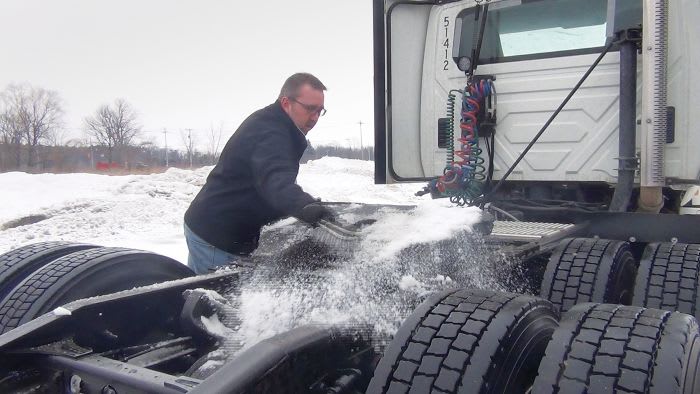
It is also very important to make sure all the grease buildup is removed in and around the lock jaw, throat and pivot points. This is especially important before winter sets in, Rosato says.
“People keep adding grease [throughout the year] and you might be able to get away with that in the summertime,” he says. “But in the winter the old grease, which has picked up a lot of road grime and contaminants, can freeze. You could end up with a grapefruit-size piece of frozen grease inside your fifth wheel, and that will keep the lock from operating properly.”
His recommendation is to thoroughly degrease the fifth wheel and then regrease the mechanism with a thin coat of 90-weight gear oil. Jones says it’s important to use a lithium EP (extreme pressure) grease on the plate if you want to ensure the fifth wheel operates smoothly.
Just as important as winter fifth wheel service is servicing it in the spring. “The lube get washed off or worn away because of winter conditions,” Nissen says. “In addition, the sodium chloride and magnesium chloride that states are putting on the roads are brutal not just on fifth wheels but on other components as well.” According to Nissen, those deicing chemicals can dry out the fifth wheel and cause rust to form. “When things get rusty and corroded, everything starts moving slower and that is a problem because the coupling and uncoupling of the fifth wheel depends on timing. Things need to be free and loose so the [tractor and trailer] can snap into place.”
A maintenance manual from SAF-Holland sums up the importance of fifth wheel maintenance. “Failure to properly maintain your fifth wheel could result in tractor-trailer separation which, if not avoided, could result in death or serious injury.”
Ad Loading...
Nissen says, “To me it is worth an hour of your time to clean the fifth wheel, look at it, check the adjustment, and relubricate it before putting it back on the street, because one failure can be catastrophic.”
Step-by-step
This quick checklist of key points of fifth wheel maintenance was culled from maintenance manuals and bulletins from Fontaine Fifth Wheel, Jost and SAF-Holland. For complete maintenance procedures consult the fifth wheel manufacturer’s maintenance manual.
Clean dirt, debris and grease from the fifth wheel and mounting brackets. Pay special attention to the areas around the lock jaw, throat and pivot points.
Inspect for cracks, wear and damaged moving parts.
Check bracket liner thickness at all scheduled maintenance intervals. Replace liners that are broken or have worn excessively or if liner thickness is less than 0.125 in. at the top of the liner.
Replace liners every 300,000 miles in standard-duty applications and every 180,000 miles in moderate- or severe-duty applications.
Inspect bracket pin bolts, and make sure locking tabs are properly securing the bolts.
Replace worn or damaged parts as needed
Apply new water-resistant lithium grease to all fifth wheel-to-trailer contact surfaces. This includes: yoke tips where contact is made with the locks and casting, cam profile, yoke shaft in the area that slides in and out of the fifth wheel casting, secondary lock where contact is made with the cam plate, release handle and where contact is made with the kingpin.
Lubricate the kingpin lock.
Apply a light oil to all moving parts.
For sliding fifth wheels, spray diesel fuel on slide path of the base plate.
Check fifth wheel operation. Lock and unlock using a lock tester. The lock should not be too loose or too tight.
Check for proper fore and aft articulation.
Verify that the fifth wheel closes completely and is operating properly.
PrePass Intelligence helps fleets measure bypass savings, flag potential toll overcharges, and spot suspicious transactions by combining data from separate systems.
An NTSB investigation found that last-minute lane changes and large speed differences at an Ohio toll plaza created a hazard the truck driver couldn't avoid in time.
English language proficiency rules for commercial drivers aren’t new, but renewed out-of-service enforcement has raised the stakes. Here’s what carriers need to know before a driver reaches a roadside inspection.
Marijuana is getting stronger, laws are changing, and drug tests still can’t reliably establish impairment. What does that mean for truck drivers and the fleets that employ them?
The system will allow enforcement agencies to verify Enhanced Inspection information and decide whether Kodiak’s autonomous trucks can bypass roadside screening sites.
After three decades in trucking, Harold Perry shares what he's learned about driver safety, mentorship, and helping the next generation build confidence behind the wheel.
Carriers whose updates were due on or after June 1 have more time, while FMCSA works to stabilize its new registration system and warns of phishing sites impersonating its new carrier registration system, Motus.
ZF is expanding its North American commercial-vehicle presence with new transmission applications, electrification, trailer technology and autonomous-driving systems.
Fleets have more visibility into truck health, safety events, and driver activity than ever. The next challenge is turning all that information into useful guidance for the person who has to decide what to do next.