




9 Tips for Better Trailer Maintenance
Don’t treat your trailers as an afterthought. Give them the attention they deserve by inspecting and maintaining them on a regular basis.


Check tire pressure and tread depth to help avoid on-road breakdowns.
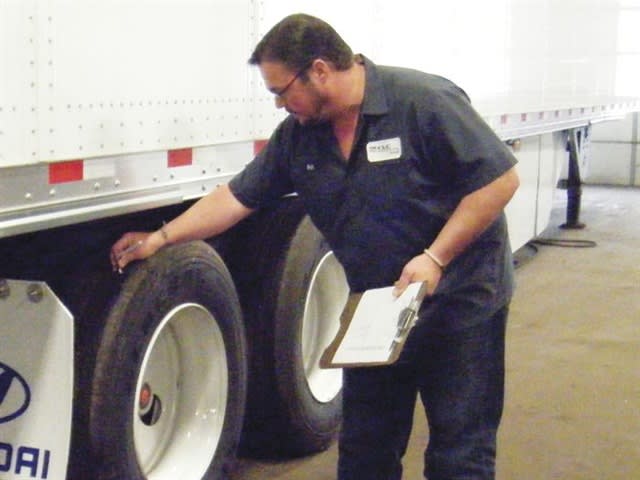
Check tire pressure and tread depth to help avoid on-road breakdowns.
When talk turns to maintenance, it’s usually the tractor that gets all the attention. While today’s trailers are designed to last longer, they still need some TLC.
The following trailer maintenance tips can help ensure your trailers are always in top operating condition.
1. Check the air
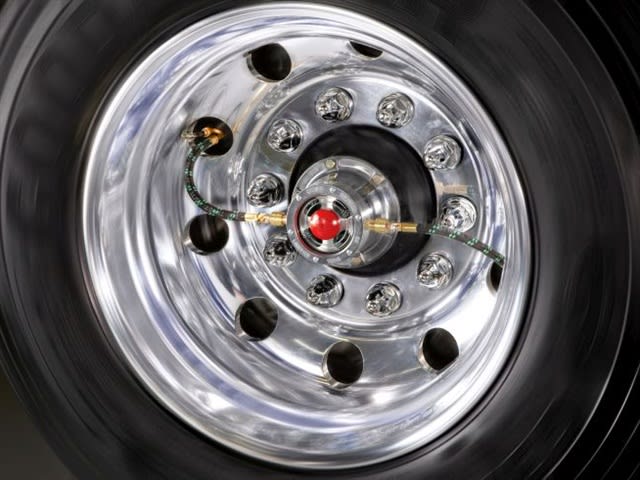
It’s important to make sure tires operate at the proper inflation level. If you use tire pressure monitoring/inflation systems make sure to inspect them for leaks.
Tires are a major expense, so they deserve your attention. “Proper tire air pressure is key to tire longevity,” says Mike Goor, president of Contract Leasing Corp., a trailer leasing, sales and service company. Since drivers are often too busy to check tires as they should, he recommends tire pressure monitoring or inflation systems.
However, these systems need their own attention, notes John Morgan, senior product manager at Meritor. “Check the supply hose connection to the tire on a regular basis and occasionally look for leaks.”
Chris Steph, Stemco Intelligent Transportation Systems business leader, suggests these three simple checks:
• Verify that the system pressure is set correctly
• Check the auxiliary battery switch (ABS)/auxiliary power fuse
• Check the system shut-off valve position.
More specifically, check regulator pressure at least once a quarter and check the power fuse monthly, since the driver warning lamp will not illuminate without power. The system shut-off valve needs to be checked every time there is a visual inspection of the trailer.
If your tires are properly inflated but you’re still seeing tire wear, the problem is probably not with the tires, says Russ Franks, field service manager for Meritor. “Unusual tire wear is an indication you have something wrong with the undercarriage, suspension, shock absorbers or axle alignment.”
2. Inspect suspensions
Visually inspect suspensions looking for signs of irregular wear, tears or heat cracks on the air springs, advises Dave Vanette, new business development manager at Firestone Industrial Products. Make sure nothing is touching the suspension or interfering with its movement. Also make sure air springs have sufficient and equal pressure.
Every air suspension has a defined ride height position, “but sometimes it gets damaged or tinkered with,” Franks says. If the ride height is not correct, you will not reap the full benefits of an air-ride suspension. Make sure the ride height is not too high because it can interfere with safely navigating overpasses. If there is too little air, instead of riding on the air bag, the trailer will ride on the suspension’s bumpers, which damages other suspension components.
3. Lube it correctly
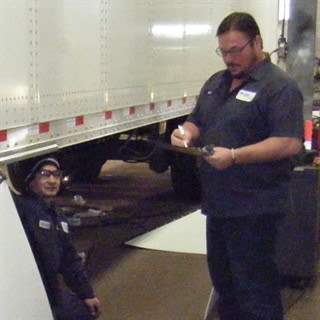
Sometimes it’s necessary to crawl under the trailer to inspect undercarriage components.
The correct lube in the right amount is essential to proper trailer operation. Grease has three characteristics, according to Donna Mosher, lubricant specialist for Eaton Vehicle Group. The thickening system, grade and performance rating are all important in selecting the right grease.
“Ninety percent of greases are lithium complex based, but some are calcium based.” But don’t mix the two greases, as performance will drop. The grade of the grease speaks to its viscosity and most grease used on trailers is NLGI, which, according to Mosher, “has the consistency of peanut butter.”
The performance characteristics of the grease can be harder to find, as not all grease manufacturers put it on the label. Consult with the grease manufacturer to ensure you’re getting a grease with the proper performance characteristics.
Make sure you add enough new grease to purge the old grease. “It’s not that the old grease wears out, but the debris that cling to the grease make it ineffective. Adding new greases purges the dirt,” she says.
4. Take time for brakes
John Thompson, sales manager at TMD Friction, suggests using the following procedure to check trailer brakes.
“On wheel ends with spring brakes applied, look at the angle formed by the air chamber push rod and slack adjuster. That angle should be 90 degrees. If it isn’t, the brake is out of adjustment and needs to be fixed.”
Morgan suggests checking drum conditions while performing brake or wheel end service. “Measure the drums to make sure there is enough material to last until the next maintenance inspection. If it’s borderline, replace it.”
5. Keep it lit up
An inoperable trailer light is like waving a red flag and asking to be pulled over for a roadside inspection, according to Brett Johnson, president and CEO of Optronics International. Corrosion is the enemy of the electrical system, and the liquid road salt used to de-ice roads attacks electrical connections.
“When the right steps are not taken to prevent corrosion, it can spread throughout a vehicle, significantly shortening its life and that of the electrical system,” Johnson adds. Regularly inspect lamps, wires and harness systems and replace grease when needed at connection points.
6. Keep it clean

The lighting and electrical systems are susceptible to corrosion. Be sure to inspect connections and replace lamps as needed.
De-icing chemicals don’t just attack electrical connections. They also attack metal parts.
“Routinely wash equipment after exposure [to these chemicals],” says Greg Smith, vice president of sales and marketing for Talbert Trailers. “Most importantly, wash the underside where chemicals can remain undetected.”
A clean trailer also allows you to more easily spot trailer problems, according to Jeff Hopper, director of sales for trailer manufacturer Direct Trailer. He recommends trailers be washed every 45 days and brought into the shop every 45 to 60 for a more thorough inspection.
While Hopper says pre- and post-trip inspections are the starting point for a good maintenance effort, “you have to do more than check the boxes on the list. The driver has to actually do a thorough and complete check.”
Smith also recommends checking for debris that may be caught in trailer components, being especially mindful of the hydraulic system. If the hydraulic system gets compromised it could begin leaking hydraulic fluid, which is considered toxic.
7. Don’t forget the inside
While drivers may do a great job looking at things outside the trailer, they may forget to take a peek inside. Bob Tyman, general manager of River States Truck & Trailer, a Wisconsin-based Freightliner dealer, stresses the importance of looking for things like holes in the roof and broken aluminum cross members. “Holes in the roof can cause leaks which could damage cargo” as well as letting potentially damaging moisture into the trailer.
8. Check security
Your trailer maintenance must include a close inspection of tiedown straps, chains, ratchets and winches. Look for holes, tears, cuts, snags, loose stitching or embedded particles in the straps and at securing hardware, including loose logistics tracks on the inside of the trailer or rusted winches and hooks on the outside.
Washing tiedowns is not recommended, according to Ralph Abato, president of Doleco USA, a manufacturer of cargo securement products. “Washing has an adverse affect on the nylon tiedown straps and actually will cause the grit to grind into the fiber, reducing strap integrity and work load limits,” he says. “Dirty is better than washing.”
Abato also says winches need to be regularly lubricated, and ratchets lightly oiled to keep them in good working order.
9. Prioritize prevention
When it comes to trailers, Morgan, says, prevention is important. “Look for little symptoms that if fixed prevent big damage.”
Or as Hopper put it, “If it moves, slides or goes up and down, it needs to be inspected on a regular basis.”
More Equipment

Used-Truck Remarketing Math Is Changing
Used-truck value is no longer just a concern at trade-in. Decisions made throughout a truck’s first life can influence what it’s worth years later.
Read More →
How Volvo Updated Its D13 for EPA 2027 [Watch]
Volvo’s updated D13 promises lower emissions without sacrificing performance or fuel economy. Take a closer look at what changed inside the engine in this HDT Spotlight video.
Read More →
Michelin Tire Improves Efficiency and Durability for Regional Fleets
The Michelin X Multi Energy D2 is a regional haul drive tire engineered to help fleets improve fuel efficiency, durability and traction in demanding stop-and-go operations.
Read More →
ZF Expands Commercial Vehicle Push in North America
ZF is expanding its North American commercial-vehicle presence with new transmission applications, electrification, trailer technology and autonomous-driving systems.
Read More →
Tesla Wants a Self-Driving Semi. Are Cameras Enough?
Could Tesla’s camera-only autonomous driving technology work on an 80,000-pound Semi? In this commentary, HDT's Deborah Lockridge takes a look at Tesla, Cybercab, and how autonomous trucks see the road.
Read More →
Kodiak: Driverless Long-Haul Truck Launch on Track for 2026
Kodiak AI says its driverless long-haul safety case is 93% complete and it remains on track to begin commercial operations by year-end 2026.
Read More →
What DOT’s Automated Vehicle Strategy Means for Trucking
The U.S. Department of Transportation issued a new automated-vehicle strategy that outlines plans for driverless-truck regulations, cross-state freight corridors, and federal safety standards.
Read More →
East Coast Port Launches $45M Electric Truck Push
The Port Authority of New York and New Jersey announced millions in incentives for zero-emission drayage trucks, yard tractors, and new charging hubs near the port.
Read More →
PlusAI Going Public to Fund Autonomous Truck Launch
A SPAC deal could provide PlusAI with up to $300 million as it works toward a 2027 commercial launch of factory-built autonomous trucks.
Read More →
NHTSA Moves to Rewrite Truck Fuel-Economy Rules
The National Highway Traffic Safety Administration says it lacks authority to regulate medium- and heavy-duty truck engines separately from complete vehicles, but the existing standards have not yet been eliminated.
Read More →