




Avoiding Damage From Aggressive Cargoes
The Liquid Products Database lists 5,000-plus substances and how they affect the interior walls of tank trailers.


A corrosive fluid pitted this stainless steel tanker’s interior and started serious rusting. It might or might not be repairable. Once pitting occurs, the material is weakened and it’s likely to happen again. Knowing exactly what a commodity is enables a carrier to use the correct type of tanker and avoid such expensive damage.

A corrosive fluid pitted this stainless steel tanker’s interior and started serious rusting. It might or might not be repairable. Once pitting occurs, the material is weakened and it’s likely to happen again. Knowing exactly what a commodity is enables a carrier to use the correct type of tanker and avoid such expensive damage.
Here’s the scenerio: A carrier sends a tanker rig to a chemicals manufacturer for a load of ferric acid. The tank is made of stainless steel, and should be able to carry the acid safely. Unbeknownst to the carrier, the customer has added a chloride to the brew, making it more aggressive and damaging. Sooner or later, the tank’s interior is found to be pitted, making for costly repairs, or worse, leaks have developed. The $100,000 trailer is shot.
John Cannon, vice president for engineering at The Walker Group, a unit of Wabash National Corp., has heard of such events from customers, who began talking about them at the group’s annual exposition in Fond du Lac, Wisc. Tank products from the Walker, Brenner, Garsite and Bulk divisions were usually the features at the meeting for motor carrier representatives, but the damage issue became a stronger topic.
“It came to a head at the 2012 expo, when we talked about it and decided to do something about it,” he recalls. The result was the Corrosion Initiative, which quickly became the Liquid Products Database. This is a compilation of chemical products and all their variations, with information on how they affect materials used in tank construction and how they can be dealt with. Early on, the informal group of stakeholders turned over the project to the National Tank Truck Carriers, a conference of the American Trucking Associations.
NTTC is paying Battelle Memorial Institute, a scientific research organization based in Columbus, Ohio, to compile the database, according to Dan Furth, the conference’s president. Work began about six months ago.
“We own it and pay for all of it,” he says of the database. “We agreed to go to $100,000 in the first phase of development. I think we’ll continue to fund it. We’re asking folks to send in information on more and more products. Some of our big member-carriers have tools that they use already. Then we’ll engage our partners, like the chemical manufacturers. It’s a rather technical thing when you get a bunch of metallurgists around a table, and chemists. We’re trying to gauge the corrosivity of the chemicals we haul. A lot of them are in the public domain. Where we don’t know we can have our partners at Battelle test them.”
“It’s to put information at the fingertips of the carriers so they can decide whether to take the load,” says Doug Pape, the project manager and a senior research engineer at Battelle. “They want to know what the load will do to the tank,” he explains.
“There are things that one load will destroy the tank, and there goes $100,000. There are other things that leaving the tank unwashed for a day or so, it can start doing damage to the tank.”
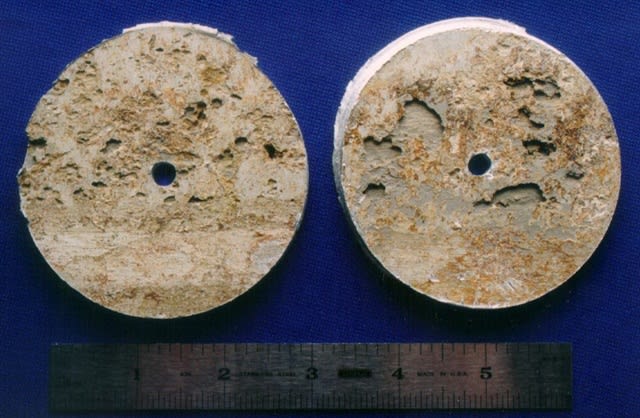
Samples cut from a tank truck wall showing severe pitting attack of aluminum after it was exposed to a corrosive solution for a couple of days.
The database now includes 400 chemicals with variations , and the total number of listings is now over 5,000, says Barry Hindin, a corrosion engineer at Battelle who is doing the compilation and necessary testing. Examples are concentrations of hydrochloric acid, which become more aggressive as they are diluted or mixed, and many kinds of resins. Some are pure chemicals and some are proprietary products, whose makeup may not be known but whose behavior toward materials can be gotten from manufacturers or tested.
Type of trailer by material — stainless steel, rubber-lined steel, aluminum or fiberglass-reinforced plastic — and a proper washing method for each item is among the information listed. Battelle maintains the database in an outside server, and it’s accessible through a user’s computer, iPad, tablet or smart phone by going to www.tanktruck.org and clicking into it.
“The user will probably be a carrier’s salesman, who decides whether to take the load, or in larger companies, somebody who has something to do with equipment, and he’ll make the final call,” says Pape. Some listings include hazmat placard codes, and code numbers assigned by Chemical Abstracts Services (another Columbus concern), and the United Nations. An NTCC steering committee is testing it and “so far we’ve heard no complaints,” he reports.
Hindin is finishing some features for the database, such as allowing carriers to quiz each other. “Carriers can make comments like, ‘I think it damaged my tank,’” Pape says. “Other carriers can respond, ‘Yes, it damaged mine.’ Barry can review it. In some cases we can test it in the lab.” If NTCC continues to fund the project, Battelle will add more and more materials.
“A precedent is a handbook for people who put screws and rivets into metal, and need to know how the materials interact,” he says. “It was started after World War II when the aircraft and aerospace industry started growing. Battelle has done this for 60 years. That’s the vision for this. Long after Barry and I have retired, this will still be going on.”
NTCC plans to roll out the Liquid Products Database during Tank Truck Week in Houston, with a presentation in mid November.
“It’s a pretty cool service to offer our members, and for non-members too,” who can pay a licensing fee to use it, says Furth. “Each of our 240 fleets sometimes encounter a chemical it may not know about. When you lose a $110,000 asset, it’s, ‘Who screwed up my trailer?’ Or, it’s a haul you should probably wash this way to avoid damage.”
Furth, who earlier worked for Quality Carriers in Wisconsin, succinctly explained the damage in our opening scenario: “When there’s an ‘ide’ in it, it’s something that will corrode.”
More Maintenance

Color Match Smarter: Tools That Restore & Perform
For fleet managers and collision repair professionals keeping heavy-duty trucks on the road, getting the color right the first time isn't just about appearance — it's about efficiency, turnaround time, and bottom-line results. Discover how today's digital color tools are transforming the repair process from guesswork to precision.
Read More →
Wrong Repair Prompts Recall of Freightliner, Western Star 4x2 Trucks
DTNA is recalling more than 2,400 trucks that received an incompatible software fix instead of the hardware repair required to address brake valve corrosion.
Read More →
Truck Drivers Need More Than Another Alert
Fleets have more visibility into truck health, safety events, and driver activity than ever. The next challenge is turning all that information into useful guidance for the person who has to decide what to do next.
Read More →
The Maintenance Checks Trucking Fleets Should Prioritize Before Fall Freight Picks Up
Making it through August isn’t the same as being ready for the next several months of operation. Find out what systems may have suffered from summer heat and need to be checked out before fall.
Read More →
What Three Fleets Are Doing Differently When Buying Truck Parts in 2026
With freight improving but costs still climbing, fleet maintenance executives explain how they're balancing price, quality, and supplier relationships.
Read More →
Paccar Recalls 2027 Trucks Built This Summer for Possible Electrical Problem
The nearly 6,000 Kenworth and Peterbilt trucks in the recall could potentially lose engine power, among other things.
Read More →
Will API PC-12 Oil Change Trucking Fleet Maintenance?
The new API PC-12 heavy-duty engine oil category reflects the changing demands of modern diesel engines. But fleets like Foodliner are looking to getting their own data before making decisions on adopting the new oils and questions such as extending oil drain intervals.
Read More →
Brake Safety Week to Focus on Drums and Rotors
Commercial vehicle inspectors are focusing on truck brakes during CVSA's Brake Safety Week, August 23-29.
Read More →Possible Battery-Cable Fires Prompt Recall of 15,000+ International MV and HV Trucks
On the recalled vehicles, manufacturing variations can cause the battery interconnect cable to contact the auxiliary stud and hold down the bracket.
Read More →
Rush, MCT Team Up to Grow Refrigeration Service Network
The joint venture will operate MCT's network of Carrier Transicold dealerships and mobile service locations, with the companies promising greater service capacity and uptime for refrigerated fleets.
Read More →