




Bulk Intermodal a Hit for Schneider
The intermodal container business has allowed many companies to shift longer-haul freight to rails in the face of tight capacity and a driver shortage. But in recent years, Schneider and a handful of other companies have turned that same concept to the liquid bulk business.

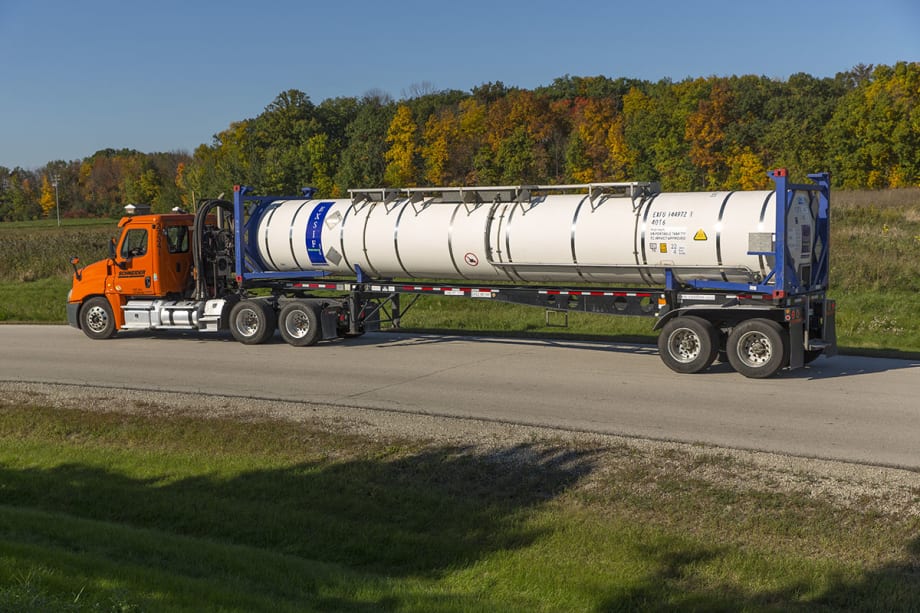
Schneider worked with tank companies and the railroads to develop a way to ship liquid bulk loads intermodally.
Photo courtesy Schneider
The intermodal container business has allowed many companies to shift longer-haul freight to rails in the face of tight capacity and a driver shortage. But in recent years, Schneider and a handful of other fleets have turned that same concept to the liquid bulk business.
Schneider is celebrating the sixth anniversary of its first bulk intermodal container movement, which it says was one of the first in the industry.
It was a fairly lengthy process to study the opportunities, work with the railroads, and develop a special container, explains Jason Howe, who moved from Schneider’s van truckload business several months ago to become senior vice president and general manager of Schneider’s Bulk division.
“It operates very similar to our dry intermodal business,” he explained in an interview. “You think of this tank on a frame, a bit of a capsule-looking tank surrounded by a square frame. That square frame is really the box and it sits on the chassis. The crane comes just like an intermodal dry container, picks up that frame, and sets it in the well car on the train.”
Schneider is currently operating about 400 of these containers, up from the 100 it started with back in 2012. The company started offering this service in 2012 with two customers, and by late 2017 it had grown to 68 customers.
Fast-growing business
During the initial years of operating Bulk Intermodal containers, Schneider focused on building out its service and growing relationships with the rails. Then, in the first six months of 2014, capacity-crunched chemical shippers latched onto Schneider’s Bulk Intermodal offering, increasing the company’s volume by 75%. First-quarter 2018 results show that Bulk Intermodal volume continues to grow, increasing 13.5% year-over-year.
“The chemical and liquid bulk shipping industry has not been immune to the capacity challenges you read about across transportation in general,” Howe said.
The growth of the chemical industry also contributes to the demand. According to the American Chemistry Council, there are plans for 294 new production units for chemicals in the U.S. – representing $179 billion in new capital investment in the industry. “We would like to say we can apply this to almost all our existing product base across the chemical business,” Howe said, such as polymers, monomers, water treatment chemicals, and lubricants.
“With an improving economy and growing driver shortage, bulk shippers are experiencing extremely tight capacity conditions,” Howe said.
Unique to the 40-foot Schneider Bulk Intermodal containers, according to the company, is the ability to haul up to 45,600 pounds of specialty chemical and liquid payloads. Also, unlike the typical ISO bulk 20-foot containers, Schneider’s Bulk Intermodal containers:
Have standard fittings for easy offloading
Fit standard loading racks for safe service
Give shippers the feel of a regular tank trailer for ease of use and consistency
Opportunity for Drayage Drivers
Schneider is hiring dray drivers dedicated to Bulk Intermodal at major ramps in all major bulk markets.
Bulk intermodal, Howe explained, “frees up drivers to move other product while these containers are moving on the train, so the train runs the long miles and allows our trucks and drivers to move other freight.”
The increased need for drayage drivers to handle the move at both ends “is a really positive thing in this environment, where we have driver associates and candidates looking for more time at home. The intermodal business in general is more suited to that. It allows us to hire drivers who are interested in only that and also drivers in our existing business who may want to come off the road and drive local for a while.”
Unlike intermodal containers, which are onloaded and offloaded by cranes at both ends of such a move, bulk intermodal containers require more interaction from drivers.
“There’s some specialized training that’s required for the bulk drayage drivers,” Howe said. “Loading and offloading is still fairly unique and specialized.” There are different training and hazardous materials requirements, knowing how to operate the pumps and compressors and hoses for loading and unloading, etc.
“It’s all about finding the right candidate, the right driver who’s interested in doing the right kind of work,” Howe said. “What I’ve learned in my time in the liquid bulk space is it’s a different kind of driver, who wants to interface with customers more directly and be part of that customer’s supply chain – and that can be very different from some of our dry business, where it may be drop and hook and very little interface. We try to match the driver candidate in the best place they are going to be comfortable and able to succeed.”
Related: Schneider Completes Shift to Company-Owned Intermodal Chassis Network
More Fleet Management

Color Match Smarter: Tools That Restore & Perform
For fleet managers and collision repair professionals keeping heavy-duty trucks on the road, getting the color right the first time isn't just about appearance — it's about efficiency, turnaround time, and bottom-line results. Discover how today's digital color tools are transforming the repair process from guesswork to precision.
Read More →
FMCSA Pauses Biennial-Update Enforcement Amid Motus Transition
Carriers whose updates were due on or after June 1 have more time, while FMCSA works to stabilize its new registration system and warns of phishing sites impersonating its new carrier registration system, Motus.
Read More →
2026 Blueprint for Countering Smarter Supply Chain Theft
Cargo theft is no longer just the cost of doing business. It's a multi-billion-dollar criminal enterprise exploiting vulnerabilities across your fleet, drivers, and supply chain.
Read More →


How Telematics Improves Visibility, Control, and Performance in Refrigerated Fleets
Explore how telematics help refrigerated fleets improve visibility, uptime, efficiency, compliance, and cargo protection across connected cold chain operations.
Read More →
What the U.S.-Canada Trade War Means for Trucking
Escalating U.S.-Canada tariffs could disrupt cross-border freight, reduce truck volumes, raise costs, and create new uncertainty for carriers on both sides of the border.
Read More →
What Are Trucking’s Top Concerns for 2026?
The American Transportation Research Institute wants to know what's worrying trucking fleet managers, drivers, and other stakeholders in its annual Industry Issues survey.
Read More →
American Trucking Associations Looks for a New Leader
ATA President and CEO Chris Spear abruptly left his job at the association on August 21, at a pivotal time for the trucking industry.
Read More →
Public Wi-Fi Cybersecurity Risks: How Truck Drivers and Fleets Can Protect Their Data
Public Wi-Fi can expose truck drivers and fleets to credential theft, malware, and other cyber threats. Here’s how to reduce the risk on the road.
Read More →
For Nicky Cupp, Fleet Innovation Starts With Frustration
HDT Truck Fleet Innovator Nicky Cupp turns everyday pain points at Fraley & Schilling into opportunities for better technology and smarter processes.
Read More →
Adam Buttgenbach’s Approach to Electric Trucks: Start With Where They Fit
HDT Truck Fleet Innovator Adam Buttgenbach helped PepsiCo build one of North America’s largest EV fleets by focusing on where electric trucks make operational sense.
Read More →