




Test Drive: Volvo's I-Shift - A Smooth Operator
Wayne Klink, founder and president of a fleet with his name, likes his 90 Volvo trucks and the latest component in three of them, the I-Shift automated mechanical transmission.

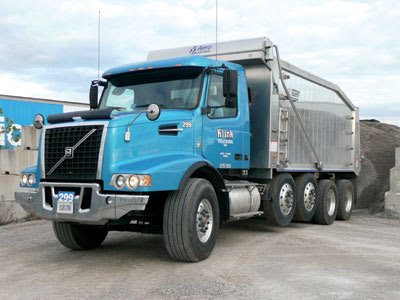
Testimonials are fine, but repeat business is the best endorsement for a product. Wayne Klink, founder and president of a fleet with his name, likes his 90 Volvo trucks and the latest component in three of them, the I-Shift automated mechanical transmission.
I-Shift is "a good value proposition," he says, because it reduces maintenance and fuel costs and cuts work for drivers. That, he says, make the purchase price of about $6,000 more than a manual transmission worth it.
Klink Trucking, based at Ashley in northeastern Indiana, hauls aggregates, asphalt, dirt and salt. This stop-and-start service lets the electro-mechanical gearbox do a lot of a driver's work, often better than he can. (Klink also is testing four Eaton Fuller UltraShift transmissions.)
The I-Shifts are in two "distribution" tankers that spray liquid asphalt and dust-control chemicals, which he usually drives himself, and in a dump truck. The Volvo VHD dump truck featured here is assigned to driver Perry Allen.
Allen, who previously drove one of the UltraShifts, had his own praise for the I-Shift during a morning of work. As we headed south toward Fort Wayne using Interstate 69 and county and state roads, he pointed out many examples where the Volvo product shifted more quickly and smoothly than its competitor would have. Stop signs, traffic lights and varying speeds kept the tranny busy, and usually it was efficient and unobtrusive.
Intelligent shifting
I-Shift is very popular in Europe, Volvo says, but far less so in North America, where owners are more frugal and drivers simply expect to shift for themselves. It's primarily an on-highway transmission, but Volvo engineers have approved its use in numerous on/off-road trucks, including Klink's.
The "I" in the name could mean intelligent, because I-Shift usually chooses the correct gear for any situation. There are brief pauses as the device shifts up or downward among its 12 ratios.
But it's not brilliant. Allen pointed out the times when it started out in first gear, even when the truck was empty, a quirk that can be overridden by selecting Manual and thumbing an Up button. The transmission's "brain" allows the start-out gear to be as high as third, and clutch engagement was always very smooth, with absolutely no chatter and no front-end hopping. From first it would go quickly to second or third and then skip-shift upward from there.
Later, when I drove, the tranny did the first-gear thing often, but sometimes took off in fourth, skip-shifted to seventh, then ninth and finally 11th, where it stayed for most street cruising above 35 or 40 mph. Sometimes it chose other gears, but they all worked fine in propelling the truck. The only reason I noted them is that I watched the brightly lit read-out in the info panel below the speedometer and tachometer.
Given a light foot, the engine tended to stay between 1,200 and 1,500 rpm at street speeds, right in the Volvo engine's sweet spot. A heavier foot sent revs a few hundred rpm higher, but the tranny almost never hung in a gear too long.
And the I-Shift changes quickly between Drive and Reverse, which is important while maneuvering at jobsites and while trying to rock out of mud, Allen said. If the truck was pointed downhill, as it was at one construction site we delivered to, the clutch quickly engaged and we moved backward without unintentionally rolling forward — a good thing, because a van and a pickup were parked just ahead. I feathered the brake pedal with my left foot while spinning the steering wheel, and released the brakes only as we began moving rearward. A wider pedal face would make this a little easier for a driver's left foot to reach the brake, but I could also have used the trolley handle on the dash.
The Truck
The Volvo's wide cab gave me the impression that it was almost too wide for street lanes, but of course it wasn't, and I soon got accustomed to it. The big right-side window compensated for its distance from my eyes and, thanks also to good mirrors, I never had trouble seeing what was alongside.
The truck steered precisely, turned rather sharply and stopped promptly, all with minimal work from Allen or me. It rode smoothly, too, and the nicely appointed interior gave a deluxe feel. Noise from the Volvo D13 diesel was minimal, and the I-Shift made the most of its 425 horsepower and 1,550 pounds-feet, so the truck accelerated briskly.
Klink says his drivers really like all his Volvos, including earlier models. Overall they give few problems, have good trade-in value (or do when the truck market is more normal), and his dealer, VoMac Truck Sales & Service in New Haven, a Fort Wayne suburb, is tops. That's why he'll buy more Volvos, and they'll have I-Shifts.
From the July 2009 issue of Heavy Duty Trucking.
More Equipment

How Volvo Updated Its D13 for EPA 2027 [Watch]
Volvo’s updated D13 promises lower emissions without sacrificing performance or fuel economy. Take a closer look at what changed inside the engine in this HDT Spotlight video.
Read More →
Michelin Tire Improves Efficiency and Durability for Regional Fleets
The Michelin X Multi Energy D2 is a regional haul drive tire engineered to help fleets improve fuel efficiency, durability and traction in demanding stop-and-go operations.
Read More →
ZF Expands Commercial Vehicle Push in North America
ZF is expanding its North American commercial-vehicle presence with new transmission applications, electrification, trailer technology and autonomous-driving systems.
Read More →
Tesla Wants a Self-Driving Semi. Are Cameras Enough?
Could Tesla’s camera-only autonomous driving technology work on an 80,000-pound Semi? In this commentary, HDT's Deborah Lockridge takes a look at Tesla, Cybercab, and how autonomous trucks see the road.
Read More →
Kodiak: Driverless Long-Haul Truck Launch on Track for 2026
Kodiak AI says its driverless long-haul safety case is 93% complete and it remains on track to begin commercial operations by year-end 2026.
Read More →
What DOT’s Automated Vehicle Strategy Means for Trucking
The U.S. Department of Transportation issued a new automated-vehicle strategy that outlines plans for driverless-truck regulations, cross-state freight corridors, and federal safety standards.
Read More →
East Coast Port Launches $45M Electric Truck Push
The Port Authority of New York and New Jersey announced millions in incentives for zero-emission drayage trucks, yard tractors, and new charging hubs near the port.
Read More →
PlusAI Going Public to Fund Autonomous Truck Launch
A SPAC deal could provide PlusAI with up to $300 million as it works toward a 2027 commercial launch of factory-built autonomous trucks.
Read More →
NHTSA Moves to Rewrite Truck Fuel-Economy Rules
The National Highway Traffic Safety Administration says it lacks authority to regulate medium- and heavy-duty truck engines separately from complete vehicles, but the existing standards have not yet been eliminated.
Read More →
Detroit Opens Orders for EPA 2027 Engines
Detroit isn’t starting from scratch to meet EPA 2027 diesel emissions standards. Its Gen 6 DD13 and DD15 engines keep much of today’s platform while updating the fuel and aftertreatment systems.
Read More →