




ATA’s Spear: Trucking Must “Take Seat at the Table” for Making Autonomous-Driving Policy
Because autonomous driving technologies offer “a lot of potential but also a lot of unknowns,” Chris Spear, ATA president, said trucking must “take our seat at the table with other industries to develop a [policy] framework without stymying innovation.

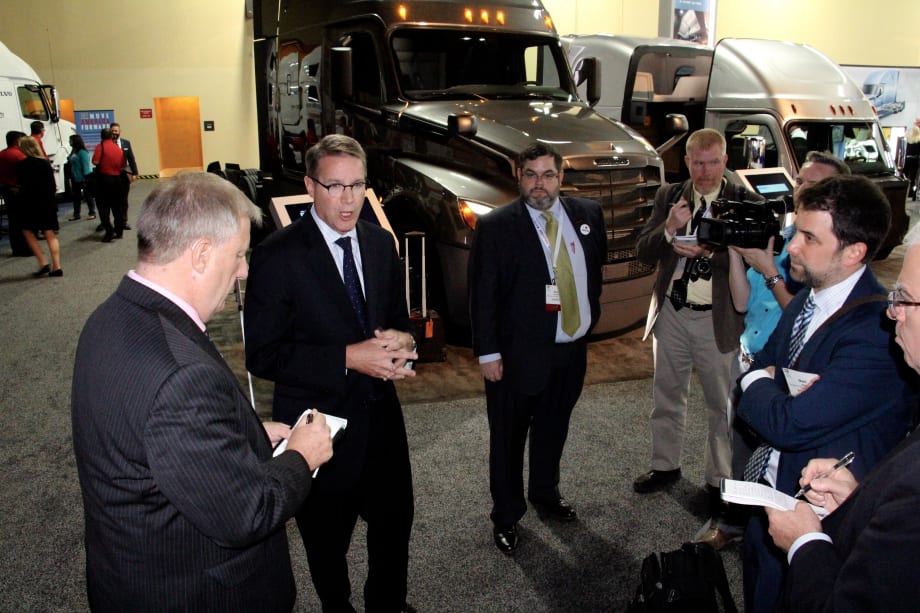
ATA president Chris Spear fielding reporters' queries on autonomous policymaking. Photo: Evan Lockridge
ATA president Chris Spear fielding reporters' queries on autonomous policymaking.Photo: Evan Lockridge
LAS VEGAS. Because autonomous driving technologies offer “a lot of potential but also a lot of unknowns,” Chris Spear, president of the American Trucking Associations, said trucking must “take our seat at the table with other industries [primarily the automotive sector] to develop a [policy] framework without stymying innovation.
“The technology is here and will grow rapidly,” Spear told members of the industry press during a brief Q&A on Oct. 2 here on the show floor of ATA’s Management Conference & Exposition. “Suppliers are already creating connected and automated technology.”
He said trucking is “a different animal than the car side” so the association is aiming to ensure the industry’s voice is heard as federal policymaking develops.
Suggesting there is urgency to this issue, Spear lamented that the first federal guidelines for the testing and deployment of autonomous vehicles recently released by the Department of Transportation were put together with almost no input from the trucking industry.
On the other hand, he said that “[technological developments] are not going to wait for the federal government. He also pointed out that autonomous policymaking will move on two tracks.
“States are not waiting for the federal government, either.” He pointed to Nevada, which has enacted legislation and regulations to enable the testing and operation of autonomous vehicles, as an example. “Nevada is innovating; creating a breeding ground for this technology.
“As far as [putting in place] seamless regulation, that has to be done by the federal government,” Spear continued. “But we will also get engaged at the state level to avoid a patchwork of laws [for autonomous trucks.]”
Spear said connected and autonomous vehicles hold the promise of increasing highway safety, reducing fuel consumption and emissions, and by alleviating congestion, boosting trucking productivity, which in turn “would be better for driver pay.”
As for that seat at the table, Spear said he sees ATA working closely with DOT but also with other transportation modes as well as the auto industry as “our trucks will have to communicate with those cars” to gain the full measure of safety and traffic-flow benefits of autonomous driving.
He also said it’s imperative to “ensure that the technology will be reliable and understood by all industries and government agencies before it is deployed” on a large scale.
Turning to Capitol Hill, Spear said that he expects Congress will “largely focus on oversight” of autonomous regulations with an eye to not inhibiting technological innovations.
He also said that it is well to keep in mind that “one regulation can take four years” to implement and to consider how much innovation can take place in that time.
Spear added that what must be asked is “How fast can our government get into this game and be collaborative— so the result is good for safety and the economy.”
More Fleet Management

Color Match Smarter: Tools That Restore & Perform
For fleet managers and collision repair professionals keeping heavy-duty trucks on the road, getting the color right the first time isn't just about appearance — it's about efficiency, turnaround time, and bottom-line results. Discover how today's digital color tools are transforming the repair process from guesswork to precision.
Read More →
FMCSA Pauses Biennial-Update Enforcement Amid Motus Transition
Carriers whose updates were due on or after June 1 have more time, while FMCSA works to stabilize its new registration system and warns of phishing sites impersonating its new carrier registration system, Motus.
Read More →
2026 Blueprint for Countering Smarter Supply Chain Theft
Cargo theft is no longer just the cost of doing business. It's a multi-billion-dollar criminal enterprise exploiting vulnerabilities across your fleet, drivers, and supply chain.
Read More →


How Telematics Improves Visibility, Control, and Performance in Refrigerated Fleets
Explore how telematics help refrigerated fleets improve visibility, uptime, efficiency, compliance, and cargo protection across connected cold chain operations.
Read More →
What the U.S.-Canada Trade War Means for Trucking
Escalating U.S.-Canada tariffs could disrupt cross-border freight, reduce truck volumes, raise costs, and create new uncertainty for carriers on both sides of the border.
Read More →
What Are Trucking’s Top Concerns for 2026?
The American Transportation Research Institute wants to know what's worrying trucking fleet managers, drivers, and other stakeholders in its annual Industry Issues survey.
Read More →
American Trucking Associations Looks for a New Leader
ATA President and CEO Chris Spear abruptly left his job at the association on August 21, at a pivotal time for the trucking industry.
Read More →
Public Wi-Fi Cybersecurity Risks: How Truck Drivers and Fleets Can Protect Their Data
Public Wi-Fi can expose truck drivers and fleets to credential theft, malware, and other cyber threats. Here’s how to reduce the risk on the road.
Read More →
For Nicky Cupp, Fleet Innovation Starts With Frustration
HDT Truck Fleet Innovator Nicky Cupp turns everyday pain points at Fraley & Schilling into opportunities for better technology and smarter processes.
Read More →
Adam Buttgenbach’s Approach to Electric Trucks: Start With Where They Fit
HDT Truck Fleet Innovator Adam Buttgenbach helped PepsiCo build one of North America’s largest EV fleets by focusing on where electric trucks make operational sense.
Read More →