





Related News: WattEV Unveils New Southern California Charging Depots
WattEV Unveils Solid-State Transformer for Megawatt Electric Truck Charging
WattEV’s new solid-state Transformer technology is designed to simplify and accelerate deployment of megawatt charging systems for heavy-duty electric trucks.
November 4, 2025
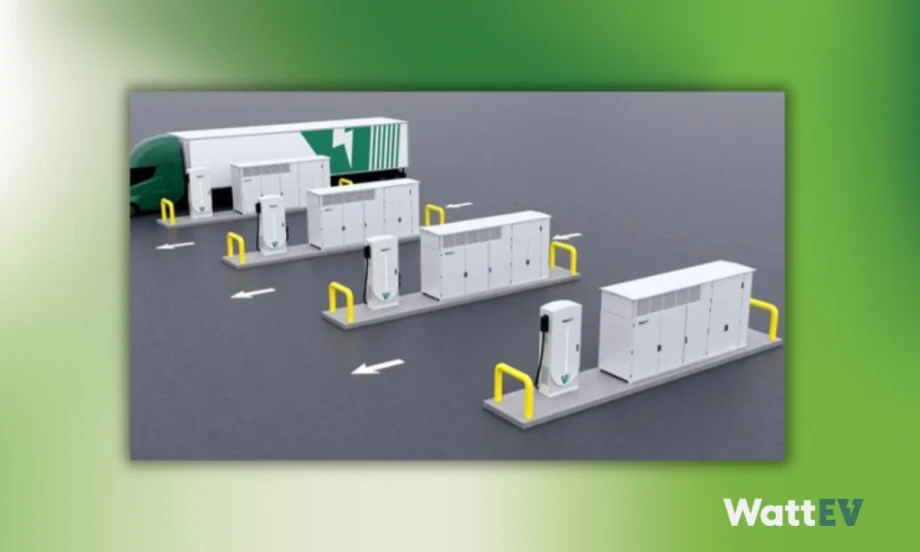
WattEV’s Solid-State Transformer integrates medium-voltage power conversion and cooling into a compact cabinet, allowing direct connection to utility lines and faster installation of megawatt charging systems at heavy-duty truck depots.
Photo: WattEV
2 min to read
WattEV has introduced a solid-state transformer, a compact, medium-voltage power conversion system designed to accelerate installation of megawatt charging system fast chargers for heavy-duty electric trucks.
The system, funded in part by the California Energy Commission, was developed to replace traditional step-down transformers, switchgear, and low-voltage rectifiers.
It is designed for installation on service islands between pass-through charging lanes, supporting the next generation of megawatt charging system-capable trucks expected to enter volume production in 2026.
Simplified Design for Faster, Lower-Cost EV Charger Installation
Unlike conventional 480-volt systems, WattEV’s solid-state transformer integrates power conversion and cooling in a single cabinet. The design connects directly to utility medium-voltage lines (12,000 to 15,000 volts), eliminating the need for multiple intermediary components, according to the company.
This direct connection simplifies installation and reduces both equipment and labor costs associated with site development.
“As fleets move toward megawatt charging, complex system requirements and supply chain constraints have become real challenges,” said Salim Youssefzadeh, CEO and co-founder of WattEV, in a release.
“The solid-state transformer helps bring megawatt charging to heavy-duty depots faster and at lower cost.”
Versatile High-Voltage Architecture
While the solid-state transformer is primarily designed for electric truck charging, WattEV said its high-voltage DC architecture is also applicable in other sectors, including data centers, marine power, mining operations, and industrial systems requiring large-scale direct current.
Key Benefits for Fleet Electrification
Faster site development: Replaces multiple components with one integrated system, reducing engineering and installation time.
Lower installation and maintenance costs: Fewer parts mean less procurement, setup, and service complexity.
High-capacity output: Converts medium-voltage power (12–15 kV) directly to DC, delivering between 1.2 and 3.8 megawatts.
Modular scalability: Allows operators to expand capacity incrementally as charging demand increases.
Production Timeline
WattEV has completed its proprietary solid-state transformer design and expects production-ready units in 2026.
As fleet and public charging infrastructure expand nationwide, the transformer can provide a practical, cost-efficient approach to deploying megawatt-level charging systems, enabling depots and logistics hubs to scale more easily, according to the company.
More Fuel Smarts

Wex Adds Cardless Fuel Payments for Over-the-Road Customers
A new fuel card feature for Wex customers offers convenience and security.
Read More →
New California Law Could Shed Light on Electric Truck Prices
Why do battery-electric Class 8 trucks remain so expensive? A California bill signed by Gov. Gavin Newsom would give fleets and state agencies more visibility into what manufacturers charge.
Read More →
How Volvo Updated Its D13 for EPA 2027 [Watch]
Volvo’s updated D13 promises lower emissions without sacrificing performance or fuel economy. Take a closer look at what changed inside the engine in this HDT Spotlight video.
Read More →

Diesel Price Spike Shortens Payback for Natural Gas Trucks, Report Says
Energy Vision estimates fleets could recover the higher purchase price of an RNG-fueled Class 8 tractor in 1.3 to 2.8 years under current fuel-price scenarios.
Read More →
Calstart Becomes Catalyst Mobility, Reflecting Broader Focus
Calstart is now Catalyst Mobility, reflecting the nonprofit’s growing national role in clean transportation, including zero-emission trucks, infrastructure and incentive programs.
Read More →
Record Diesel Prices Squeeze Trucking Fleets
Average U.S. diesel prices have climbed to nearly $6 a gallon, surpassing the 2022 record as tight refinery capacity and Middle East disruptions keep fuel costs elevated.
Read More →
Sponsored•September 9, 2026
How Fuel Delivery Shapes Engine Performance
Fuel delivery depends on more than what happens at the injector. For fleet, maintenance and technical professionals, looking at the full path from pump to injector can provide useful context for understanding engine performance.
Read More →
East Coast Port Launches $45M Electric Truck Push
The Port Authority of New York and New Jersey announced millions in incentives for zero-emission drayage trucks, yard tractors, and new charging hubs near the port.
Read More →
Detroit Opens Orders for EPA 2027 Engines
Detroit isn’t starting from scratch to meet EPA 2027 diesel emissions standards. Its Gen 6 DD13 and DD15 engines keep much of today’s platform while updating the fuel and aftertreatment systems.
Read More →
Zero-Emission Truck Corridor Planned for West Coast
California, Oregon, Washington, British Columbia and Baja California are coordinating plans for truck charging and hydrogen fueling from Canada to Mexico.
Read More →