





Similar News: WattEV adds Tesla Semis to Port of Long Beach ZEV Fleet
WattEV Unveils New Southern California Charging Depots
WattEV is adding three high-capacity truck charging depots across California with state grant funding, targeting key freight corridors ahead of megawatt charging adoption.
July 16, 2025
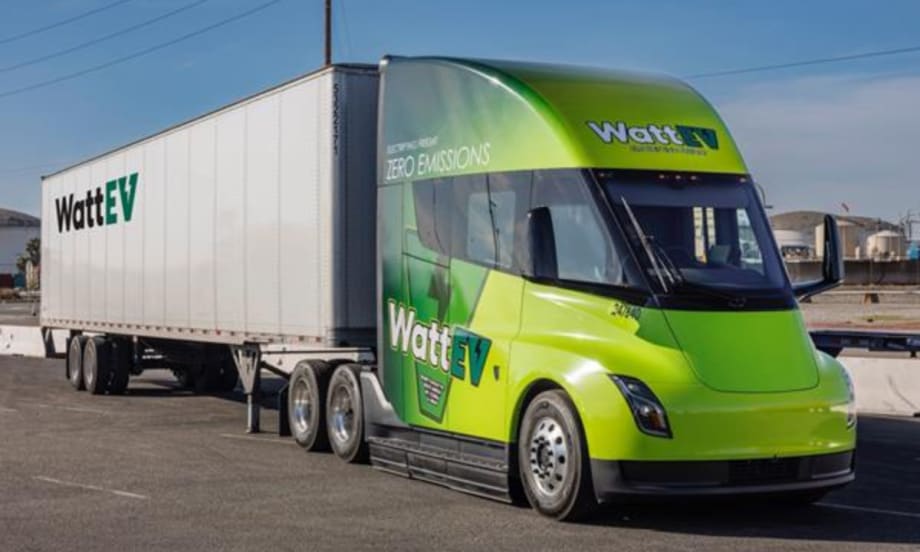
New WattEV depots in Otay Mesa, Baker and Long Beach will deploy 29 megawatt chargers to support heavy-duty freight electrification along major California transport routes.
Photo: WattEV
2 min to read
WattEV is expanding its electric truck charging network with the development of three new depots in California. The projects are supported by more than $24 million in state grant funding aimed at improving heavy-duty freight electrification infrastructure.
Depot Locations
The new charging sites are under development at the following locations:
Otay Mesa: Near the U.S.-Mexico border in San Diego County
Baker: Along the I-15 corridor between Southern California and Nevada
Port of Long Beach: Expanding capacity at the container port
Together, the sites will add 29 Megawatt Charging System (MCS) units. The stations are expected to handle approximately 100,000 charging sessions per year. Funding is provided through a program from the California Transportation Commission to develop zero-emission freight infrastructure along high-traffic corridors.
“The inflection point in freight electrification is arriving with the introduction of trucks capable of megawatt charging at scale,” said Salim Youssefzadeh, CEO of WattEV. “We see 2026 as the turning point, and we are building ahead of demand to ensure that all major freight corridors in California are ready.”
Site Details
Otay Mesa (7 MCS chargers): Located less than 1,000 feet from the U.S.-Mexico border in a high-traffic international trade area. Developed with San Diego Gas & Electric (SDG&E), the site is intended to support frequent cross-border freight activity.
Baker (10 MCS chargers): Positioned along I-15 to serve long-haul freight traffic between Southern California and Las Vegas. Development is in partnership with Southern California Edison (SCE).
Port of Long Beach (12 MCS chargers): Adds new charging capacity at one of the country’s largest cargo hubs. The installation features Silicon Carbide-based medium-voltage power rectifiers developed by WattEV’s technology division, Charge America. The use of proprietary Solid-State Transformer (SST) technology removes the need for traditional step-down transformers, which may lower installation costs and simplify site development. Charging cabinets are installed between lanes in a layout similar to conventional diesel fueling stations.
Each location is designed to support vehicle charging times of 30 minutes or less. Their placement is intended to align with regional transportation and freight movement strategies.
More Fuel Smarts

How Volvo Updated Its D13 for EPA 2027 [Watch]
Volvo’s updated D13 promises lower emissions without sacrificing performance or fuel economy. Take a closer look at what changed inside the engine in this HDT Spotlight video.
Read More →
Diesel Price Spike Shortens Payback for Natural Gas Trucks, Report Says
Energy Vision estimates fleets could recover the higher purchase price of an RNG-fueled Class 8 tractor in 1.3 to 2.8 years under current fuel-price scenarios.
Read More →
Calstart Becomes Catalyst Mobility, Reflecting Broader Focus
Calstart is now Catalyst Mobility, reflecting the nonprofit’s growing national role in clean transportation, including zero-emission trucks, infrastructure and incentive programs.
Read More →

Record Diesel Prices Squeeze Trucking Fleets
Average U.S. diesel prices have climbed to nearly $6 a gallon, surpassing the 2022 record as tight refinery capacity and Middle East disruptions keep fuel costs elevated.
Read More →
Sponsored•September 9, 2026
How Fuel Delivery Shapes Engine Performance
Fuel delivery depends on more than what happens at the injector. For fleet, maintenance and technical professionals, looking at the full path from pump to injector can provide useful context for understanding engine performance.
Read More →
East Coast Port Launches $45M Electric Truck Push
The Port Authority of New York and New Jersey announced millions in incentives for zero-emission drayage trucks, yard tractors, and new charging hubs near the port.
Read More →
California Bill Could Shed Light on Electric Truck Prices
Why do battery-electric Class 8 trucks remain so expensive? A California bill headed to Gov. Gavin Newsom would give fleets and state agencies more visibility into what manufacturers charge.
Read More →
Detroit Opens Orders for EPA 2027 Engines
Detroit isn’t starting from scratch to meet EPA 2027 diesel emissions standards. Its Gen 6 DD13 and DD15 engines keep much of today’s platform while updating the fuel and aftertreatment systems.
Read More →
Zero-Emission Truck Corridor Planned for West Coast
California, Oregon, Washington, British Columbia and Baja California are coordinating plans for truck charging and hydrogen fueling from Canada to Mexico.
Read More →
A Closer Look at Kenworth’s Electric T880E Vocational Truck [Video]
Learn more about Kenworth's T880E battery-electric vocational truck at the Paccar Technical Center, including its range, applications, upfitting considerations, and PTO options, in this HDT Spotlight video.
Read More →