Part 4 in a Series
Part 1: Smart Post-Crash Actions to Protect Your Trucking Fleet
Part 3: The Critical Role of Evidence Preservation
Note: This series is a longer version of a feature in HDT's July/August 2025 print issue
 MENU
MENU SEARCH
When a trucking company can’t produce evidence such as phone data, driver logs, maintenance records, even weather reports after a crash, juries notice what’s not there as much as what is.

Plaintiff attorneys will come after trucking company records that have nothing to do with the crash.
HDT Graphic
It’s often not a truck crash itself that puts a trucking company on the defensive — it’s the missing piece of the puzzle afterward. A deleted text, an edited log, or a file that never got saved can take on a life of its own in the hands of a plaintiff’s attorney.
When a trucking company can’t produce evidence such as phone data, driver logs, maintenance records, even weather reports after a crash, juries notice what’s not there as much as what is.
In the previous installment of this series, we focused on physical evidence, in-cab camera data and telematics. But there are more types of evidence and records trucking companies need to preserve that they may need to defend themselves in case of litigation.
Doug Marcello, a longtimetrucking defense attorney with the Saxton & Stump law firm, says fleets should act fast on preserving critical data after a crash:
The question of driver distraction is a common one after accidents. That’s why Jennifer Akre, managing partner at Tyson & Mendes, believes in getting the truck driver’s phone after the crash and preserving it.
Plaintiff’s attorneys will be able to find out about a driver’s phone and ask for what it may show about whether they were distracted.
While other attorneys may disagree, Akre says that whether that information is good or bad for the driver or trucking company, she wants to know about that early on.
Without preservation of that data, she explains, testimony often goes something like this:
Driver: “I immediately texted my boss.”
Attorney: “Where are those text messages?”
Driver: “Well, I got rid of that phone.”
Another area where fleets can get into trouble is not preserving data is not preserving the driver’s log book or ELD data for the time leading up to the crash.
And editing the log book or ELD record of duty status after a crash is another potential pitfall.
“I’ve seen lots of edited log books that become a problem,” Akre says. “And then you’re just trying to explain why you edited them” in a deposition or before a jury.
Lang says when working at Halvor Lines, because driver logs purge after six months, “we'd want to get those pulled [after a crash] so that those logs would live beyond the six-month period.”
In the aftermath of a crash, it’s easy to let DOT-required post-accident drug and alcohol testing slip.
Drug and alcohol tests are required post-accident if the crash resulted in:
Nick Saeger, assistant vice president for transportation products and pricing at Sentry Insurance, says it’s a mistake he sees trucking companies making after a crash.
“Getting that done, that’s a simple thing that you can maybe forget to do after an accident,” he says.
If you delay a drug test or an alcohol test following a crash, it will be used against you, Akre says.
Even when the drug test is clear, she says, if it’s been delayed, plaintiff’s attorneys will argue that numerous substances would have shown up if the test had been conducted sooner.
In addition to camera footage, ECM data, ELDs, post-crash drug testing results, other types of data you should look at preserving include:
Adam Lang, director of customer advisory services at Netradyne, spent nearly 10 years at Wisconsin-based Halvor Lines. The award-winning fleet safety expert cautions fleets to be careful in internal communications regarding the crash, which need to be preserved in case of litigation.
“Make sure that every single email that you send in regard to a collision is an email that you’re comfortable with pasting outside your office door for everyone to read, because those emails may get pulled,” he says.
“Communication in that regard should have a lot of brevity. It should be very fact-based, without any opinion or conjecture of who was at fault.”
Akre says some of the worst legal cases she has had to argue in defending trucking companies are ones where the motor carrier’s records aren’t in order.
It may have nothing to do with the actual crash, but plaintiff’s lawyers will do everything they can to paint a company as unsafe, uncaring, and negligent.
For instance, say a trucking company doesn’t have the required MVR (motor vehicle record) checks on file, she says.
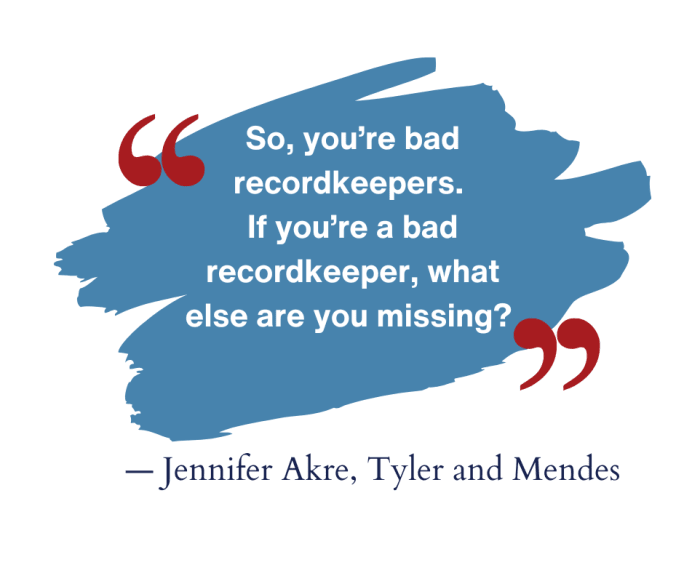
“So, you’re bad recordkeepers. That looks messy,” she says.
Plaintiff attorneys will argue that companies that are messy can’t be trusted.
“If you’re a bad recordkeeper, what else are you missing? What other trainings are you missing?”
Before you know it, Akre says, “You’re defending the company for their back-office work as opposed to the negligence of the trucker, the actual cause of the accident.
“I don’t care if your system is a filing cabinet. I don’t care if your system is Google Docs. I don’t care if you’ve got some fancy system in place with one of the trucking platforms that gets used,” Akre says.
“It doesn’t matter to me — as long as you’ve got a system in place and you use it consistently.”
Companies run into problems when they fail to realize that all of those details matter and to preserve them. When a company has failed to preserve evidence, it makes the jury think you have something to hide.
“It essentially gives the jury the right to assume that you were doing something untoward,” Akre says.

English language proficiency rules for commercial drivers aren’t new, but renewed out-of-service enforcement has raised the stakes. Here’s what carriers need to know before a driver reaches a roadside inspection.
Read More →
Footage alone may not be enough to pass broker vetting processes. Here's what counts as a defensible safety program now.
Read More →
Marijuana is getting stronger, laws are changing, and drug tests still can’t reliably establish impairment. What does that mean for truck drivers and the fleets that employ them?
Read More →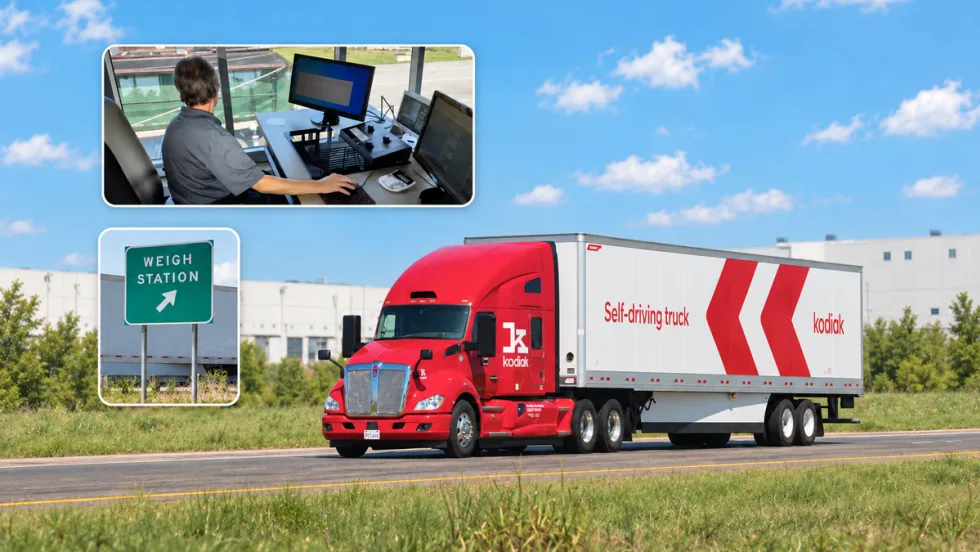
The system will allow enforcement agencies to verify Enhanced Inspection information and decide whether Kodiak’s autonomous trucks can bypass roadside screening sites.
Read More →
After three decades in trucking, Harold Perry shares what he's learned about driver safety, mentorship, and helping the next generation build confidence behind the wheel.
Read More →
Carriers whose updates were due on or after June 1 have more time, while FMCSA works to stabilize its new registration system and warns of phishing sites impersonating its new carrier registration system, Motus.
Read More →
ZF is expanding its North American commercial-vehicle presence with new transmission applications, electrification, trailer technology and autonomous-driving systems.
Read More →
Fleets have more visibility into truck health, safety events, and driver activity than ever. The next challenge is turning all that information into useful guidance for the person who has to decide what to do next.
Read More →
Could Tesla’s camera-only autonomous driving technology work on an 80,000-pound Semi? In this commentary, HDT's Deborah Lockridge takes a look at Tesla, Cybercab, and how autonomous trucks see the road.
Read More →
The U.S. Department of Transportation issued a new automated-vehicle strategy that outlines plans for driverless-truck regulations, cross-state freight corridors, and federal safety standards.
Read More →