





Similar News: Latest Bendix Fusion ADAS Available on Peterbilt Model 579 Trucks
Mack Details Pioneer Comprehensive Safety Package
Mack's digital mirror system eliminates blind spots around the truck while enhancing aerodynamic performance.
July 9, 2025
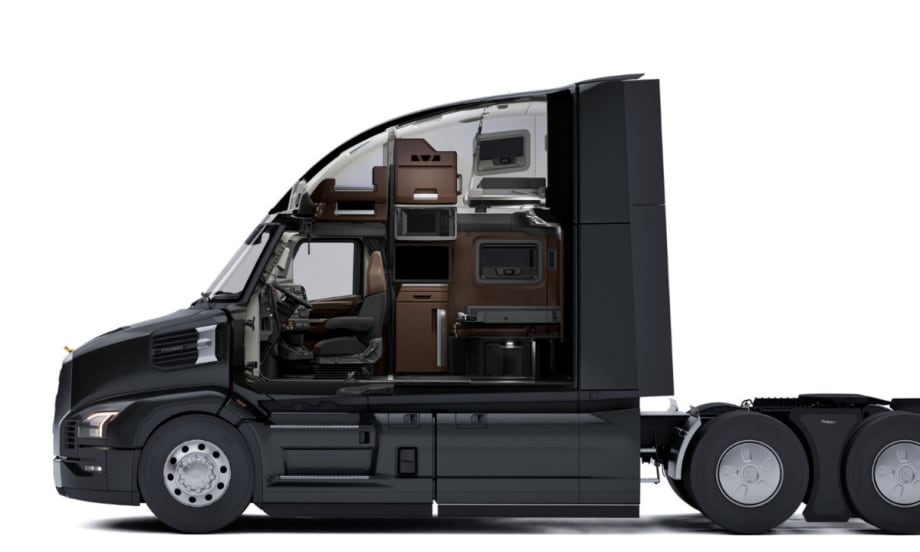
The Mack Pioneer's chassis is designed so that the engine and transmission will break away underneath the cab in a frontal collision, leaving a survivable space for driver and passenger.
Photo: Mack Trucks
3 min to read
Mack Trucks announced comprehensive details of the advanced passive and active safety technologies in the Mack Pioneer, the company’s most advanced highway truck. Building upon Mack’s commitment to durability and reliability, the Pioneer introduces a suite of new safety features, including front and side curtain airbags, a digital mirror system and a high-strength steel cab designed to exceed rigorous safety standards.
“With professional drivers spending an average of 150 hours per month in their trucks, we’ve engineered safety technologies that provide protection before, during and after any potential incident,” said Stephen Roy, president, Mack Trucks.
Industry-Leading Emergency Response Technology
To demonstrate Mack Trucks’ commitment to safety, the Pioneer comes standard with driver and passenger frontal airbags, with optional side curtain airbags. These supplemental restraint systems work in conjunction with carefully engineered seat belt systems and cab structures to provide maximum protection in the event of a collision.
The Pioneer also features Mack’s new E-Call 911, an advanced automatic emergency response system similar to those found in modern passenger vehicles, bringing automotive-grade safety technology to the commercial trucking industry.
When activated by airbag deployment or a detected rollover event, the system automatically executes a series of coordinated safety measures: doors unlock to facilitate easy exit during emergencies, interior lights activate to improve visibility for first responders and the system immediately contacts emergency services with the vehicle’s location.
This comprehensive post-crash response protocol, long employed in the automotive industry, represents a significant advancement in commercial vehicle safety technology and promotes rapid emergency response when drivers need it most.
High-Strength Steel Cab with Superior Crash Protection
The Mack Pioneer features a high-strength steel cab that exceeds federal safety requirements and additional rigorous global testing protocols. The cab has been tested against Swedish Impact (BOF10) standards and UN ECE R29 Cab Strength protocols. Additional tests, including frontal sled, trailer barrier and 90-degree rollover scenarios, also were conducted.
“We’ve subjected the Pioneer to extensive testing beyond what’s federally required, including specialized roof crush, A-pillar and rear-wall impact scenarios to ensure maximum occupant protection,” said Jonathan Randall, president of Mack Trucks North America.
Innovative Chassis Design for Enhanced Safety
The Pioneer’s chassis design includes splayed frame rails that direct crash energy away from the cab. The chassis frame itself is constructed using high-tensile steel that provides exceptional strength while maintaining optimal weight distribution for vehicle stability. In the event of a frontal collision, this design allows the engine to break away and drop below the cab rather than being pushed toward the driver.
“The splayed frame design is a crucial safety feature,” said Scott Sokach, safety product manager at Mack Trucks. “By directing the engine downward in a collision, we prevent it from intruding into the driver’s space, significantly reducing the risk of lower extremity injuries.”
Digital Mirror System Enhances Driver Visibility
A significant safety innovation in the Pioneer is the digital mirror system–a first for Mack–which replaces traditional side mirrors with cameras mounted in sleek pods. This system improves driver visibility by eliminating blind spots while simultaneously enhancing aerodynamics.
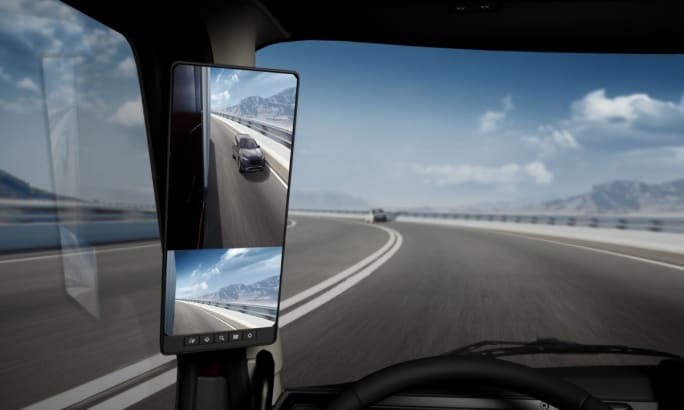
The Mack Pioneer’s digital mirror system improves visibility before a crash and remains operational after impact, helping drivers and first responders maintain situational awareness during emergencies.
Photo: Mack Trucks
“The digital mirror system represents a major advancement in both safety and efficiency,” said Lukas Yates, expert chief designer at Mack Trucks. “It provides drivers with an expanded field of view, infrared night vision capability, clear visibility in rain and snow and trailer panning functionality with distance indicators. Beyond the safety benefits, the system improves fuel efficiency by approximately 1% through reduced drag.”
More Safety & Compliance

FMCSA Pauses Biennial-Update Enforcement Amid Motus Transition
Carriers whose updates were due on or after June 1 have more time, while FMCSA works to stabilize its new registration system and warns of phishing sites impersonating its new carrier registration system, Motus.
Read More →
ZF Expands Commercial Vehicle Push in North America
ZF is expanding its North American commercial-vehicle presence with new transmission applications, electrification, trailer technology and autonomous-driving systems.
Read More →
Truck Drivers Need More Than Another Alert
Fleets have more visibility into truck health, safety events, and driver activity than ever. The next challenge is turning all that information into useful guidance for the person who has to decide what to do next.
Read More →
Tesla Wants a Self-Driving Semi. Are Cameras Enough?
Could Tesla’s camera-only autonomous driving technology work on an 80,000-pound Semi? In this commentary, HDT's Deborah Lockridge takes a look at Tesla, Cybercab, and how autonomous trucks see the road.
Read More →
What DOT’s Automated Vehicle Strategy Means for Trucking
The U.S. Department of Transportation issued a new automated-vehicle strategy that outlines plans for driverless-truck regulations, cross-state freight corridors, and federal safety standards.
Read More →
NYC Expands Speed, Pedestrian Safety Tech Across Fleet
New York City is expanding intelligent speed assistance and pedestrian-alert systems across its municipal fleet, moving the technologies from pilot programs into vehicle procurement and retrofit requirements.
Read More →
FMCSA Removes 110 Truck Driver Training Schools from Certified ELDT List
Federal regulators also are targeting more than 160 additional training providers and launching a nationwide audit of third-party CDL skills testers as part of a broader crackdown on trucking fraud.
Read More →
Beyond DOT Compliance: What Makes a Trucking Fleet Truly Safe?
A trucking fleet can follow every rule and still make unsafe decisions. The real test comes when safety conflicts with freight, productivity, or cost.
Read More →
Hours of Service Pilot Programs: FMCSA Readies for 2027 Rollout
Two pilot programs could eventually reshape hours-of-service rules, giving truck drivers options to pause their 14-hour clock or use longer split sleeper rest periods.
Read More →
New Guide Offers Pet Safety Tips for Truck Drivers
Hundreds of thousands of pets travel in truck cabs. A new safety guide from Volvo Trucks and the Center for Pet Safety offers practical advice for truck drivers who bring dogs and cats along for the ride.
Read More →