




NACFE Releases ‘Messy Middle’ White Paper
A new NACFE white paper on trucking's "Messy Middle' transition period away from fossil fuels toward zero-emission vehicles takes a detailed look at the technologies available today.

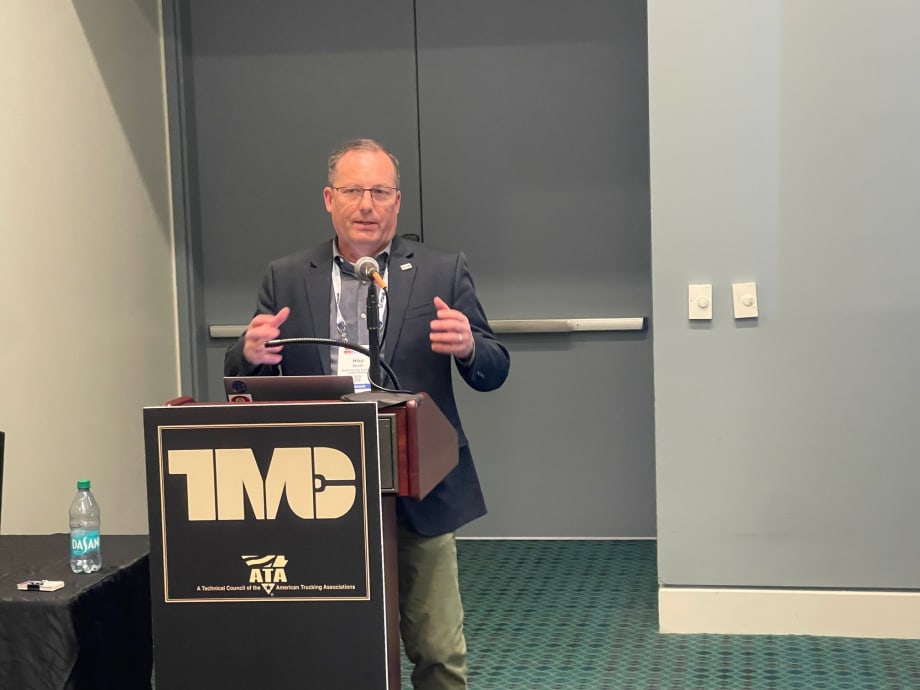
NACFE Executive Director Mike Roeth speaks to journalists at the ATA TMC Annual Meeting in Nashville on March 9.
Photo: Jack Roberts
The North American Council for Freight Efficiency (NACFE) has released a new white paper called Navigating the Messy Middle: The Move to More Sustainable Trucking.
This is the second white paper NACFE has released this year. In February, NACFE introduces a new white paper calling for new definitions for heavy- and long-haul fleet applications.
Recognizing that all the powertrain solutions currently available to fleets can make it difficult to determine which solution is best suited to a fleet’s operation, NACFE published a white paper that provides deeper insight into the term Messy Middle.
“I liken the Messy Middle to a smorgasbord where fleets have a wide variety of options,” said Mike Roeth, NACFE’s executive director. “It can seem like an overwhelming number of choices, and we wrote this white paper to bring some clarity to the current situation.”
All Options on the Table
NACFE first began using the term Messy Middle in 2018 to describe the time between now and when trucking gets to a zero-emission future.
But the paper goes beyond just identifying the various options. Roeth said tt also delves a little deeper into the term Messy Middle. “We have received a good deal of feedback on the idea since introducing it in 2018. Much of it good and some questioning our declaring it a mess. While I don’t think many of us love being in a mess, we don’t always select the situations we find ourselves in,” Roeth said.
“We don’t think messy is necessarily bad,” he added. “In fact, messy can be good because it implies a variety of options available for fleets to choose from.”
In addition, the defining the Messy Middle, the white paper provides a brief overview of the various powertrain options available to fleets today.
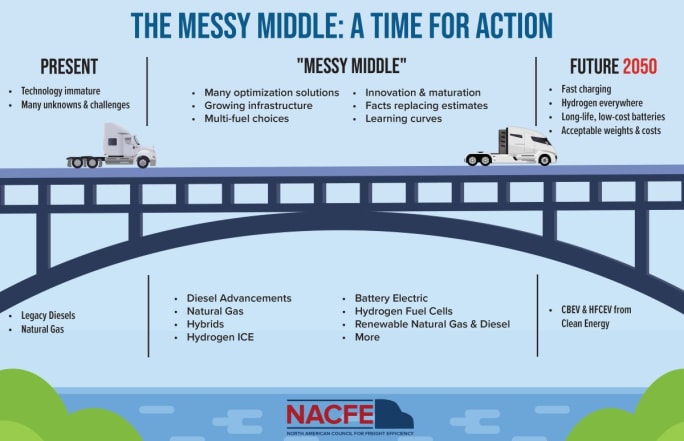
Being in a mess means you have options, Roeth said. And that is definitely the case for green trucking today.
Graphic: NACFE
The key is to choose the right powertrain for the application.
“We maintain a fleet of more than 450,000 vehicles and are always looking at ways to optimize our assets,” said Paul Rosa, senior vice president procurement and fleet, Penske. “We are constantly evaluating powertrain options to determine which make sense for each of our Class 2b to 8 commercial vehicle duty cycles. NACFE’s work on defining the Messy Middle and laying out a framework for evaluating the various options should help fleets have a better understanding of which powertrain solutions will work for them.”
Decision-Making Framework
The paper also explains the factors that need to be considered when choosing a powertrain solution and provides a framework which is useful in the decision-making process.
“This paper along with the previously published A Need to Redefine Class 8 Long-Haul Trucking, are part of our Run on Less – Messy Middle efforts which also includes a Bootcamp, and will feature profiles of participating fleets and a dashboard of metrics from the fleets’ operations. All of these efforts are designed to help bring clarity to long-haul trucking,” Roeth noted.
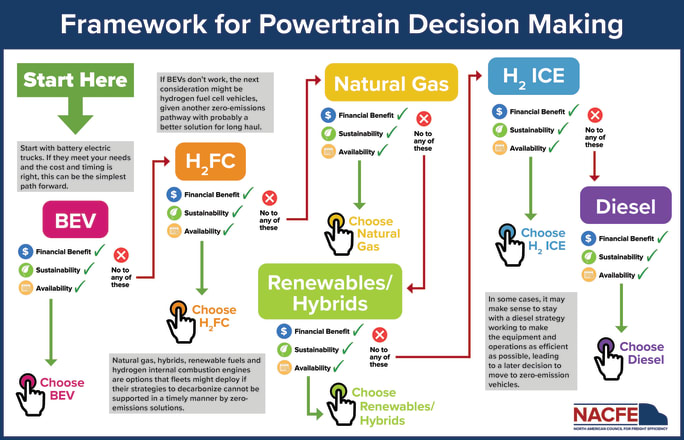
NACFE's latest white paper provides deeper insight into the term Messy Middle.
Graphic: NACFE
“To have a ‘middle,’ you have to have a beginning and an end,” Roeth added.
It’s obvious that the beginning of commercial heavy duty trucks is diesel. And we think it's very probable, if not certain, that the end, or a future state where battery electric and hydrogen fuel cell or zero emission is very likely. Now, 2050, 2040, 2060, who knows when all of that will kind of reach a saturation point? But that's what we mean by the middle. We really believe we're in a middle now. And this middle period is going to scale a bunch of technologies that we don't have today, or we don't have at much scale now. That includes hydrogen ICE, natural gas, renewable natural gas, and on.”
More Fuel Smarts

Record Diesel Prices Squeeze Trucking Fleets
Average U.S. diesel prices have climbed to nearly $6 a gallon, surpassing the 2022 record as tight refinery capacity and Middle East disruptions keep fuel costs elevated.
Read More →
How Fuel Delivery Shapes Engine Performance
Fuel delivery depends on more than what happens at the injector. For fleet, maintenance and technical professionals, looking at the full path from pump to injector can provide useful context for understanding engine performance.
Read More →
East Coast Port Launches $45M Electric Truck Push
The Port Authority of New York and New Jersey announced millions in incentives for zero-emission drayage trucks, yard tractors, and new charging hubs near the port.
Read More →

California Bill Could Shed Light on Electric Truck Prices
Why do battery-electric Class 8 trucks remain so expensive? A California bill headed to Gov. Gavin Newsom would give fleets and state agencies more visibility into what manufacturers charge.
Read More →
Detroit Opens Orders for EPA 2027 Engines
Detroit isn’t starting from scratch to meet EPA 2027 diesel emissions standards. Its Gen 6 DD13 and DD15 engines keep much of today’s platform while updating the fuel and aftertreatment systems.
Read More →
Zero-Emission Truck Corridor Planned for West Coast
California, Oregon, Washington, British Columbia and Baja California are coordinating plans for truck charging and hydrogen fueling from Canada to Mexico.
Read More →
A Closer Look at Kenworth’s Electric T880E Vocational Truck [Video]
Learn more about Kenworth's T880E battery-electric vocational truck at the Paccar Technical Center, including its range, applications, upfitting considerations, and PTO options, in this HDT Spotlight video.
Read More →
Kenworth T880E Brings EV Power to Vocational Trucks
A closer look at the Kenworth T880E’s range, charging, powertrain and upfit options — and where fleets are showing the most interest.
Read More →
Jennie Abarca Is Proving Electric Trucks Can Do the Job
HDT Truck Fleet Innovator Jennie Abarca is building confidence in fleet electrification one load at a time while openly sharing the challenges she encounters along the way as a small-fleet owner.
Read More →
Cummins Adjusts 2027 Engine Rollout After EPA Proposal
The engine maker will gradually introduce its new Model Year 2027 diesel engines while continuing to offer current models during the transition, citing the EPA's proposed emissions rule changes.
Read More →