




Reyes Beverage Group Takes Delivery of 29 Freightliner eCascadias
The new eCascadias mark the first phase of the California beverage fleet’s transition to a fully zero-emission fleet by 2039.

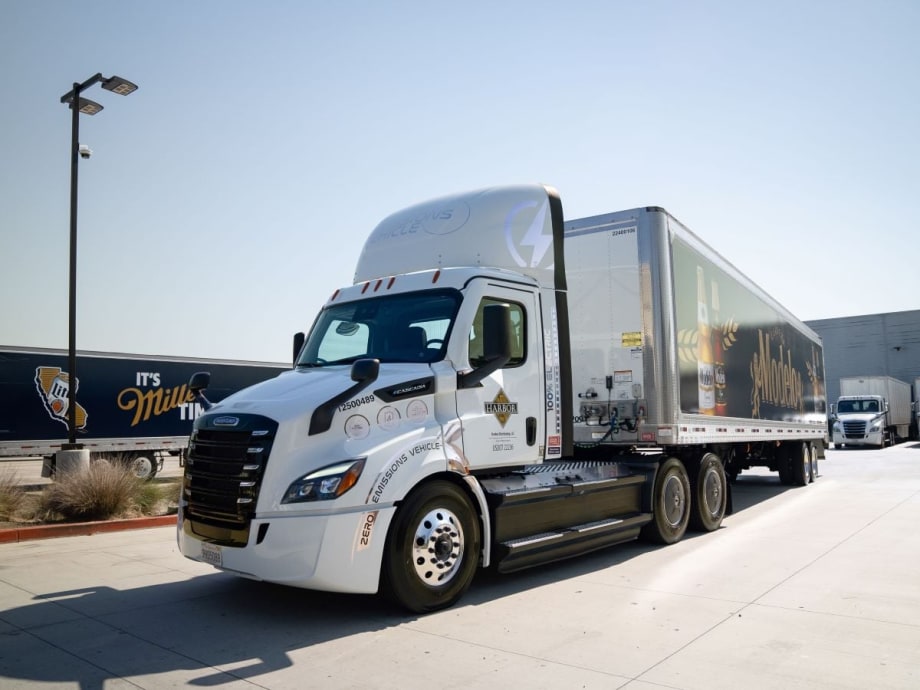
Reyes Beverage Group has a goal of reducing carbon emissions by 60 percent by 2030.
Photo: DTNA
Daimler Truck North America has delivered 20 zero-emission, battery-electric Freightliner eCascadia Class 8 tractors to Reyes Beverage Group (RBG), a total bev-alc (alcoholic beverages) distributor.
The vehicles, deployed at RBG’s Golden Brands – East Bay and Harbor Distributing – Huntington Beach warehouses, mark the first phase in RBG’s transition to a fully zero-emission fleet in the state by 2039.
An additional nine vehicles are scheduled for delivery to RBG’s Gate City Beverage – San Bernardino warehouse later this year.
Built with Productivity in Mind
With the customer at the center of its strategy, DTNA is focused on leading the transformation to zero-emission transportation by developing vehicles that meet the evolving needs of fleet operators.
“The Freightliner eCascadia is built with maximum productivity in mind for fleets switching to efficient, zero-emission vehicles,” said David Carson, senior vice president, sales and marketing for DTNA. “As the leading manufacturer of medium- and heavy-duty trucks in the U.S., we are fully committed to reducing emissions with our vehicles and working with partners like RBG who share our vision to continue moving the commercial transportation industry toward a more sustainable future.”
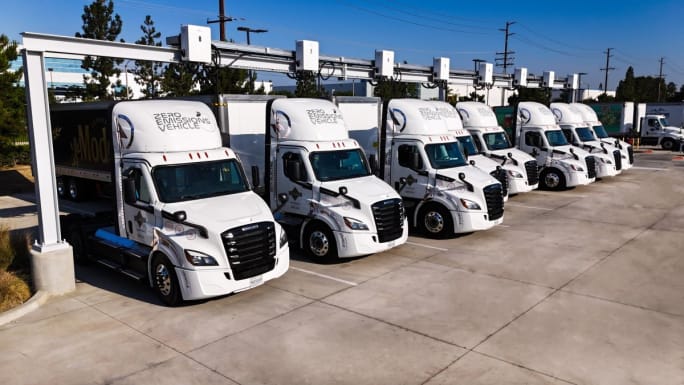
RBG’s decision to adopt the Freightliner eCascadia builds on its recent transition to renewable diesel and its ongoing idle-time reduction program
Photo: DTNA
RBG’s decision to adopt the Freightliner eCascadia builds on its recent transition to renewable diesel and its ongoing idle-time reduction program.
These electric vehicles (EVs) will contribute significantly toward RBG's goal of reducing carbon emissions by 60 percent by 2030, saving over 98,000 gallons of diesel annually and avoiding nearly 700 metric tons of carbon dioxide emissions each year.
“We are excited to be among the first in our industry to adopt these electric vehicles,” said Tom Reyes, President of RBG West. “This is a significant step toward our sustainability goals and ensuring compliance with state regulation as we transition our fleet to EV.”
90-Minute Charging Times
RBG’s Freightliner eCascadia tractors will rely on electric charging stations installed at each facility, allowing them to recharge to 80% capacity in as little as 90 minutes.
With a typical driving range of 220 miles as equipped, these trucks are well-suited for RBG's distribution needs, the OEM said.
The Freightliner eCascadia offers multiple battery and drive axle configurations with ranges between 155 and 230 miles, depending on the truck specification.
Developed with the Detroit proprietary ePowertrain, the eCascadia ensures high levels of power, efficiency, and reliability, according to DTNA.
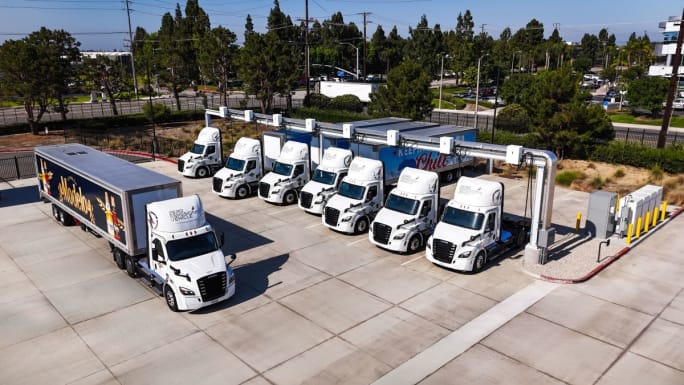
Freightliner eCascadias have a typical single charge driving range of around 220 miles and can reach an 80% state of charge in 90 minutes.
Photo: DTNA
For enhanced road safety, the trucks come standard with Detroit Assurance with Active Brake Assist 5 Suite of Safety Systems.
For customers currently transitioning to electric vehicles or interested in electrification, DTNA said it offers comprehensive fleet electrification solutions. From Detroit eFill commercial chargers to Detroit eConsulting services, DTNA can assist customers with charging infrastructure, energy optimization, and renewable energy integration, providing a seamless transition to zero-emission operations.
More Fuel Smarts
Trucking’s Diesel Squeeze Isn’t Letting Up
With diesel topping $6 a gallon nationally, ATA's Bob Costello explains why fleets should prepare for continued pressure at the pump.
Read More →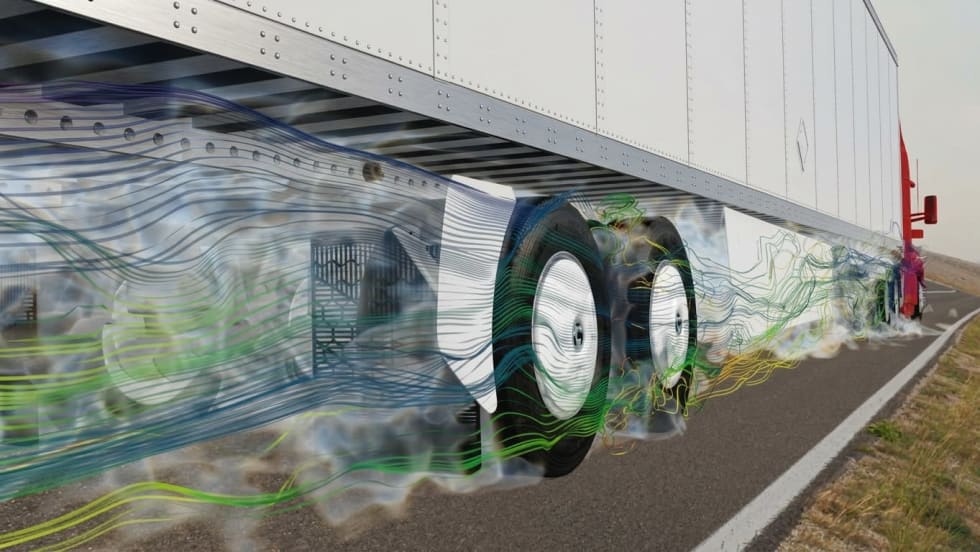
FlowBelow Redesigns Trailer AeroSlider to Cut Fuel Use
The lighter trailer aerodynamic system installs in less than 45 minutes, according to the company, with potential payback in under a year depending on fuel prices and trailer mileage.
Read More →
Why Diesel Price Relief Efforts May Fall Short
Diesel prices have eased from September’s record high, but doubts about additional Russian supply and limits on dyed-diesel tax relief mean trucking fleets still face expensive fuel. And prices could go higher.
Read More →
Why Small Fuel Savings Matter in Trucking
Can better fuel economy help pay for driver raises? In this podcast, GP Transco explains how small efficiency gains create room to reinvest in its people.
Read More →
How GP Transco Cuts Trucking Fuel Costs, a Tenth of a Gallon at a Time
What’s another tenth of a mile per gallon worth? GP Transco shares how equipment upgrades and driver coaching turn small gains into meaningful fuel savings.
Read More →
Electric Yard Tractors Move Beyond Pilots
Operating-cost savings have overtaken sustainability goals as the leading reason surveyed fleets are adopting battery-electric terminal tractors, according to new NACFE research.
Read More →
Geotab Links Fleet Card to Vehicle Data
The new card combines fuel discounts with telematics-based purchase controls. Geotab’s analysis also points to potential savings from choosing lower-priced fuel stops.
Read More →
Fleet Economics Shape Electric Truck Outlook
ACT Research expects costs, charging infrastructure, and technology improvements to drive zero-emission commercial vehicle adoption as federal regulations and incentives retreat.
Read More →
Wex Adds Cardless Fuel Payments for Over-the-Road Customers
A new fuel card feature for Wex customers offers convenience and security.
Read More →
New California Law Could Shed Light on Electric Truck Prices
Why do battery-electric Class 8 trucks remain so expensive? A California bill signed by Gov. Gavin Newsom would give fleets and state agencies more visibility into what manufacturers charge.
Read More →