Transportation Workers Have Most Fatal Workplace Incidents
Transportation and material moving workers were the occupational group with the highest number of fatal work injuries in 2022 and the highest fatal incident rate, according to the Bureau of Labor and Statistics.
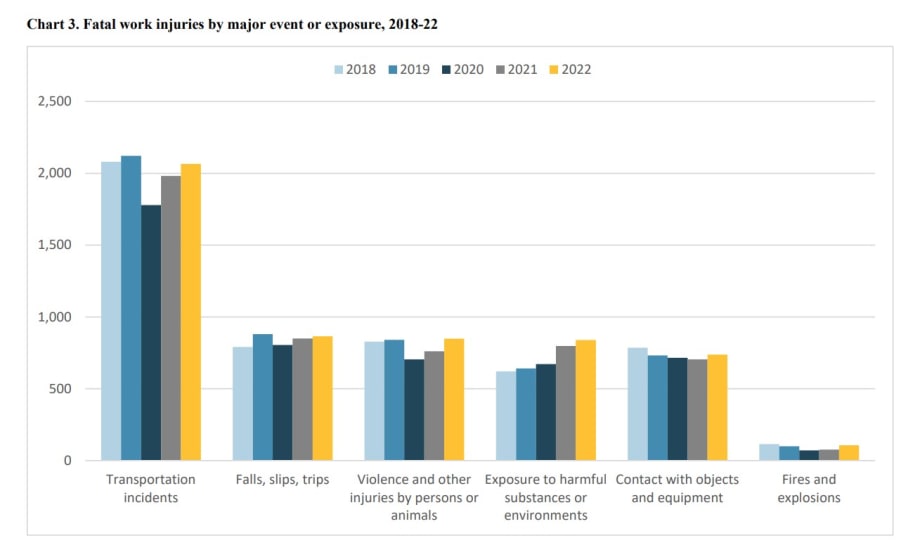
Fatal work injuries related to transportation work increased in 2020, 2021, and 2022 but remained lower than in 2019.
Source: Bureau of Labor Statistics
2 min to read
There were more transportation and material moving worker deaths in 2022 than in any other occupational group, according to the Bureau of Labor Statistics' recent release of the National Census of Fatal Occupational Injuries in 2022. Those occupations had the highest rate of fatalities, as well.
The report attributes the increase to fatalities of driver/sales workers and truck drivers increasing by 8%, from 1,032 fatalities in 2021 to 1,115 in 2022.
Ad Loading...
Workers in transportation and material moving occupations experienced 1,620 fatal work injuries in 2022. The next occupational group with the highest number of fatal incidents was construction and extraction workers with 1,056 incidents.
Transportation and material moving workers also had the highest rate of fatalities, 14.6 fatalities per 100,000 full-time equivalent (FTE) workers. Farming, fishing, and forestry occupations had a higher fatality rate, 23.5 per 100,000 FTE, but fewer fatal incidents overall.
Transportation Incidents
Transportation incidents remained the most frequent type of fatal event accounting for 37.7% of all occupational fatalities. There were 2,066 fatal injuries from transportation incidents in 2022, a 4.2% increase from 1,982 in 2021.
Ad Loading...
Roadway Incidents
Roadway incidents involving a vehicle accounted for the largest portion of fatal transportation incidents, according to the report. Those incidents increased 9.3% between 2021 and 2022, leading to a series high of 1,369.
Transportation and material moving, as an occupation, had the second highest rate of fatal work injuries in 2022 and the largest number of fatal injury incidents.
Source: Bureau of Labor Statistics
Non-Roadway Incidents
Other transportation incident counts, not occurring on a roadway, included:
Aircraft incidents — 101
Rail vehicle incidents — 43
Water vehicle incident — 31
Non-roadway incident involving motorized land vehicle — 185
Non-roadway non-collision incident — 128
Jack-knifed or overturned, non-roadway — 77
Ad Loading...
Demographics Most Impacted
Transportation incidents were the highest cause of fatalities among African American workers, 278, and Hispanic workers, 439.
Workers in the 55- to 64-year-old age group continued to have the highest number of fatalities in 2022 with 1,175, which was 21.4% of total fatalities. Transportation incidents were the highest cause of fatalities for this age group (455), followed by falls, slips, and trips (251).
Despite consecutive increases in 2021 and 2022, transportation incidents were still down 2.6% from pre-pandemic levels in 2019 when there were 2,122 fatalities.
Carriers whose updates were due on or after June 1 have more time, while FMCSA works to stabilize its new registration system and warns of phishing sites impersonating its new carrier registration system, Motus.
ZF is expanding its North American commercial-vehicle presence with new transmission applications, electrification, trailer technology and autonomous-driving systems.
Fleets have more visibility into truck health, safety events, and driver activity than ever. The next challenge is turning all that information into useful guidance for the person who has to decide what to do next.
Could Tesla’s camera-only autonomous driving technology work on an 80,000-pound Semi? In this commentary, HDT's Deborah Lockridge takes a look at Tesla, Cybercab, and how autonomous trucks see the road.
The U.S. Department of Transportation issued a new automated-vehicle strategy that outlines plans for driverless-truck regulations, cross-state freight corridors, and federal safety standards.
New York City is expanding intelligent speed assistance and pedestrian-alert systems across its municipal fleet, moving the technologies from pilot programs into vehicle procurement and retrofit requirements.
Federal regulators also are targeting more than 160 additional training providers and launching a nationwide audit of third-party CDL skills testers as part of a broader crackdown on trucking fraud.
Two pilot programs could eventually reshape hours-of-service rules, giving truck drivers options to pause their 14-hour clock or use longer split sleeper rest periods.
Hundreds of thousands of pets travel in truck cabs. A new safety guide from Volvo Trucks and the Center for Pet Safety offers practical advice for truck drivers who bring dogs and cats along for the ride.