Intelligent camera systems in cargo areas not only can monitor the cargo but can also help trailer utilization.
Source: Spireon
3 min to read
With the prevalence of cargo theft, much of which is now through fraudulent means and shipment diversion, many experts suggest the key to not becoming a victim is to better vet others you deal with in the industry. But technology can also lend a hand in monitoring cargo and possibly recovering it if stolen.
Ad Loading...
Cameras can provide a view inside trailers and cellular data can provide timely updates of the location of the shipment on a regular basis.
“The nice thing about a lot of the technology today, is it's covertly installed,” says Roni Taylor, senior vice president of strategy and business development for Spireon, a Solera company. “Some of the devices are installed underneath, and there are also tamper alerts on many of the devices.”
Ad Loading...
She says it now is nearly impossible for a would-be thief to disarm or uninstall a tracking device or camera.
Tracking devices vary, and multiple systems could be installed within a fleet based on need.
One of the simplest is a GPS tracking device, which is often installed under the trailer – whether flatbed, van, or reefer. Some less-than-truckload carriers will also install such tracking devices on converter dollies.
Some in the industry say that many fleets cannot afford such security technology, but Taylor believes that is not the case. Solera now has a GPS tracker that is not tethered to the trailer’s electrical system, but instead is battery-powered.
“It can go pretty much anywhere on the trailer, and it's very affordable and in one or two pings per day, it'll report on motion,” she explained. “We think that it’s going to really give the smaller carriers the ability to take one of these devices, put it up underneath the trailer, and be protected from the theft problem at a very affordable price point.”
Ad Loading...
The battery does not need to be serviced or replaced, and the tracking unit can be moved from one vehicle to another if needed. She explained you simply install the device and let it run for the duration of the battery’s life, which is four or five years.
Trailer Utilization
Although many see such GPS tracking devices as a way to protect against theft, Taylor says the more important role they play for many fleets is providing visibility when it comes to trailer utilization.
“When trucking companies buy trailer tracking, it’s rare today that they’re buying it for theft (protection),” she says. “Theft is a big deal, but utilization of your trailers is even a bigger deal, making sure that you know where all your trailers are so you can haul as much freight as you can and be competitive with the larger carriers.”
Camera Security
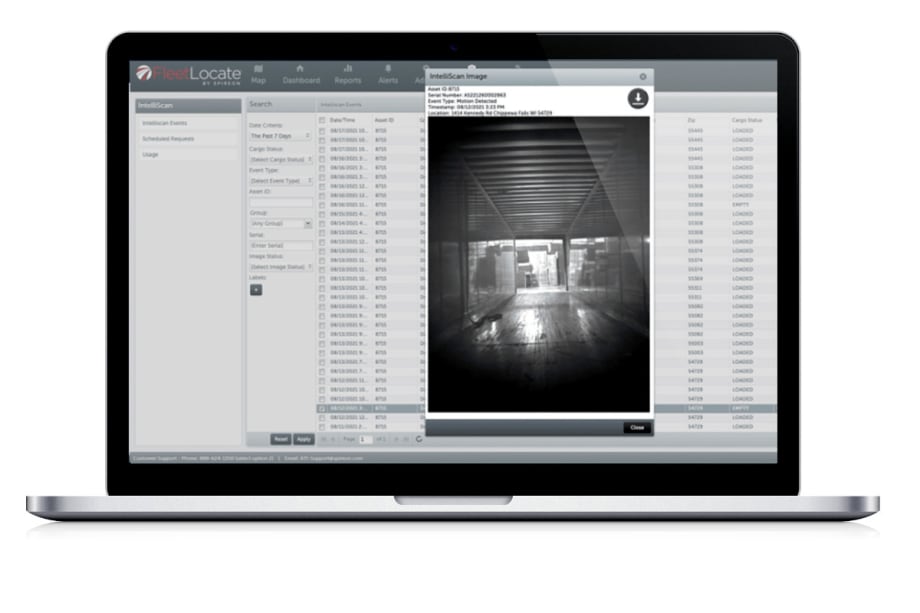
IntelliScan, by Spireon, can help fleet managers know available cargo floorspace through artificial intelligence.
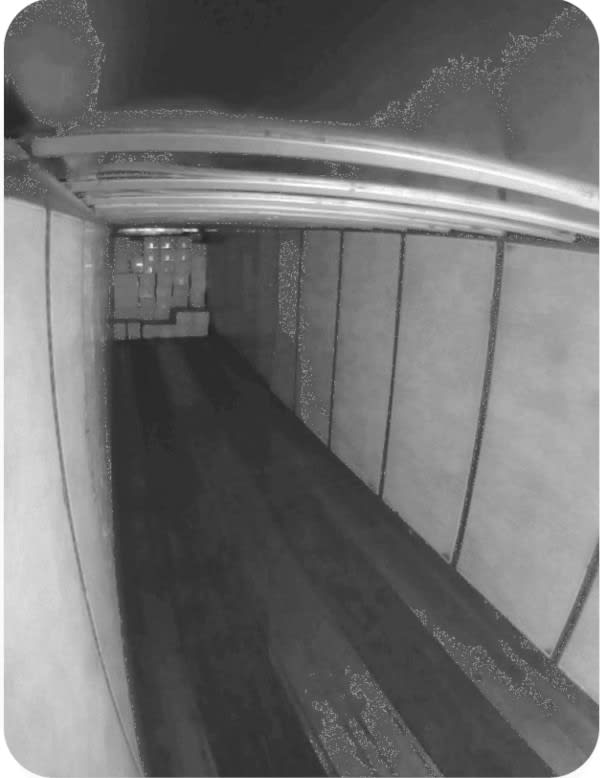
In the case of Spireon they are typically either placed in the nose of the trailer looking rearward or on the sidewalls just inside the door facing forward. Although they can be used to check cargo in terms of theft, primarily they are there to establish load accuracy.
Ad Loading...
“Since 2018, our cargo sensors have been using artificial intelligence to determine through the images, whether the trailer is loaded or empty,” she explains.
Fleets use those images to back up detention data, reporting, and billing by giving a glance at the cargo, she says.
The cameras facing forward can be advantageous for less-than-truckload carriers since through AI those cameras can calculate floor space and volume, delivering insight on how full the trailer actually is at the time. In the case of photos, they can be sent to a fleet through its API.
Other companies offer freight-monitoring cameras, as well, including Orbcomm, Phillips Connect, PowerFleet, and SkyBitz, among others.
For fleet managers and collision repair professionals keeping heavy-duty trucks on the road, getting the color right the first time isn't just about appearance — it's about efficiency, turnaround time, and bottom-line results. Discover how today's digital color tools are transforming the repair process from guesswork to precision.
Carriers whose updates were due on or after June 1 have more time, while FMCSA works to stabilize its new registration system and warns of phishing sites impersonating its new carrier registration system, Motus.
Cargo theft is no longer just the cost of doing business. It's a multi-billion-dollar criminal enterprise exploiting vulnerabilities across your fleet, drivers, and supply chain.
Explore how telematics help refrigerated fleets improve visibility, uptime, efficiency, compliance, and cargo protection across connected cold chain operations.
Escalating U.S.-Canada tariffs could disrupt cross-border freight, reduce truck volumes, raise costs, and create new uncertainty for carriers on both sides of the border.
The American Transportation Research Institute wants to know what's worrying trucking fleet managers, drivers, and other stakeholders in its annual Industry Issues survey.
HDT Truck Fleet Innovator Adam Buttgenbach helped PepsiCo build one of North America’s largest EV fleets by focusing on where electric trucks make operational sense.