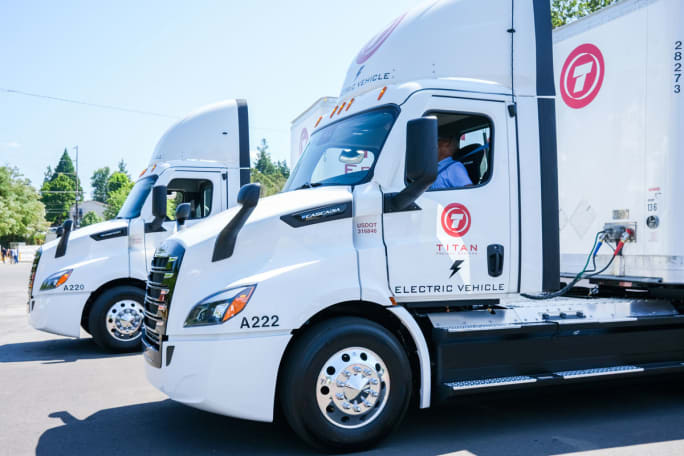
After much anticipation, Titan Freight Systems has taken delivery of its first battery-electric trucks, three Freightliner eCascadias. They’ll be joined by three Freightliner eM2 medium-duty electric box trucks by the end of the year.
Titan Freight Systems Adds Electric Trucks in Oregon
“These heavy-duty electric trucks are a natural evolution in our journey to be a carbon-neutral transportation company,” said Titan Freight Systems President and CEO Keith Wilson.

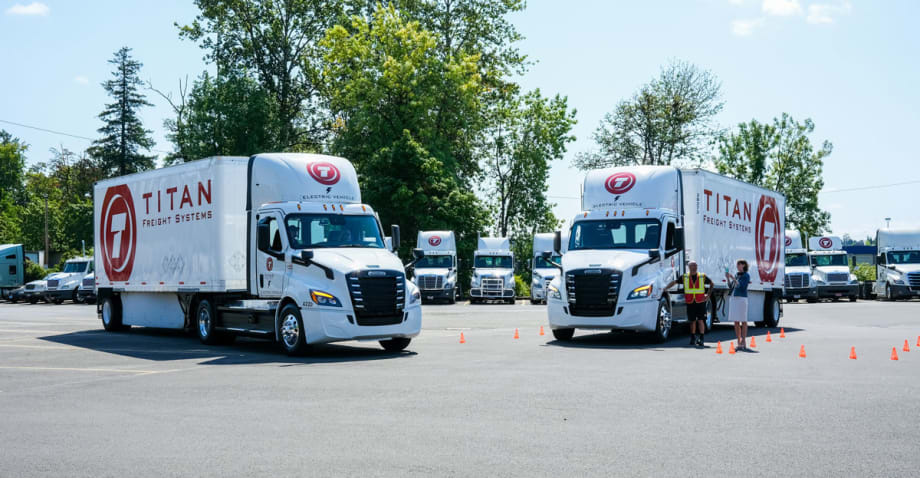
Titan Freight Systems celebrated the delivery of its first Freightliner eCascadia electric trucks with a special event.
Photo: Daimler Truck North America
Titan, headquartered in Portland, Oregon, is a regional carrier providing overnight LTL freight service, with seven service centers located throughout Oregon, Washington, and Idaho.
The eCascadias will provide deliveries to businesses throughout the Portland metropolitan area. The eM2s will be assigned to densely populated downtown Portland routes. They will make deliveries in a new 16-square-block Zero-Emission Delivery Zone in downtown Portland. The Portland Bureau of Transportation this year was awarded nearly $2 million through the USDOT Strengthening Mobility and Revolutionizing Transportation (SMART) Grants program to create the zone.
To power the electric fleet, six Detroit eFill commercial charging stations have been installed at Titan’s depot.
To celebrate, Titan hosted a special event for media, government officials, and its partners in this project, including Daimler Truck North America and the local utility.
Titan’s Sustainability Journey
“These heavy-duty electric trucks are a natural evolution in our journey to be a carbon-neutral transportation company,” said Titan Freight Systems President and CEO Keith Wilson. “We now have a new zero-emission, lower operating-cost tool to help us get closer to realizing our sustainability goals.”
In 2019, Titan switched its Oregon operations from petroleum diesel to 100% renewable diesel as a bridge fuel to electric vehicles. Now, the company said, that bridge has been crossed as Titan becomes Oregon’s first carrier operating 100%-electric heavy-duty vehicles, according to Wilson.

Titan's new eCascadias will make deliveries to businesses throughout the Portland metropolitan area.
Photo: Daimler Truck North America
That commitment to sustainability was one reason Wilson was named an HDT Truck Fleet Innovator in 2022.
As he told HDT in an interview for that story, “Every time I invest in something that is focused on an environmental benefit ... it almost uniformly turns out to be a competitive advantage.”
At that time, in the spring of 2022, Titan had completed installation of its first six Level 2 charging stations, had broken ground on six direct-current fast-charging units, and expected to receive the first truck by the end of that year. Like many other companies ordering both conventional and electric trucks, Titan’s order was delayed by truck production that couldn’t keep up with demand.
The Road to Battery-Electric Trucks
"We're excited to partner with Titan and introduce the first customer eCascadia to Oregon's roads," said David Carson, senior vice president, sales and marketing at Daimler Trucks North America.
In 2019, Titan began working with DTNA’s dedicated Electric Mobility Group to determine the availability and timing of its heavy-duty electric vehicles and the infrastructure that would be needed to transition its fleet from diesel-powered to electric.
In 2021, Titan was awarded an Oregon Department of Environmental Quality Diesel Emissions Mitigation Grant to replace six diesel trucks with Freightliner electric vehicles.
Additionally, Portland General Electric provided technical analysis and its “Make-Ready” fleet partner build incentives to assist with charging and infrastructure design and costs.
More Fuel Smarts

Top Green Fleets of 2026: Nomination Deadline Extended
Is your company a leader in sustainability efforts among trucking fleets? If so, Heavy Duty Trucking's editors want to hear from you.
Read More →New Lightweight Wheel Cover Targets Simpler Aero Gains [Watch]
Watch to learn how Deflecktor's new wheel cover design is taking a simpler approach to aerodynamics, with an eye toward making it more practical for both trucks and trailers.
Read More →
Deflecktor: Hubbub Aerodynamic Wheel Cover Cost-Effective Even for Trailers
Aerodynamic wheel covers can deliver small but meaningful fuel-economy gains for fleets, and Deflecktor says its latest design aims to make the technology easier and more affordable to deploy.
Read More →Cutting Fleet Fuel Costs in a Volatile Market [Listen]
When diesel prices are as volatile as they've been in 2026, it makes it tough for trucking fleets to plan and control costs. Breakthrough Fuel's Jenny Vander Zanden has insights on near-term savings strategies.
Read More →Diesel Price Swings Aren’t Over. What Can Your Fleet Do?
Practical steps fleets can take to manage fuel costs, from purchasing strategies to driver behavior.
Read More →
Diesel Prices Surge Toward Record Highs as Oil Price Volatility Intensifies
Prices jumped another 24 cents in a week, with California topping $7.50 and new data showing fleet fuel costs may already be at record levels.
Read More →
Volvo Testing Hydrogen-Fueled Internal Combustion Engines on Trucks in Europe
Hydrogen combustion engine trucks will be especially suitable over longer distances and in regions where there is limited charging infrastructure or time for recharging of battery-electric trucks, according to the company.
Read More →
Toyota’s Entry Into Cellcentric Signals Push to Accelerate Hydrogen Truck Adoption
By joining Daimler Truck and Volvo, Toyota brings fuel cell expertise to a joint effort aimed at making hydrogen viable for heavy-duty transport.
Read More →
U.S. Diesel Prices Hit $5.40, Top $7 in California
Trucking operators are slowing speeds, cutting empty miles, and declining unprofitable freight as diesel costs continue to rise due to conflict in the Middle East.
Read More →
EPA Targets DEF Sensor Failures Behind Truck Derates
New guidance allows engine makers to replace problematic DEF sensors with NOx-based systems, aiming to reduce unnecessary derates and downtime caused by failures in the sensors designed to monitor diesel exhaust fluid on trucks.
Read More →