




New Smart-Trailer Kits Can Retrofit Telematics
Phillips Connect is offering what it calls Internet of Trailers kits, which allow fleets of all sizes to convert to smart-trailers.

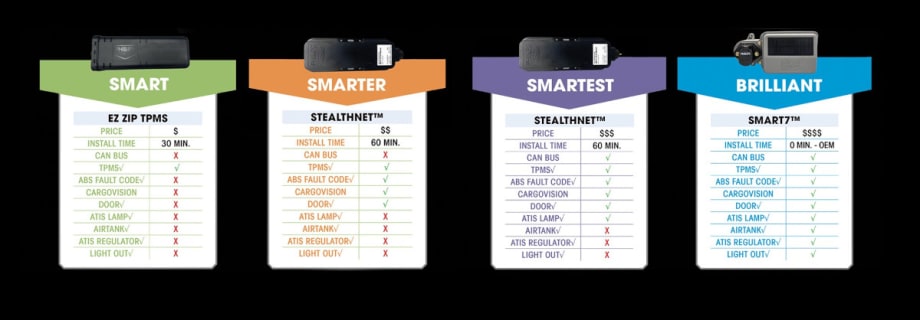
Phillips Connect now offers four levels of smart-trailer kits.
Graphic: Phillips Connect
Phillips Connect has assembled four kits, which it calls Internet of Trailers kits, that allow fleets to convert to smart trailers. Smart-trailer technology uses telematics to enable real-time diagnostics, fault detection, and trend reporting.
Jim Epler, executive vice president at Phillips Connect, has been studying some of the largest fleets in North America to learn how to “future-proof” fleet operations. These new smart-trailer kits are designed to increase fleet efficiency, uptime, and safety, and provide a return on investment even for smaller fleets that have limited resources to add telematics solutions.
Each kit has an average payback of 12 months and an average return on investment of 500% after 10 years, according to Phillips Connect.
The kits now available are:
Smart Kit — Gateway: EZ Zip TPMS
Smarter Kit — Gateway: StealthNet
Smartest Kit — Gateway: StealthNet
Brilliant Kit — Gateway: Smart7
Smart Kit
The Phillips Connect Smart upgrade kit includes TPMS Check, a tire pressure monitoring system, and installs in just 30 minutes. The company said this can save costs and allow fleets to monitor their tire health, preventing early replacement and downtime.
Smarter Kit
The Phillips Connect Smarter Kit features the hidden/under-trailer installed StealthNet gateway to avoid theft. In addition to TPMS Check, this kit adds ABS Fault Code Check, which advises what the ABS fault is for; Door Check, which monitors door events outside of authorized geofences and can prove to customers doors weren't opened en route; and CargoVision, which monitors the interior of trailers using camera technology. It can be installed in under one hour.
Smartest Kit
The Phillips Connect Smartest Kit with StealthNet gateway provides everything the Smarter Kit does, plus CAN communications and ATIS Lamp Check, which monitors automatic tire inflation systems remotely. It can also be installed in just one hour.
Brilliant Kit
The Phillips Connect Brilliant Kit fieatures an array of sensors and data, providing a complete picture of a trailer’s health. The Phillips Connect Smart7 gateway provides CAN communication, TPMS Check, ABS Fault Code Check, Door Check, CargoVision, ATIS Lamp Check, AirTank Check, ATIS Regulator Check, and Light Out Check. This kid requires OEM installation.
Benefits of Smart Trailer Kits
According to Phillips Connect, these are some benefits of using smart-trailer technology:
Adding the ability to remotely monitor tire pressures gives customers the ability to stay on top of tire health before costs add up from downtime, roadside service, and early replacement.
Monitoring brake faults lets fleets avoid dispatching drivers to trailers that need maintenance before they can go back into service.
Remote ATIS monitoring ensures that fleet maintenance managers can proactively dispatch technicians to trailers that need tire service, while continuing to monitor the other trailers in their fleet that need attention.
Phillips Connect’s Remote Pre Check feature provides customers with on demand trailer health and cargo updates. Fleets can see which trailers are healthy versus unhealthy and at the same time which trailers are loaded or empty. This combined view of trailer health and trailer utilization lets customers maximize driver productivity by avoiding the hours lost driving to trailers that are not ready to move.
Like all Phillips Connect products, the IoT kits communicate to its Connect1 platform, which provides complete fleet analytics in real-time with easy reporting, on-demand notifications, historical trends to assist with maintenance schedules and predictive analysis, geo-fencing, and customization for each fleet’s needs.
For more information online, visit Explore IoT Kits - Phillips Connect.
More Equipment

How Volvo Updated Its D13 for EPA 2027 [Watch]
Volvo’s updated D13 promises lower emissions without sacrificing performance or fuel economy. Take a closer look at what changed inside the engine in this HDT Spotlight video.
Read More →
Michelin Tire Improves Efficiency and Durability for Regional Fleets
The Michelin X Multi Energy D2 is a regional haul drive tire engineered to help fleets improve fuel efficiency, durability and traction in demanding stop-and-go operations.
Read More →
ZF Expands Commercial Vehicle Push in North America
ZF is expanding its North American commercial-vehicle presence with new transmission applications, electrification, trailer technology and autonomous-driving systems.
Read More →
Tesla Wants a Self-Driving Semi. Are Cameras Enough?
Could Tesla’s camera-only autonomous driving technology work on an 80,000-pound Semi? In this commentary, HDT's Deborah Lockridge takes a look at Tesla, Cybercab, and how autonomous trucks see the road.
Read More →
Kodiak: Driverless Long-Haul Truck Launch on Track for 2026
Kodiak AI says its driverless long-haul safety case is 93% complete and it remains on track to begin commercial operations by year-end 2026.
Read More →
What DOT’s Automated Vehicle Strategy Means for Trucking
The U.S. Department of Transportation issued a new automated-vehicle strategy that outlines plans for driverless-truck regulations, cross-state freight corridors, and federal safety standards.
Read More →
East Coast Port Launches $45M Electric Truck Push
The Port Authority of New York and New Jersey announced millions in incentives for zero-emission drayage trucks, yard tractors, and new charging hubs near the port.
Read More →
PlusAI Going Public to Fund Autonomous Truck Launch
A SPAC deal could provide PlusAI with up to $300 million as it works toward a 2027 commercial launch of factory-built autonomous trucks.
Read More →
NHTSA Moves to Rewrite Truck Fuel-Economy Rules
The National Highway Traffic Safety Administration says it lacks authority to regulate medium- and heavy-duty truck engines separately from complete vehicles, but the existing standards have not yet been eliminated.
Read More →
Detroit Opens Orders for EPA 2027 Engines
Detroit isn’t starting from scratch to meet EPA 2027 diesel emissions standards. Its Gen 6 DD13 and DD15 engines keep much of today’s platform while updating the fuel and aftertreatment systems.
Read More →