




WattEV to Open Charging Depot at Port of Long Beach
The WattEV public charging depot will serve heavy-duty electric trucks with routes connecting to inland destinations throughout Southern California.

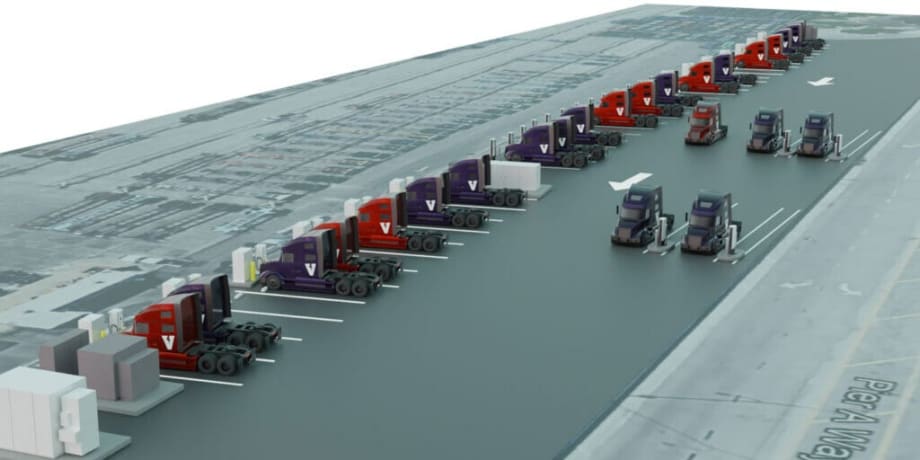
The WattEV depot, located adjacent to the Pier-A terminal in the Port of Long Beach, features 5 mW capacity for concurrent charging of 26 trucks at up to 360kW each.
Photo: WattEV
Electric transportation developer WattEV has completed its 26-truck charging plaza at the Port of Long Beach and is preparing to take delivery of 14 Nikola Tre battery-electric trucks.
WattEV is building public charging depots to serve fleets of commercial electric trucks. But the company also provides electric trucks as a service to meet the needs of shippers and fleet operators committed to meeting California’s mandates towards zero-emissions.
WattEV’s first of four charging depots in Southern California will open for service at the Port of Long Beach with access to Interstate 710 and 110 starting the week of May 15. Nikola trucks can use the WattEV depots for daily charging.
WattEV CEO Salim Youssefzadeh says his company aims to reduce charging times significantly.
“We have been running a pilot test with Nikola battery-electric trucks for the past six months and are quite satisfied with the energy efficiency of the trucks and the ongoing technical support," he said. "Nikola’s customer-centric approach to meet our requirement for transition from CCS to MCS charging will be a game changer, which will allow us to rapidly expand our fleet size,” Youssefzadeh said.
The Combined Charging System (CCS) is the current charging standard for heavy-duty e-trucks, while faster charging systems are under development. The higher-power Megawatt Charging System is expected to become the worldwide standard for fast-charging of medium- and heavy-duty commercial vehicles, reducing the typical charge sessions to less than 30 minutes.
More About the WattEV Charging at Long Beach Port
The plaza's public opening will follow the Volts Conference, a charging infrastructure event taking place May 9-10 in Long Beach, sponsored by the California Energy Commission, hosted by the North American office of the Charging Interface Initiative, known as CharIN, with testing provided by WattEV.
Branded as WattEV, the depot will serve heavy-duty electric trucks with routes connecting to inland destinations throughout Southern California. The facility will support its first batch of 14 Nikola electric trucks with the fleet expected to expand to about 100 electric trucks by the end of 2023, with the opening of additional charging depots in Southern California.
According to WattEV, the Port of Long Beach charging depot is designed to serve electric truck operations throughout the San Pedro Bay ports complex. It's the first of several WattEV electric truck charging depots in the works throughout California, including warehouse districts in nearby Gardena and inland near San Bernardino.
"This charging station is the southern anchor of our planned electric-truck charging freight corridor, which will incrementally connect to all the major freight routes throughout California, Oregon, Arizona, and Nevada," said Salim Youssefzadeh, CEO of WattEV, in a statement. "Our truck-charging depot at the Port of Long Beach is a major step towards enabling transporters to transition to zero-emission trucking."
The ports have been setting clean air goals for about 20 years with a goal of having 100% zero-emission trucks serving the ports by 2035.
On opening, WattEV's Port of Long Beach e-truck charging plaza will feature 26 charging bays using Combined Charging System (CCS) connectors to provide power at up to 360kW. When trucks with megawatt charging capability become available, four more pass-through e-truck bays will be added, which will feature the higher-power Megawatt Charging System, rated for charging at up to 1.2 megawatts, reducing charge sessions for medium and heavy-duty commercial vehicles to less than 30 minutes.
More Fuel Smarts
Fleet Economics Shape Electric Truck Outlook
ACT Research expects costs, charging infrastructure, and technology improvements to drive zero-emission commercial vehicle adoption as federal regulations and incentives retreat.
Read More →
Wex Adds Cardless Fuel Payments for Over-the-Road Customers
A new fuel card feature for Wex customers offers convenience and security.
Read More →
New California Law Could Shed Light on Electric Truck Prices
Why do battery-electric Class 8 trucks remain so expensive? A California bill signed by Gov. Gavin Newsom would give fleets and state agencies more visibility into what manufacturers charge.
Read More →

How Volvo Updated Its D13 for EPA 2027 [Watch]
Volvo’s updated D13 promises lower emissions without sacrificing performance or fuel economy. Take a closer look at what changed inside the engine in this HDT Spotlight video.
Read More →
Diesel Price Spike Shortens Payback for Natural Gas Trucks, Report Says
Energy Vision estimates fleets could recover the higher purchase price of an RNG-fueled Class 8 tractor in 1.3 to 2.8 years under current fuel-price scenarios.
Read More →
Calstart Becomes Catalyst Mobility, Reflecting Broader Focus
Calstart is now Catalyst Mobility, reflecting the nonprofit’s growing national role in clean transportation, including zero-emission trucks, infrastructure and incentive programs.
Read More →
Record Diesel Prices Squeeze Trucking Fleets
Average U.S. diesel prices have climbed to nearly $6 a gallon, surpassing the 2022 record as tight refinery capacity and Middle East disruptions keep fuel costs elevated.
Read More →
How Fuel Delivery Shapes Engine Performance
Fuel delivery depends on more than what happens at the injector. For fleet, maintenance and technical professionals, looking at the full path from pump to injector can provide useful context for understanding engine performance.
Read More →
East Coast Port Launches $45M Electric Truck Push
The Port Authority of New York and New Jersey announced millions in incentives for zero-emission drayage trucks, yard tractors, and new charging hubs near the port.
Read More →
Detroit Opens Orders for EPA 2027 Engines
Detroit isn’t starting from scratch to meet EPA 2027 diesel emissions standards. Its Gen 6 DD13 and DD15 engines keep much of today’s platform while updating the fuel and aftertreatment systems.
Read More →