




Q&A: Plus COO on the Role of Autonomous Trucking Tech
Shawn Kerrigan, the COO and co-founder of Plus, believes autonomous technology will be focused on making human drivers safer and more productive for many years to come.


HDT Senior Contributing Editor Jack Roberts (left) and Plus COO Shawn Kerrigan sit down to talk the the future of autonomous tech in the trucking industry.
Photo: Plus
Autonomous truck tech start-up Plus was an early innovator in the rapidly evolving world of self-driving vehicles. The company demonstrated a Level 4 autonomous control system in 2016 and quickly focused on trucking as the target market for its vehicle control systems.
In February, 2021, Plus began selling its Level 2 PlusDrive autonomous control system, positioning it in the market as an advanced driver safety system. In the meantime, the company has racked up notable successes, including adding Amazon as a PlusDrive customer, selling systems in Asia and Europe, and forging an OEM relationship with Italian truck builder Iveco.
In this exclusive HDT interview, Plus Co-Founder and Chief Operating Officer Shawn Kerrigan talks about the pathway his company has followed and how he sees the future of autonomous technology in trucking evolving.
HDT: Early on, the common thinking was that autonomous trucks would mean completely robotic trucks crisscrossing the country with little or no human interaction. It seems like your focus is more on providing an advanced safety and efficiency system for drivers and fleets.
Kerrigan: I think the thinking has changed somewhat. If you go back to where we came from, and look to where we’re going with autonomous technology, we were attracted to trucking because there’s such a strong business case for this technology. Our early Level 4 demonstrations were intended primarily to showcase what this technology can do for trucking. And we’ve come market with an autonomous solution that can be applied by fleets today and make a huge difference in their operations – both in terms of safety and a significant boost in fuel economy.
HDT: It’s kind of ironic that a technology that is widely regarded as ultimately taking jobs away from drivers is intensely focused on making drivers’ jobs easier and safer.
Kerrigan: Well, our system provides drivers with a constant, 360-degree field of view around their truck. And it never gets tired. It never gets distracted. And it makes a big difference in all aspects of drivers’ work and lives. They’re more comfortable while on the job, and less tired when the workday is over. It makes driving a truck easier and safer. And so we feel that PlusDrive is a system that can encourage more people to come into trucking as drivers and stay in those jobs longer.
HDT: And there are advantages for fleets as well, correct?
Kerrigan: Yes. Outside of a massive improvement in safety, the 10% improvement PlusDrive delivers in fuel economy is the most obvious advantage from a fleet perspective. It’s almost a true plug-and-play system that can be installed in about nine hours. And it doesn’t require daily or routine maintenance once its installed on a truck. There was a lot of shock and awe when the first autonomous trucks appeared. Naturally, there was a lot of skepticism and hesitation that went along with that. But we feel like we have a Level 2 system that is easy to learn, easy to use, and is a great way for fleets and trucking in general to get acquainted with autonomous technology and what it can do.
HDT: It seems obvious after my test drive that “even” a Level 2 autonomous control system like PlusDrive offers clear safety benefits for drivers. Do you think it's reasonable to press regulatory agencies for some sort of autonomous endorsement on a CDL? Maybe grant extended hours of service for drivers’ whose electronic data records show the truck was driven in autonomous mode for most of a day?
Kerrigan: It’s something we’re looking into. We see this as a technology that boosts safety and helps drivers get home at night. I think things like an HOS extension will come in time. But we need the data to prove that our technology can allow that safely. We are talking with regulatory agencies and gathering data now.

Plus Co-Founder and Chief Operating Officer Shawn Kerrigan.
HDT: You struck a deal with Amazon early on. What can you tell us about that relationship?
Kerrigan: Not much, frankly, because of the none-disclosure agreements we’ve signed with them. What I can tell you is we are focused on finding partners around the globe that we can collaborate and partner with to advance this technology and help it gain acceptance worldwide. Our relationship with Iveco is a perfect example of that. I hope that potential partners see that we are focused on delivering value for our customers and want to work with us because of that.
HDT: Driving or riding in a PlusDrive-equipped truck goes a long way toward understanding this technology. What can fleets do if they’re interested in seeing it for themselves?
Kerrigan: Reach out to us via our website, go for a demo ride and experience the technology. It’s really as simple as that. Large fleets are interested in autonomous technology because they share common challenges: High driver turnover, a need for improved safety and better fuel economy. Our position is that automation is a new technology that can help them with those problems. It hits all of those pain points, while giving them a powerful new tool to attract, recruit and retain drivers.
HDT: What about fleets worried about getting service when there’s a problem?
Kerrigan: We have our partnership with Velociti, which is a big boost for installations. They can be done on a truck in about nine hours. And we’re building out a lot of training resources so that we’ll be able to help fleets train their trainers and get drivers educated on how to use PlusDrive.
Beyond that, our system is self-calibrating and self-diagnosing when there’s a problem. If service is needed, it’s robust and modular in design. Issues can often be resolved by simply swapping out a component like an electronic control module or a sensor. And if the system isn’t getting the data it needs to operate correctly, it’s not going to work. So you don’t have to worry about the system acting on bad data.
HDT: My final question is one that I get asked all the time: When can we expect to see Level 4 and Level 5 — truly driverless — autonomous trucks working day-to-day for fleets?
Kerrigan: Everybody has an opinion, but nobody really knows. But it is coming. Still, I think that for a very long time, autonomous technology is mainly going to be focused on helping human drivers be safer and work more efficiently. When fully driverless trucks do arrive, they’ll go to work in narrow market segments and in specific geographic regions — the American Southwest, for example. So, for the foreseeable future, we see our approach to autonomous technology as something that really works well for trucking with human drivers behind the wheel.
More Equipment

ZF Expands Commercial Vehicle Push in North America
ZF is expanding its North American commercial-vehicle presence with new transmission applications, electrification, trailer technology and autonomous-driving systems.
Read More →
Tesla Wants a Self-Driving Semi. Are Cameras Enough?
Could Tesla’s camera-only autonomous driving technology work on an 80,000-pound Semi? In this commentary, HDT's Deborah Lockridge takes a look at Tesla, Cybercab, and how autonomous trucks see the road.
Read More →
Kodiak: Driverless Long-Haul Truck Launch on Track for 2026
Kodiak AI says its driverless long-haul safety case is 93% complete and it remains on track to begin commercial operations by year-end 2026.
Read More →
What DOT’s Automated Vehicle Strategy Means for Trucking
The U.S. Department of Transportation issued a new automated-vehicle strategy that outlines plans for driverless-truck regulations, cross-state freight corridors, and federal safety standards.
Read More →
East Coast Port Launches $45M Electric Truck Push
The Port Authority of New York and New Jersey announced millions in incentives for zero-emission drayage trucks, yard tractors, and new charging hubs near the port.
Read More →
PlusAI Going Public to Fund Autonomous Truck Launch
A SPAC deal could provide PlusAI with up to $300 million as it works toward a 2027 commercial launch of factory-built autonomous trucks.
Read More →
NHTSA Moves to Rewrite Truck Fuel-Economy Rules
The National Highway Traffic Safety Administration says it lacks authority to regulate medium- and heavy-duty truck engines separately from complete vehicles, but the existing standards have not yet been eliminated.
Read More →
Detroit Opens Orders for EPA 2027 Engines
Detroit isn’t starting from scratch to meet EPA 2027 diesel emissions standards. Its Gen 6 DD13 and DD15 engines keep much of today’s platform while updating the fuel and aftertreatment systems.
Read More →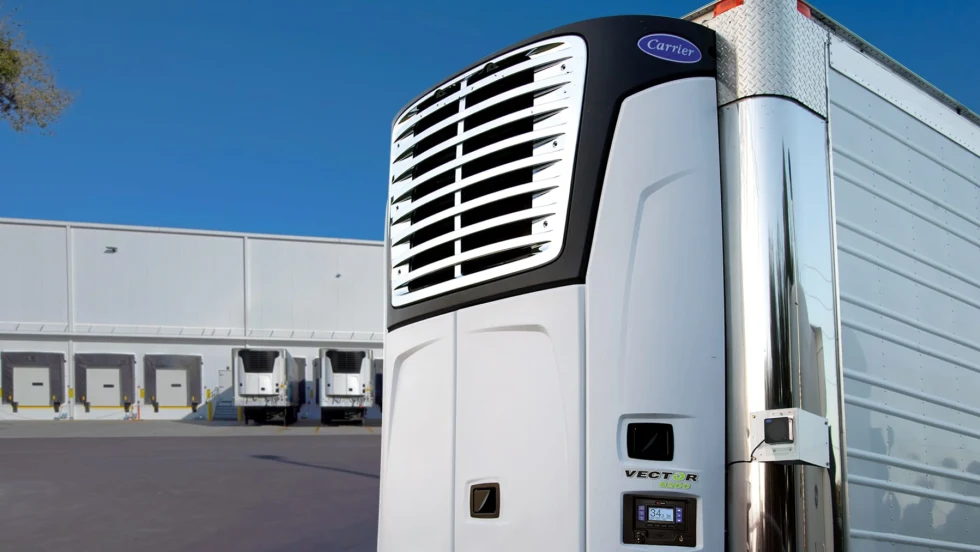
Carrier Transicold Adds All-Electric TRU for Stationary Cold Storage
Carrier Transicold’s new Vector 8200 all-electric transport refrigeration unit gives fleets a diesel-free option for temporary refrigerated and frozen trailer storage.
Read More →
A Closer Look at Kenworth’s Electric T880E Vocational Truck [Video]
Learn more about Kenworth's T880E battery-electric vocational truck at the Paccar Technical Center, including its range, applications, upfitting considerations, and PTO options, in this HDT Spotlight video.
Read More →