Kenworth showed off its zero-emissions medium- and heavy-duty trucks at the Paccar Innovation Center. HDT’s Jack Roberts reports on what it’s like behind the wheel of these not-so-futuristic commercial vehicles.
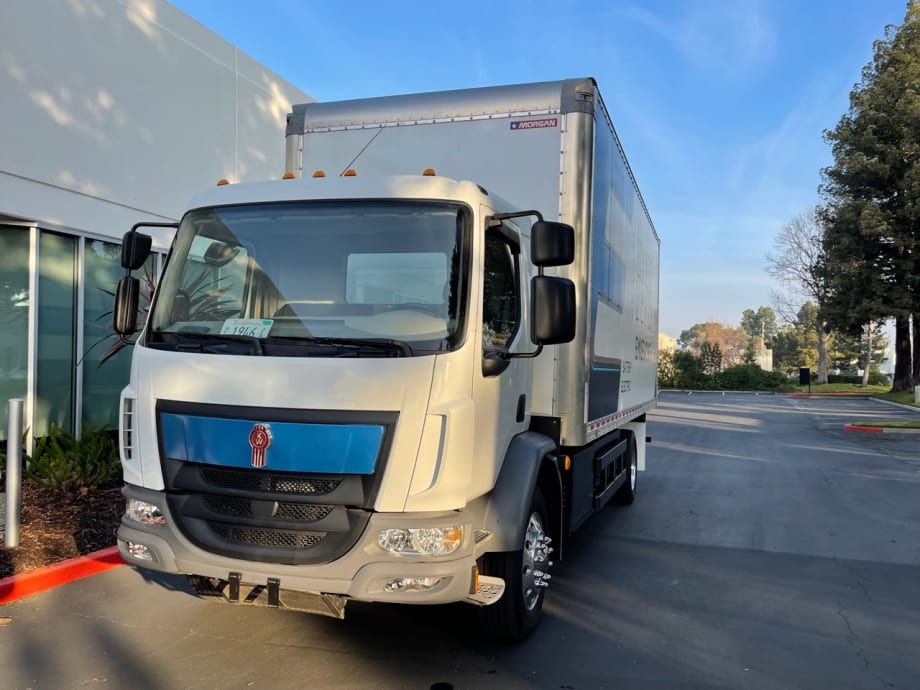
The Kenworth K270E can go up to 200 miles on a single battery charge and can cruise comfortably at 65 mph.
Photo: Jack Roberts
7 min to read
The Paccar Innovation Center sits in a quiet California neighborhood in the heart of Silicon Valley within a stone’s throw of some of the biggest names in automotive design and technology. And it’s here — where Paccar engineers work to find, perfect and integrate the latest technologies into Kenworth and Peterbilt trucks — that Kenworth choose to showcase its latest developments on the zero-emissions vehicle front.
Ad Loading...
On hand for short test drives was a medium-duty K270E battery-electric Class 6 cabover, as well as Kenworth’s flagship ZEV model, the all-electric T680E. Also waiting in the wings was a T680FCEV hydrogen-fuel-cell Class 8 tractor developed in partnership with Toyota.
All three trucks were impressive in their own right and give insight into where Kenworth stands with its ZEV product line and where it’s headed.
Ad Loading...
ZEVs: A Quiet Revolution
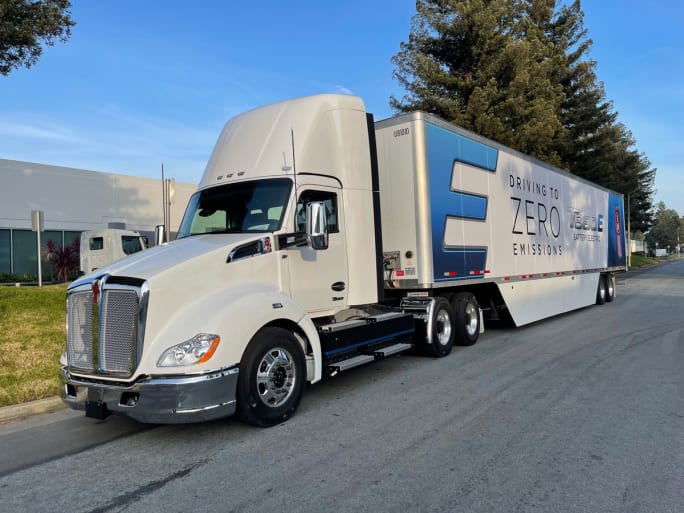
My first test drive of the morning was in the T680E. As with all Kenworth ZEV models, from the outside, there’s nothing noticeable about the truck identifying it as a green vehicle apart from the marketing logos on the tractor and trailer. It just looks like a regular T680.
The same holds true when you climb up in the cab and settle in behind the steering wheel. Nothing seems out of place or unusual as you scan the instrument cluster and dash display. There’s a key to start the truck — but you don’t turn it all the way and crank it as you do on a conventional diesel truck. You simply turn it to the “On” position and wait a heartbeat while all the vehicle systems boot up. When a green icon light next to the trip odometer flashes on, you know you’re ready to go. At that point, you twist the column-mounted transmission control knob to “D,” release the brakes and step on the throttle.
Kenworth’s T60E battery-electric Class 8 tractor delivers big-bore diesel performance without all the noise, vibration and exhaust smoke.
Photo: Jack Roberts
My test model T680E was loaded to 67,000 pounds. Even with that load in the trailer, acceleration from the Meritor e-powertrain was immediate, crisp and powerful. The truck accelerates quickly and smoothly without any gear shifts at all. It’s not an understatement to say the T680E’s performance from a dead stop is truly impressive. The e-drivetrain churns out an impressive 536 horsepower with instantaneous response to throttle inputs.
Also impressive is the truck’s regenerative braking system. This is set up the same way a conventional engine brake is on a diesel truck, with three different power settings. I kept mine all the way down in the most aggressive setting and was deeply impressed by how quickly and efficiently it slowed the truck when I took my foot off the accelerator.
A regenerative braking system captures the kinetic energy generated by the truck’s forward momentum and flows it back into the battery system. In practical terms, the system puts vastly less wear on brake friction material. I wouldn’t be surprised to learn that some fleets running this truck with the most aggressive brake setting double their brake change intervals. Moreover, because all the kinetic energy is flowed back into the battery, it means the truck’s advertised range of 150 miles on a single battery charge is actually a highly fluid number that will depend greatly on the route being run. In many instances, with good, sensible route planning, it might be possible to extend that daily range significantly thanks to energy being put back into the battery by the regenerative brake system.
Ad Loading...
The most amazing aspect of driving the Kenworth T680E, though, is how unbelievably quiet it is inside the cab. There’s a little bit of noise coming from the electric motors mounted on the axles. But it’s very subtle whine — hardly noticeable at all. And certainly far less of an issue than even the quietest diesel truck on the market today.
Once you’re up and running, the T680E rides and drives very much like a conventional Class 8 tractor. Really, the only noticeable differences are the quietness of the ride and how crisply the truck responds when you add throttle. In all other aspects, there’s nothing out of the ordinary about the way it handles. If you like the way a T680 rides and handles in traffic, then you’re not going to be disappointed by the ZEV version of the truck — unless you’re just a huge fan of diesel engine powertrain noise.
Hydrogen Power to Spare
My next test drive was the Kenworth T680FCEV. I was really looking forward to this one, because it is the first hydrogen-fuel-cell truck I’ve had an opportunity to take for a drive.
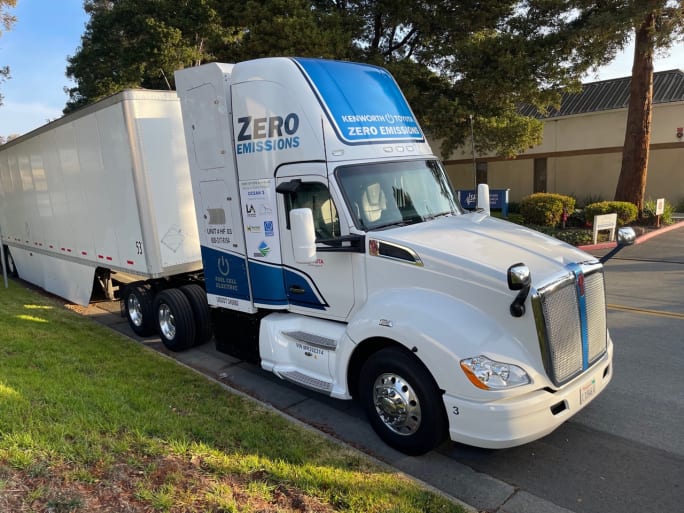
Unlike the T680E, there is a bit of a difference in outward appearance for the T680FCEV compared to conventional T680s. This is in the form of an additional area added to the back of the cab — looking a bit like a small sleeper cab — where the hydrogen fuel tanks are housed.
Startup is exactly the same as in the T680E, and acceleration was once again crisp and authoritative as the truck gained speed. The T680FCEV isn’t quite as smooth as its all-electric brother, however, thanks to a conventional, four-speed, automated transmission. There were still very familiar shift points as the truck accelerated or slowed down.
Ad Loading...
The Kenworth T680FCEV, developed in partnership with Toyota, has a 300-mile range, a top speed of 70 mph and can be refueled in as little as 15 minutes.
Photo: Jack Roberts
The regenerative braking system on the fuel-cell truck isn’t as aggressive, either, because there’s no need to put energy back into the battery the way there is on the T680E. The truck does have a small battery on board to “help out” by adding additional power to the drivetrain when needed (on a steep grade, for example). But because its power demands are much lower than on the all-electric T680E, a powerful regenerative braking system isn’t a priority.
The T680FCEV is also louder than the all-electric version of the truck. There’s a noticeable whine on the road emitted by various air pumps on the vehicle. But Kenworth engineers noted that this is a prototype truck and those pumps would be muted considerably on a production version of the tractor.
Once again, however, the overall feel of the truck was very much that of a conventional T680 in terms of comfort, safety and handling — absent the usual engine and powertrain noise. It accelerates very well, thanks to the 560 horsepower the powertrain cranks out. Kenworth says the truck can cruise for 300 miles at 70 mph and only has a 15-minute refueling time when you need to replenish the hydrogen tanks.
Medium Duty E-Mobility
Last up was the Class 6 K270E all-electric cabover truck with a box van body. This truck features a Dana electric powertrain that puts out 469 horsepower and has a daily, single-charge range of between 100 and 200 miles, depending on application.
As with the bigger trucks, starting the K270E is as simple as turning the key, waiting for all the onboard systems to boot up, releasing the parking brake and taking off. It is astonishing how quickly the truck accelerates compared to a conventional diesel K270. That power curve remains consistent no matter how fast you’re going. If you’re cruising at 40 mph and need to get up to 60 mph in a hurry, that’s not going to be a problem for the K270E. The Dana drivetrain and system management software keep plenty of torque and horsepower on hand to meet any traffic situation.
Ad Loading...
Once again, the truck is whisper-quiet, both at low speeds and when cruising on highways. The usual engine noise and powertrain vibrations are simply nonexistent, which will pay dividends in terms of reduced driver fatigue and safety. Considering that these trucks will routinely operate in urban and last-mile applications, their vastly quieter powertrains will greatly enhance situational awareness for drivers on busy city streets.
In all three instances, Kenworth has delivered fully capable zero-emission trucks that can more than hold their own against both gasoline- and diesel-powered trucks on the road today. Kenworth engineers acknowledge that acquisition costs remain a stumbling block for some fleets. But they also note that the market for zero-emissions trucks has changed dramatically over the past 12 months. There is far more demand from shippers, fleets and corporations for these trucks as the technology continues to prove that it is capable of performing on par with conventional diesel- and gasoline-powered trucks.
Kenworth ZEV Test Drive Quick Specs
Kenworth T680E
Range: 150 miles
Top Speed: 65 mph
Powertrain rating 536 hp
Torque: 1,623 lb.-ft.
Battery Pack: 396 kWh
GVWR 82,000 lbs.*
Kenworth T60FCEV
Range: 300 miles
Top Speed: 70 mph
Powertrain rating: 560 hp
Refueling time: 15 minutes
Battery pack: 12 kWh
GCWR: 82,000 lbs.*
Hydrogen tank capacity: 60 kg
Payload capacity: 45,000 lbs.
* Includes a 2,000-lb. ZEV weight exemption for battery packs
Kenworth K270E
Range: 100-200 miles
Powertrain rating: 355 hp/2,035 lb-ft
Top speed 65 mph
Battery Pack: 141-282 kWh
GVWR: 26,000 and 33,000 lbs.
CCS1 Charging Port
Wheelbase options: 206, 218 and 274 inches
[Editor's Note: This article was updated on Jan. 8, 2022, at 12 p.m. to correct one reference to the vehicle class of the K270E, and correct its powertrain rating in the quick spec section.]
Volvo’s updated D13 promises lower emissions without sacrificing performance or fuel economy. Take a closer look at what changed inside the engine in this HDT Spotlight video.
The Michelin X Multi Energy D2 is a regional haul drive tire engineered to help fleets improve fuel efficiency, durability and traction in demanding stop-and-go operations.
ZF is expanding its North American commercial-vehicle presence with new transmission applications, electrification, trailer technology and autonomous-driving systems.
Could Tesla’s camera-only autonomous driving technology work on an 80,000-pound Semi? In this commentary, HDT's Deborah Lockridge takes a look at Tesla, Cybercab, and how autonomous trucks see the road.
The U.S. Department of Transportation issued a new automated-vehicle strategy that outlines plans for driverless-truck regulations, cross-state freight corridors, and federal safety standards.
The Port Authority of New York and New Jersey announced millions in incentives for zero-emission drayage trucks, yard tractors, and new charging hubs near the port.
The National Highway Traffic Safety Administration says it lacks authority to regulate medium- and heavy-duty truck engines separately from complete vehicles, but the existing standards have not yet been eliminated.
Detroit isn’t starting from scratch to meet EPA 2027 diesel emissions standards. Its Gen 6 DD13 and DD15 engines keep much of today’s platform while updating the fuel and aftertreatment systems.