





Canada Continues ArriveCan Education as Border Vaccination Mandate Looms
Canada to Turn Away Unvaccinated Truck Drivers at Border
U.S. truck drivers crossing the border into Canada must be vaccinated against COVID-19 by Jan. 15, or else be turned away at the port of entry.
January 12, 2022
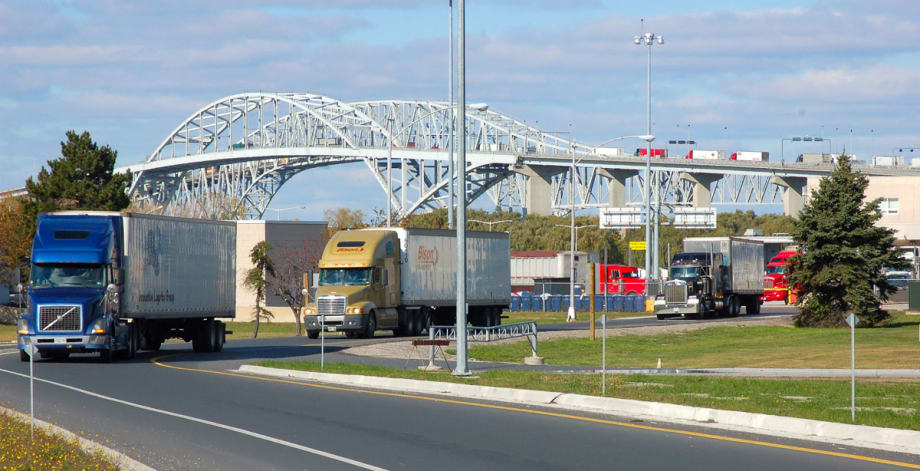
The Canadian government confirmed that U.S. drivers who are unvaccinated or partially vaccinated will be turned away.
Photo: Jim Park
4 min to read
Staring Jan. 15, U.S. truck drivers traveling across the Canadian border must show proof of having been fully vaccinated against COVID-19, or else be turned away at the port of entry.
The federal mandate in Canada will go into effect Jan. 15. The Canadian government confirmed that U.S. drivers who are unvaccinated or partially vaccinated will have their trucks returned to the U.S., according to the Canadian Trucking Alliance.
In addition to being vaccinated, drivers must upload proof of vaccination status through the government of Canada’s ArriveCan mobile app. The app is also accessible by computer.
To avoid delay or issues at the border, the Private Motor Truck Council of Canada advises all U.S. drivers to download the mobile app, download a copy of the receipt that generates after the driver submits their vaccination status information, carry a digital/paper copy of their proof of vaccination status. Drivers arriving with paper documentation only will be delayed.
“[Canadian government] officials have advised us, if you are vaccinated but do not submit the information via ArriveCan as of Jan. 15, their focus will be on education and compliance initially,” PMTC officials wrote in an emailed news alert. “Failure to submit via ArriveCan will likely lead to delays at the border however, and the possibility of penalties do exist. If not using ArriveCan yet, you are advised to transition to it as soon as possible to avoid any issues.”
If medically exempt from being vaccinated, drivers must provide an exemption card issued by the the U.S. Centers for Disease Control.
The Canada Border Services Agency says it will continue to work on contingencies to mitigate border delays and to ensure resources are appropriately allocated. The agency is also working with all ports of entry to ensure “uniformity and clarity” of these requirements.
Canadian truck drivers who enter the country without a vaccine will be subject to quarantine and testing requirements, unless they are hauling critical medical supplies. The U.S. is widely expected to being enforcing its own vaccine mandate for cross-border truck drivers on Jan. 22, but no details have been forthcoming.
Fleet Response to the Mandate
Carbon Express, a New Jersey-based tanker fleet which typically has cross-border customers, has no intention of requiring their drivers be vaccinated.
“We have more business than we can cover in the U.S., so if we have to choose, we will just stay in the U.S.,” said Carbon Express CEO Steve Rush in an email to HDT. “We are remaining status quo and letting the chips fall.”
Other fleets, such as CFI, are turning to dedicated shuttle fleets with fully vaccinated drivers. This fleet “can and will” run their freight across the border, the company told HDT. Based on current freight volumes, CFI has enough cross-border drivers to cover its volumes while meeting both Canadian and U.S. mandates.
Keeping up with both countries’ guidelines during the COVID-19 pandemic has been a challenge, CFI President Greg Orr said in an email to HDT.
“Each country has different approaches and guidelines and seems like it is in continual change,” he wrote. “Ensuring that our drivers and our customers are ready for compliance can be challenging when the goal posts keep moving. For the most part we have handled things smoothly, ensuring our customer’s freight continues to move timely while keeping our professional drivers safe.”
Rush said this mandate could worsen the supply and demand situation on the bulk side, which he says is in “total turmoil.”
“As we can probably predict, mandates such as this are certain to cause delays and increased issues regarding our supply chain,” PMTC President Mike Millian wrote in an emailed news alert. “Since this policy was first raised in government circles, we have constantly communicated the environment that this mandate would create. We had hoped that both U.S. and Canadian officials would recognize the effects this rule would have on our industry’s capacity levels. Unfortunately, at this point neither the Canadian nor U.S. officials have changed their position on this matter.”
Updated Jan. 18, 11:30 a.m. EDT, to add information about exemptions for Canadian drivers hauling medical supplies.
Updated Jan 13, 2022 at 5 p.m., EDT, to include rules for unvaccinated Canadian drivers crossing back into Canada.
More Safety & Compliance

FMCSA Pauses Biennial-Update Enforcement Amid Motus Transition
Carriers whose updates were due on or after June 1 have more time, while FMCSA works to stabilize its new registration system and warns of phishing sites impersonating its new carrier registration system, Motus.
Read More →
ZF Expands Commercial Vehicle Push in North America
ZF is expanding its North American commercial-vehicle presence with new transmission applications, electrification, trailer technology and autonomous-driving systems.
Read More →
Truck Drivers Need More Than Another Alert
Fleets have more visibility into truck health, safety events, and driver activity than ever. The next challenge is turning all that information into useful guidance for the person who has to decide what to do next.
Read More →
Tesla Wants a Self-Driving Semi. Are Cameras Enough?
Could Tesla’s camera-only autonomous driving technology work on an 80,000-pound Semi? In this commentary, HDT's Deborah Lockridge takes a look at Tesla, Cybercab, and how autonomous trucks see the road.
Read More →
What DOT’s Automated Vehicle Strategy Means for Trucking
The U.S. Department of Transportation issued a new automated-vehicle strategy that outlines plans for driverless-truck regulations, cross-state freight corridors, and federal safety standards.
Read More →
NYC Expands Speed, Pedestrian Safety Tech Across Fleet
New York City is expanding intelligent speed assistance and pedestrian-alert systems across its municipal fleet, moving the technologies from pilot programs into vehicle procurement and retrofit requirements.
Read More →
FMCSA Removes 110 Truck Driver Training Schools from Certified ELDT List
Federal regulators also are targeting more than 160 additional training providers and launching a nationwide audit of third-party CDL skills testers as part of a broader crackdown on trucking fraud.
Read More →
Beyond DOT Compliance: What Makes a Trucking Fleet Truly Safe?
A trucking fleet can follow every rule and still make unsafe decisions. The real test comes when safety conflicts with freight, productivity, or cost.
Read More →
Hours of Service Pilot Programs: FMCSA Readies for 2027 Rollout
Two pilot programs could eventually reshape hours-of-service rules, giving truck drivers options to pause their 14-hour clock or use longer split sleeper rest periods.
Read More →
New Guide Offers Pet Safety Tips for Truck Drivers
Hundreds of thousands of pets travel in truck cabs. A new safety guide from Volvo Trucks and the Center for Pet Safety offers practical advice for truck drivers who bring dogs and cats along for the ride.
Read More →