





You also might like: ATA, U.S. Xpress Reveal Forecasts for Short-, Long-Term
Medium-, Heavy-Duty Truck Orders Positive 4th Month in a Row
Class 8 orders surged in September to the highest since October 2018, as a stronger than expected economic and freight recovery is giving fleets more confidence and spurring equipment orders.
October 5, 2020
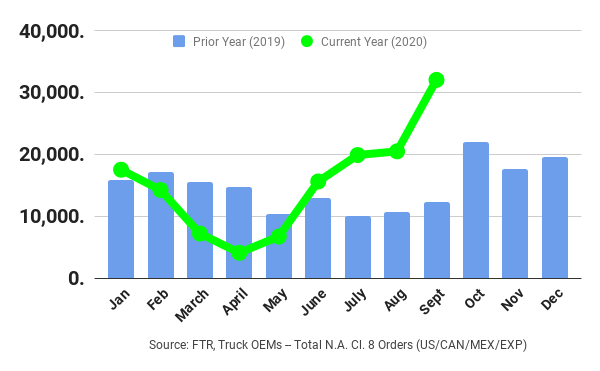
Pent-up demand from low orders during the COVID-19 quarantine is helping to push truck orders to strong levels.
Graph: FTR
2 min to read
Class 8 orders surged in September to the highest since October 2018, as a stronger than expected economic and freight recovery is giving fleets more confidence and spurring equipment orders.
FTR reported preliminary North American Class 8 net orders of 32,000 units for September, with order activity up 55% from the previous month and 160 compared to a year earlier. Class 8 net orders for the last 12 months now total 197,000 units.
ACT Research reported similar numbers, reporting 31,100 units, up 60% from August and a whopping 145% from an easy year-ago comparison.
“Preliminary data show that September orders for medium- and heavy-duty vehicles posted positive readings for a fourth consecutive month, after 19 consecutive months of negative year-over-year comparisons,” said Kenny Vieth, ACT president and senior analyst. He continued, “In aggregate, Classes 5-8 orders rose 49% from August and improved 88% compared to year-ago September.”
The orders are a combination of growing replacement demand and some expansion demand in those regions where capacity is tightening, according to FTR.
“The Class 8 truck market continues to recover faster and better than expected,” said Don Ake, vice president of commercial vehicles for FTR. “This strong order volume suggests fleets believe there will be steady freight growth going forward. Rates have improved, so carriers have the cash, and now they also have the confidence. When you combine those two factors, orders tend to surge.”
Ake also explained that there was considerable pent-up demand in the market, as orders sank in the March to May time period. Trucks that would have normally been ordered then are being ordered now.
“The order volume is very close to August’s trailer orders,” Ake added. “It appears that the fleets took care of their trailer needs first, and then caught up to the truck side in September. Ordering for 2021 deliveries will begin in earnest this month, so the industry has solid momentum going into the fall ordering season.”
ACT’s Vieth said as orders rebounded to relatively healthy levels early in the third quarter, most of those orders were targeted at filling open 2020 build slots. “With most of that work done by the end of August, we suspect the lion’s share of September’s orders were booked into 2021,” he said.
On the medium-duty side, ACT reported the Class 5-7 North American market saw orders at a healthy 26,900 units in September, up 37% month-over-month and 48% versus year-ago September volume.
“There is a symbiotic relationship between heavy-duty freight rates and medium-duty demand,” Vieth said, “and clearly, the shift in consumer spending from experiences [services] to goods has been good for the providers of local trucking services.”
More Equipment

How Volvo Updated Its D13 for EPA 2027 [Watch]
Volvo’s updated D13 promises lower emissions without sacrificing performance or fuel economy. Take a closer look at what changed inside the engine in this HDT Spotlight video.
Read More →
Michelin Tire Improves Efficiency and Durability for Regional Fleets
The Michelin X Multi Energy D2 is a regional haul drive tire engineered to help fleets improve fuel efficiency, durability and traction in demanding stop-and-go operations.
Read More →
ZF Expands Commercial Vehicle Push in North America
ZF is expanding its North American commercial-vehicle presence with new transmission applications, electrification, trailer technology and autonomous-driving systems.
Read More →
Tesla Wants a Self-Driving Semi. Are Cameras Enough?
Could Tesla’s camera-only autonomous driving technology work on an 80,000-pound Semi? In this commentary, HDT's Deborah Lockridge takes a look at Tesla, Cybercab, and how autonomous trucks see the road.
Read More →
Kodiak: Driverless Long-Haul Truck Launch on Track for 2026
Kodiak AI says its driverless long-haul safety case is 93% complete and it remains on track to begin commercial operations by year-end 2026.
Read More →
What DOT’s Automated Vehicle Strategy Means for Trucking
The U.S. Department of Transportation issued a new automated-vehicle strategy that outlines plans for driverless-truck regulations, cross-state freight corridors, and federal safety standards.
Read More →
East Coast Port Launches $45M Electric Truck Push
The Port Authority of New York and New Jersey announced millions in incentives for zero-emission drayage trucks, yard tractors, and new charging hubs near the port.
Read More →
PlusAI Going Public to Fund Autonomous Truck Launch
A SPAC deal could provide PlusAI with up to $300 million as it works toward a 2027 commercial launch of factory-built autonomous trucks.
Read More →
NHTSA Moves to Rewrite Truck Fuel-Economy Rules
The National Highway Traffic Safety Administration says it lacks authority to regulate medium- and heavy-duty truck engines separately from complete vehicles, but the existing standards have not yet been eliminated.
Read More →
Detroit Opens Orders for EPA 2027 Engines
Detroit isn’t starting from scratch to meet EPA 2027 diesel emissions standards. Its Gen 6 DD13 and DD15 engines keep much of today’s platform while updating the fuel and aftertreatment systems.
Read More →